OEM Custom Tanning Bed Shocks Manufacturer
TieYing manufactures OEM tanning bed shocks (also called sunbed gas struts, canopy lift supports or tanning bed lid shocks) designed to safely open, hold and lower the heavy UV lamp canopy of horizontal tanning beds, home sunbeds and commercial tanning booths. We custom-tune force, stroke and end fittings to your bed frame, heat-tested for the high operating temperatures inside a tanning acrylic, and SGS-verified to 200,000 cycles for salon-grade daily use.
- 23+ years OEM gas spring experience since 2002
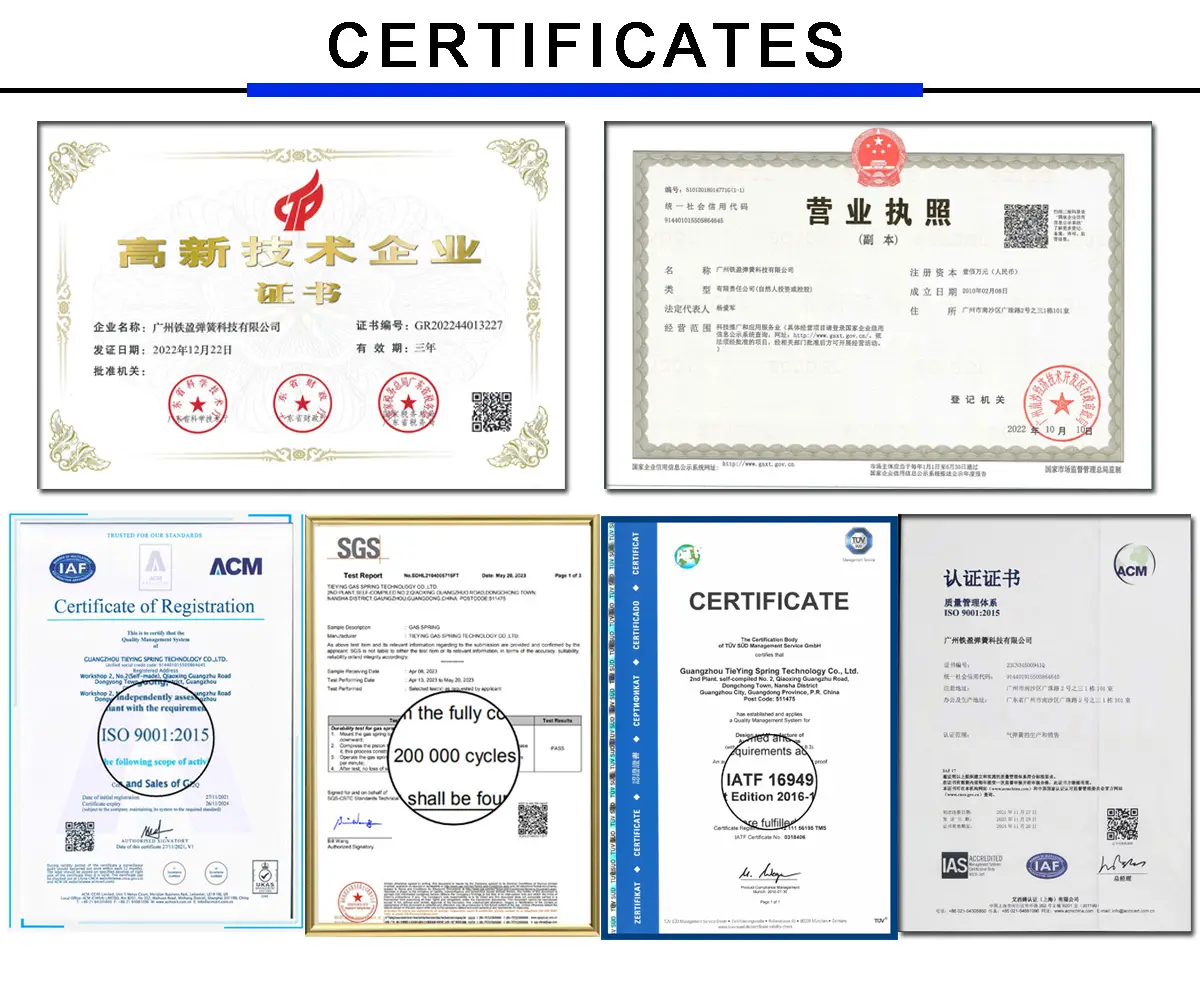
- IATF 16949 / ISO 9001 certified factory
- Force tuned to canopy weight, lamp load and pivot geometry
- Built for the 40–70 °C heat inside tanning canopies
- Bulk supply to tanning bed OEMs, parts distributors and service networks
What Are Tanning Bed Shocks?
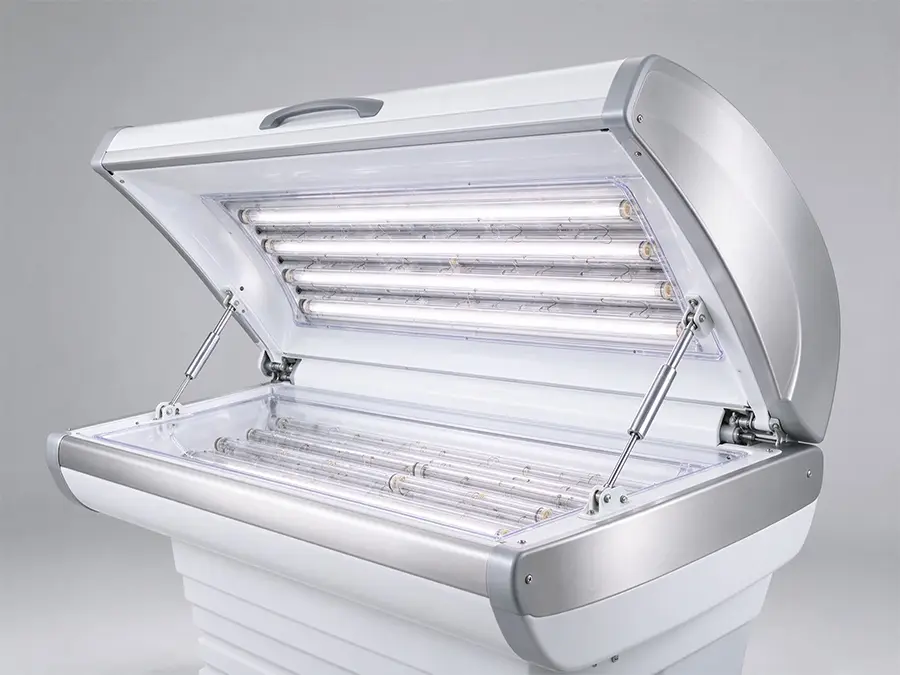
A tanning bed shock is a sealed, nitrogen-pressurized gas spring fitted between the tanning bed’s base frame and its hinged upper canopy (the lid that holds the UV lamps and acrylic sheet). It does three jobs:
- Lifts the heavy canopy upward so a tanner can lie down and get up.
- Holds the canopy open at a safe working angle during tanning, and during acrylic cleaning, relamping and salon servicing.
- Controls the descent so the canopy lowers smoothly instead of crashing onto the bed.
Unlike simple mechanical stays or friction hinges, a gas shock uses compressed nitrogen inside a steel cylinder to deliver near-constant force through the full stroke. On a tanning bed this matters because the canopy is not a flat panel — it is a dense assembly of UV lamps, acrylic, ballasts and reflectors, often weighing 15–35 kg depending on the bed model. Without correctly rated shocks, that lid is a safety hazard.
Tanning bed shocks are known by several regional names — sunbed gas struts, tanning bed hydraulic arms, canopy lift supports, tanning bed lid dampers — but they are all the same product family: compression gas springs for upward-hinged lids.
Why Tanning Beds Depend on Properly Rated Gas Shocks
A tanning bed canopy is one of the heaviest, most heat-stressed lids in consumer furniture. When shocks are undersized, worn or generic, problems show up quickly — especially in a busy salon where the bed is opened and closed 20–50 times a day, 365 days a year.
Common failures caused by wrong or degraded tanning bed shocks:
- Canopy will not stay open. The lid drifts down while a tanner is getting in or out, creating a crush/pinch hazard.
- Canopy flies open. Over-rated shocks push the lid up violently past the intended open angle, stressing hinges and startling the user.
- Lid slams shut on its own. Lost gas pressure means the canopy no longer supports itself — it drops.
- Slow, stiff operation in summer. Generic gas springs lose force as they heat up; inside a running tanning bed the canopy can reach 50–70 °C, so a “just fine at room temperature” shock becomes weak on a hot salon day.
- Premature rupture or weeping. Cheap seals break down under sustained heat and daily cycling, leaving oil residue on the acrylic.
- Uneven two-shock operation. Replacing only one of a pair leaves mismatched force, which racks the canopy frame, bends brackets and tears acrylic mounts.
TieYing engineers tanning bed shocks against the actual canopy mass, pivot position and in-bed operating temperature, rather than selling a “one-size” universal strut.
How Tanning Bed Gas Struts Work
A tanning bed shock is a compression gas spring: a steel cylinder filled with high-purity nitrogen, sealed by a rod guide and a multi-layer seal system. A piston rod extends from one end.
- When the canopy is closed, the rod is pushed into the cylinder — the gas is compressed and stores energy.
- When the salon user releases the lid, the nitrogen pressure pushes the rod outward, lifting the canopy. Because gas pressure acts on the piston, the force stays remarkably consistent through the whole travel, which is why the bed feels balanced rather than “springy.”
- Optional damping oil inside the cylinder slows the last few millimetres of travel, so the canopy closes softly and doesn’t rattle the lamps.
The useful force is not just a function of gas pressure — it is also set by:
- Cylinder inner diameter and rod diameter,
- Piston bleed-hole geometry (which shapes the force curve),
- Number of nitrogen fills,
- End-fitting lever geometry at the bed hinge.
That is why two shocks that “look the same” can feel completely different on the same bed: the internal force tuning is what makes a tanning bed easy to use.
Benefits of Specifying TieYing Tanning Bed Shocks
1. Safe, predictable canopy handling
Correctly matched shocks let a tanner open the lid with one hand, hold it comfortably overhead, and lower it without effort — or fear it dropping.
2. Heat-stable performance
Our gas springs are rated for continuous operation from −40 °C to +100 °C, far beyond the 50–70 °C reached inside a working tanning canopy. Force drift in heat is minimized, so the bed behaves the same in July as in January.
3. Long salon service life
Commercial tanning beds cycle constantly. TieYing shocks are SGS-tested to 150,000–200,000 cycles, reducing maintenance call-outs and warranty claims.
4. Protection for expensive parts
Smooth, controlled motion reduces shock loads on acrylic sheets, lamp holders, reflectors and hinge brackets — the parts salons spend the most money replacing.
5. Quiet operation
Precision rod finishing and low-friction seals mean the bed opens and closes quietly, which matters in relaxation-focused salon environments.
6. Hygienic, clean appearance
Zinc-plated or optional stainless-steel finish resists the acrylic cleaner, disinfectant and UV exposure common in tanning rooms, with no rust staining on the bed frame.
Types of Tanning Bed Shocks We Supply
TieYing supplies the full range of gas spring configurations used across horizontal tanning beds, stand-up sunbeds and tanning booths.
1. Standard Compression Tanning Bed Shocks
The default choice for most horizontal lay-down sunbeds (home beds and standard commercial 10–16 lamp units). Compact cylinder, eyelet or ball-socket ends, force tuned to the canopy.
Typical use:
- Home / residential tanning beds
- Entry-level commercial sunbeds
- Replacements for older bed models
Key features: cost-effective, reliable, available in matched pairs, zinc-plated finish.
2. Heavy-Duty Canopy Shocks
Larger high-pressure tanning units — 240W/160W lamp arrays, high-pressure booths, multi-accelerator beds and wide-canopy commercial units — carry significantly more lid weight. Heavy-duty shocks use a wider cylinder and thicker rod for higher force and better side-load resistance.
Typical use:
- High-pressure / high-horsepower commercial tanning beds
- Wide-canopy and double-extra-large beds
- Beds with integrated facial tanners or shoulder boosters built into the lid
Key features: higher Newton rating, reinforced tube, longer stroke, superior durability under frequent salon use.
3. Soft-Close / Damped Tanning Bed Struts
A damped oil zone near the end of travel slows the canopy in the last centimetres before it rests on the bed. This prevents lamp rattle, reduces acrylic stress and gives a premium, controlled feel — standard on premium and luxury sunbed lines.
Key features: controlled closing, reduced vibration, quieter operation, longer acrylic life.
4. Lockable / Position-Controlled Shocks
For stand-up tanning booths and vertical UV systems where service panels or reflector hoods must be held securely open during relamping and cleaning, a lockable gas spring holds its position until the operator releases it.
Key features: secure open-position hold, service-safety, prevents unintended closure.
5. Stainless Steel Tanning Bed Struts
Optional 304/316 stainless construction for coastal salons, high-humidity environments, and premium beds where visible hardware must stay clean and rust-free.
Key features: corrosion-resistant, disinfectant-proof, premium appearance, long service life.
6. Fully Custom Tanning Bed Gas Springs
Every tanning bed manufacturer frames its canopy differently. TieYing custom-engineers shocks to your drawings, including:
- Force (N) matched to canopy weight × pivot geometry
- Extended and compressed length to your installation envelope
- Stroke chosen for your open angle (typically 90–110° canopy opening)
- Tube and rod diameters
- End fittings: eyelet, ball socket, C-hook, L-bracket, U-clip, or customer-specific welded bracket
- Surface finish: zinc, black epoxy, silver painted, stainless
- Damping curve tuned to the bed’s closing feel
Engineering note: on a tanning bed, “stronger” is not “better.” An over-rated shock will push the canopy too hard, jump the hinges and make the bed feel unsafe. The correct shock is the lightest force that still holds the canopy open at 90° — that is what makes the bed easy to use.
How to Choose (or Replace) Tanning Bed Shocks
| Key selection parameters | Why it matters for tanning beds |
|---|---|
| Force (N) | Must balance canopy weight × moment arm from the hinge. Too low = lid drops; too high = lid flies open. |
| Extended length | Total length when the canopy is fully open; must match the bed's mounting holes. |
| Compressed length | Folded length when the bed is closed — must fit inside the canopy gap without binding. |
| Stroke | Travel of the rod; determines how far the canopy can open. |
| Cylinder × rod diameter | Sets load capacity, heat tolerance and side-load strength. |
| End fittings | Must match the bed's existing mounting studs/brackets (eyelet ID, ball stud size). |
| Operating temperature | Must handle sustained 50–70 °C under the acrylic. |
| Cycle life | Must match commercial salon duty (20–50 cycles/day). |
| Tanning bed type | Canopy load | Typical shock force (per strut, pair fitted) |
|---|---|---|
| Small home lay-down bed (8–12 lamps) | 12–18 kg | 150–250 N |
| Standard commercial bed (16–24 lamps) | 18–28 kg | 250–400 N |
| High-pressure / HP / high-horsepower bed | 25–38 kg | 400–600 N |
| Wide / double-extra-large canopy | 30–45 kg | 500–750 N (often heavy-duty tube) |
| Vertical booth / reflector service panel | varies | custom, often lockable |
These are reference ranges only. The true force is calculated from the canopy’s centre of gravity, the hinge point, and the shock’s mounting angle on the frame. Send us a drawing or photos of your bed and we will calculate the exact rating.
Step-by-step replacement guide for service technicians
- Support the canopy safely with a prop rod before touching any shock — the lid is heavy.
- Measure the old shock in three states: extended length (canopy open), compressed length (bed closed), and stroke (difference). Record the end fitting type and eyelet/ball size.
- Read the label on the old shock: force in Newtons (N), extended length, manufacturer code. Cross-reference this with your bed model.
- Replace both shocks as a matched pair, even if only one appears weak. Mismatched force on a two-strut canopy causes frame racking and premature acrylic failure.
- Fit the new shocks rod-down (rod pointing toward the floor when the bed is closed) to keep seals lubricated and extend life.
- Test the balance: at 90° open the canopy should hold itself with no drifting. If it drops, force is too low; if it pushes itself open further, force is too high.
Where Tanning Bed Shocks Are Used
1. Horizontal Lay-Down Tanning Beds
The classic reclining sunbed. Two shocks mount between the lower base and the upper lamp canopy, lifting it vertically overhead. This is the largest market for replacement tanning bed shocks.
2. High-Pressure / High-Intensity Commercial Beds
HP units use fewer, larger lamps and heavier reflectors. Their canopies carry more mass and run hotter — requiring heavy-duty, heat-stabilized shocks.
3. Stand-Up / Vertical Tanning Booths
Vertical booths use shocks on hinged reflector hoods, door panels and service access panels where secure open-position holding matters more than easy one-hand lifting. Lockable options are common here.
4. Home / Residential Tanning Beds
Smaller, lighter canopies, lower cycle count — standard shocks with clean cosmetic finish are typical.
5. Tanning Bed OEM Production Lines
For sunbed manufacturers developing new models, TieYing supplies custom-engineered shocks developed alongside the bed frame, from prototype through mass production.
6. Spare-Parts and Service Networks
Distributors and salon maintenance companies stock matched-pair replacement shocks for popular bed models, sold under their own private label.
Standard Tanning Bed Shock Specifications
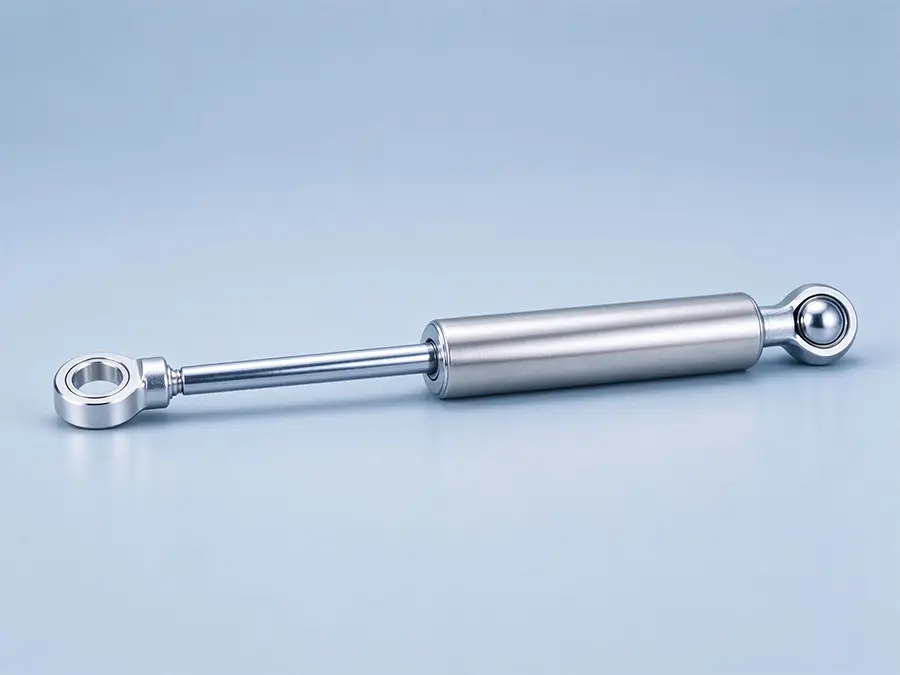
| Parameter | Standard option | Custom on request |
|---|---|---|
| Cylinder × rod | 18 × 8 mm / 22 × 10 mm / 27 × 11 mm | Other diameters |
| Force range | 150 N – 700 N | Any custom rating |
| Stroke | 100 – 300 mm | Matched to open angle |
| End fittings | Eyelet, ball socket, C-hook, L-bracket, U-clip | Customer bracket / welded stud |
| Surface | Zinc-plated, black epoxy, silver painted | 304/316 stainless |
| Operating temp | −40 °C ~ +100 °C | Extended high-temp version |
| Service life | 150,000 cycles (SGS verified, up to 200,000) | Per project |
| Force tolerance | ±10% | ±5–7% precision option |
| Pairing | Matched pairs, force-matched within ±5% | — |
| All shocks can be supplied with soft-close damping. Packaging: bulk industrial or retail color box with your brand logo. | ||
Custom Tanning Bed Shock Development Process
- Share your bed details — drawings, canopy weight, hinge position, open angle, photos or samples.
- Engineering calculation — we compute force, stroke and mounting geometry and recommend a specification.
- Prototype samples — we produce matched-pair samples for you to fit and test on the actual bed.
- Testing & approval — verify lift feel, open-angle hold, soft-close and durability; adjust force if needed.
- Mass production — bulk order with strict batch QC, private labeling and salon-ready packaging.
Why Choose TieYing for Tanning Bed Gas Struts?
TieYing (Guangzhou Tieying Spring Technology Co., Ltd.) has manufactured gas springs since 2002. We are a factory-direct OEM supplier, not a trader, exporting to 60+ countries including the USA, Canada, UK, Germany, Australia and Russia — major tanning market regions.
Engineering support for your bed design
Our engineers calculate the correct shock from:
- Canopy assembly weight (lamps + acrylic + reflectors + ballasts)
- Hinge / pivot position
- Shock mounting angle on the frame
- Required open angle (usually 90–110°)
- Number of shocks (almost always a matched pair)
- In-service temperature under the acrylic
We help you avoid the two most common tanning bed complaints — “lid won’t stay up” and “lid closes too hard” — before the bed leaves the factory.
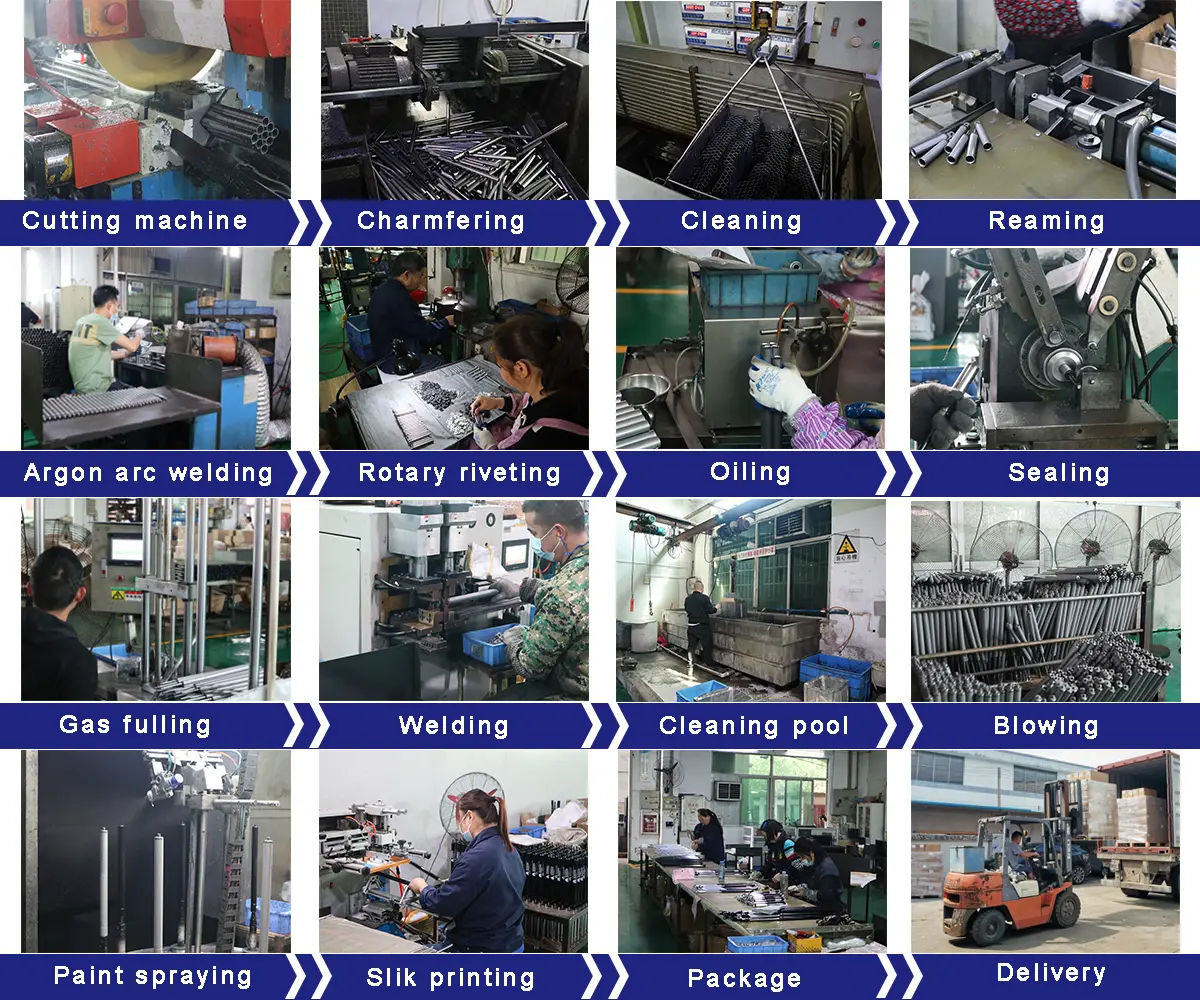
Manufacturing quality
- Cylinder production from seamless steel tube, precision-drawn for smooth internal surface and consistent pressure resistance.
- Rod processing: hardened, polished, anti-corrosion coated piston rod for low friction and long seal life.
- Seal system: multi-stage rod guide with high-grade NBR/PU seals rated for heat.
- Fill gas: 99.99% pure nitrogen, moisture-free.
- Pressure and leak testing on every unit before shipment.
Quality control
Every batch is checked for:
- Force output within tolerance (±10% standard, ±5–7% on request)
- Zero gas leakage
- Salt-spray resistance up to 96 hours
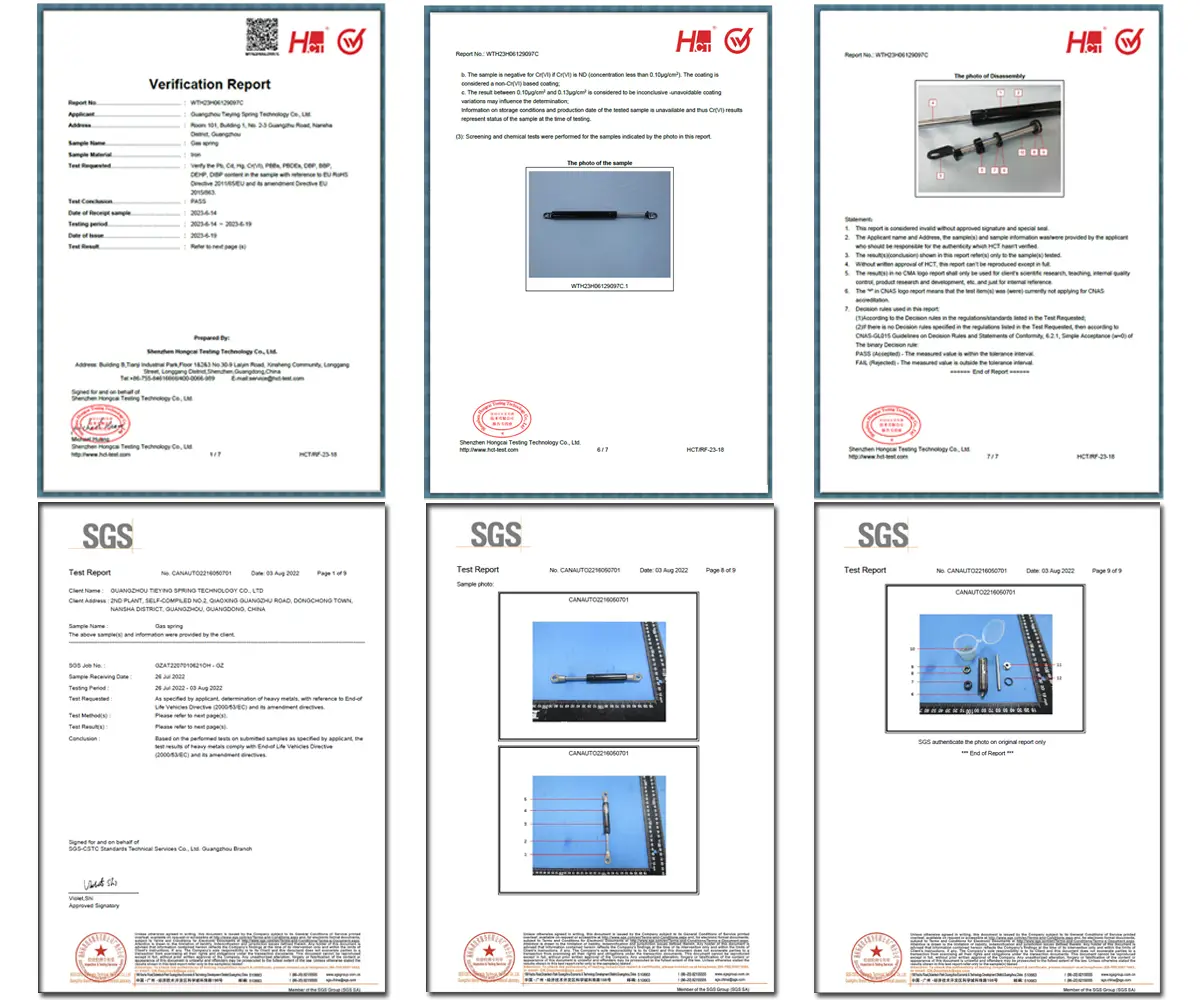
- Cycle life verified to 150,000–200,000 cycles under SGS witness testing
- 100% final inspection before packing


TieYing Factory Video Verified by SGS
Competitive Advantages of TieYing Gas Springs
| Item | TieYing Gas Springs (TieYing Supplier) | Standard Gas Springs (Other Supplier) |
|---|---|---|
| Certificate | SGS 200000 Cycles Durability Test, ROHS, T16949, IS09001 | Maybe just ISO9001 |
| Material | Top seamless steel (Full inspection by Professional testing equipment) | Maybe steel |
| Oil | Anti-wear hydraulic oil from Garmany | Maybe Semi-Synthetic |
| Piston Roughness | Up to Ra 0.696um | Maybe Ra 0.4um |
| Gas spring resistance | 100°C~-40°C | Maybe 60°C |
| Gas | 99.99% nitrogen | Maybe oxygen / Impure nitrogen |
| Uselife | 80,000-200,000 cycles with SGS test report | Maybe 50,000 cycles |
| Salt spray testing | Up to 96 hours | Maybe up to 12 hours |
| Inspection | All procedure sampling inspect, complete inspect before delivery | Maybe sampling inspection |
| Defective product | Re-produce new, If reach 10%, 100% items re-produce new | Maybe Repair |
Frequently Asked Questions (FAQ)
What size gas shocks do I need for my tanning bed?
Measure the old shock’s extended length, compressed length, stroke, force (N) printed on the label, and end fitting type. As a starting point, standard commercial beds usually use a matched pair between 250 N and 400 N; HP/high-pressure beds may need 400–600 N. Send us your bed model or measurements and we will confirm the exact rating.
Why won't my tanning bed lid stay up?
Almost always the shocks have lost gas pressure — gas springs cannot be re-gassed. Check that the force rating matches the canopy weight; if the bed was previously fine, the shocks have simply reached end of life and must be replaced. Rarely, the mounting brackets have bent, which changes the effective lever ratio.
Can I replace just one tanning bed shock?
No. Tanning beds use two shocks as a balanced pair. Fitting one new and one old creates mismatched force, which tilts the canopy, stresses hinges and can crack the acrylic. Always replace both as a matched set.
How long do tanning bed shocks last?
A quality gas shock on a home bed can last 5–8 years. On a busy commercial salon bed, expect 2–4 years of reliable service. TieYing shocks are cycle-tested to 150,000–200,000 operations, which is why salons see longer intervals between replacements.
Are tanning bed shocks heat-resistant?
They must be — inside a running tanning canopy the air near the acrylic reaches 50–70 °C. Generic shocks rated only to 60 °C lose force in summer and wear out quickly. TieYing shocks are rated to 100 °C continuous.
What is the difference between tanning bed shocks and "hydraulic" arms?
Tanning bed “hydraulics” are a misnomer — the lift is provided by a gas spring (nitrogen pressure) with a small amount of damping oil inside. They are not fluid-filled hydraulic cylinders. This is why they hold position without pumping.
Do you supply shocks for specific tanning bed brands?
We supply universal and custom gas springs that fit most horizontal bed frames when dimensions and end fittings match. We also manufacture to OEM drawings for tanning bed brands and private-label parts distributors. Send us the old shock measurements or a photo, and we will cross-reference.
Can you do private label / OEM packaging?
Yes. We supply tanning bed parts distributors, salon maintenance networks and bed manufacturers with branded packaging, matched-pair labeling and bulk carton packing.
How do I install a tanning bed shock?
Support the canopy on a prop rod first. Unclip the old shock from its ball/eyelet mount (usually a circlip or pop-off ball socket), clip the new one into the same points, and remove the prop. Fit the rod pointing downward when the bed is closed. Test that the canopy holds at 90° with no drift.
What is your minimum order for replacement tanning bed shocks?
Samples are available for fit testing. For production orders, MOQ is flexible — contact us with your estimated monthly volume for distributor or OEM pricing.
Ready to Source Tanning Bed Shocks from a Factory-Direct Manufacturer?
Whether you are a tanning bed OEM needing custom-engineered canopy shocks, a parts distributor building a private-label replacement line, or a salon service company looking for a reliable long-term supplier, TieYing can help.
Send us your bed drawings, old-shock measurements or a sample, and our engineering team will calculate the correct force and quote within 24 hours.