Gas Shocks for Doors
Reliable Gas Spring Solutions for Smooth and Controlled Door Operation
Doors are used in countless applications where safe opening, controlled movement and reliable positioning are required. Traditional hinges alone often cannot support heavy doors or prevent sudden closing.
TieYing manufactures custom gas shocks for doors that provide controlled lifting, smooth movement and secure positioning. Our door gas springs are widely used in industrial equipment, cabinets, machinery enclosures, vehicles, furniture and specialty door systems.
By using compressed nitrogen technology, our gas struts help reduce the effort required to open heavy doors while improving user safety and product durability.
Whether you need standard gas springs or fully customized solutions, TieYing provides engineering support from force calculation to mass production.
What Are Gas Shocks for Doors?
Gas shocks for doors—also called door gas struts or door gas springs—are sealed pneumatic devices that use compressed nitrogen gas to generate controlled linear force. They assist in opening, closing, and holding doors in position while providing smooth damping to prevent slamming and abrupt movement.
A typical door gas strut consists of:
- Cylinder body: Sealed steel or stainless steel tube containing pressurized nitrogen gas
- Piston rod: Hard chrome-plated or black-nitrided rod with precision piston assembly
- Piston system: Controls gas flow for smooth motion and end-of-stroke damping
- End fittings: Ball joints, eyelets, brackets, or threaded connectors for mounting
- Seal package: High-performance seals that prevent gas leakage over extended use
When the door closes, the piston rod compresses into the cylinder, reducing the internal gas volume and increasing pressure. When released, the stored gas pressure pushes the rod outward, assisting the door to open smoothly and hold it securely in the open position.
Why Use Gas Shocks on Doors?
A properly selected gas spring transforms the way a door operates.
Without a gas support system, heavy doors may:
- Drop suddenly during opening or closing
- Require excessive manual force
- Damage hinges and mounting structures
- Create safety risks for operators
Door gas shocks solve these problems by providing:
Smooth Opening Assistance
Gas springs help lift doors with less physical effort, making heavy doors easier to operate.
Controlled Closing Movement
Damping characteristics allow doors to close smoothly instead of slamming shut.
Safe Position Holding
Gas struts can hold doors securely at different opening angles, improving convenience and safety.
Reduced Mechanical Stress
By supporting the door weight, gas springs reduce pressure on hinges, frames and mounting components.
Key Advantages of TieYing Door Gas Struts
✅ Controlled, Smooth Operation
Our gas shocks for doors deliver consistent force throughout the entire stroke, eliminating jerky movement and preventing doors from slamming shut. Integrated end-of-stroke damping ensures soft landing at both fully open and fully closed positions.
✅ Enhanced Safety
Door gas struts prevent unexpected door closure caused by wind, vibration, or accidental contact. They eliminate the risk of finger pinching, impact injuries, and damage to door frames and surrounding equipment.
✅ Ergonomic Lifting Assistance
Reduce the physical effort required to open heavy doors by up to 80%. Our gas springs make even large industrial doors feel lightweight and easy to operate with one hand.
✅ Space-Saving Design
Compact cylinder dimensions allow installation in tight spaces where mechanical hinges and bulky door closers won’t fit. No external power source required—completely self-contained operation.
✅ Long Service Life
Premium materials, precision manufacturing, and rigorous testing ensure 200,000+ maintenance-free cycles. RoHS compliant and suitable for operating temperatures from -30°C to +80°C.
✅ Corrosion Resistance Options
Available in black painted steel, zinc-plated, or full stainless steel (304/316) construction for outdoor, marine, and harsh environment applications.
Applications of Gas Springs for Doors
TieYing door gas shocks are designed for various industries and door systems.
Industrial Equipment Doors
Heavy machinery often requires access panels and protective doors that need frequent opening and closing.
Gas springs provide:
- Easy access for maintenance
- Secure open positioning
- Reduced operator effort
- Improved workplace safety
Common applications include:
- Machine covers
- CNC equipment doors
- Electrical cabinets
- Industrial enclosures
- Control panels
Cabinet and Furniture Doors
Modern furniture designs often use upward-opening or assisted-opening doors.
Gas springs are commonly used in:
- Kitchen cabinets
- Storage cabinets
- Office furniture
- Display cabinets
- Custom furniture systems
They provide smooth movement while maintaining a clean appearance without bulky mechanical supports.
Vehicle and Specialty Doors
Door gas struts are widely used in transportation applications where vibration resistance and durability are important.
Applications include:
- RV doors
- Caravan compartments
- Truck storage doors
- Agricultural vehicle doors
- Marine access doors
TieYing can provide gas springs designed for demanding environments with customized force ratings and corrosion-resistant materials.
Types of Gas Shocks for Doors
Standard Lift Gas Struts
The most common type for general door applications. Provides constant lifting force and hold-open capability. Ideal for cabinet doors, furniture flaps, and light-to-medium weight doors.
Force range: 50N – 500N Best for: Cabinet doors, furniture, small access panels
Features:
- Reliable lifting assistance
- Cost-effective design
- Multiple stroke lengths available
Heavy-Duty Door Gas Shocks
Reinforced construction with larger cylinder diameters for higher load capacities. Designed for heavy industrial doors, large equipment access panels, and commercial applications.
Force range: 500N – 2500N Best for: Industrial doors, machinery panels, heavy gates
Locking Gas Springs for Doors
Feature an internal locking mechanism that holds the door at any desired position within the stroke range. Unlock with a manual release cable or button.
Force range: 100N – 1500N Best for: Adjustable access doors, inspection panels, positioning doors
Suitable for:
- Heavy industrial doors
- Maintenance access doors
- Equipment covers
Available options:
- Locking in extended position
- Locking in compressed position
Stainless Steel Door Gas Struts
Full 304 or 316 stainless steel construction for maximum corrosion resistance. Suitable for outdoor, marine, food processing, and pharmaceutical environments.
Force range: 50N – 1000N Best for: Outdoor doors, marine applications, washdown environments
Recommended applications:
- Marine equipment
- Outdoor cabinets
- Food processing equipment
- Chemical environments
Adjustable Door Gas Shocks
Equipped with a release valve that allows on-site force adjustment. Perfect for prototyping, variable load applications, and situations where exact weight is unknown.
Force range: Adjustable within 50-800N Best for: Custom projects, prototype development, variable weight doors
Miniature Door Gas Struts
Compact design with small cylinder diameters for installation in tight spaces. Ideal for small cabinet doors, electronic enclosures, and precision equipment.
Force range: 10N – 200N Best for: Small cabinets, electronic enclosures, compact equipment
Soft Close Gas Springs
Soft close gas springs (also called end-stroke damping gas struts) are calibrated to deliver smooth deceleration in the final 10–30mm of closing travel.
Benefits:
- Prevent door impact
- Reduce noise
- Protect hinges
- Improve user experience
How to Choose the Right Gas Shocks for Your Doors
Step 1: Determine Door Weight and Dimensions
- Weigh the door or calculate weight based on material and dimensions
- Measure door height, width, and thickness
- Identify the hinge location and pivot point
Step 2: Calculate Required Force
Use this simplified formula to estimate the required gas spring force:F = (G × A) / K + 10% safety factorWhere:- F = Required gas spring force (Newtons)
- G = Door weight (kg × 9.81 = Newtons)
- A = Horizontal distance from hinge to door’s center of gravity (mm)
- K = Perpendicular distance from hinge to gas spring mounting point (mm)
Step 3: Determine Stroke and Extended Length
- Stroke length: Distance the piston travels from fully compressed to fully extended
- Extended length: Total length of the gas spring when fully open
- Ensure the stroke is sufficient to allow full door opening (typically 90–110 degrees)
Step 4: Select Mounting Style
- Ball joint fittings: Allow angular movement, most versatile for door applications
- Eyelet fittings: Simple bolt-through mounting for fixed-angle applications
- Clevis brackets: Heavy-duty mounting for industrial doors
- Threaded ends: Adjustable positioning with lock nuts
Step 5: Consider Environmental Factors
- Indoor vs. outdoor installation
- Temperature extremes
- Humidity, moisture, or salt exposure
- Dust, dirt, or chemical exposure
Step 6: Decide Quantity
- Light doors (under 10kg): 1 gas spring may suffice
- Medium to heavy doors: 2 gas springs (one on each side) recommended for balance
- Very heavy or wide doors: 4 or more struts may be required
Need help selecting the right gas shocks for your doors? Our engineering team can analyze your application and recommend the optimal solution within 24 hours. Send us your door specifications for a free consultation.
Installation Guide for Door Gas Struts
Pre-Installation Safety
- Gas struts are pressurized devices—never puncture, heat, or disassemble
- Wear safety glasses during installation
- Support the door fully before removing old struts or installing new ones
- Never manually compress a gas strut beyond its rated capacity
Installation Steps
- Mark mounting positions
- Fixed mounting point on the door frame
- Moving mounting point on the door itself
- Position the moving mount approximately 1/3 of the door width from the hinge
- Attach mounting brackets
- Securely fasten brackets to both frame and door using appropriate hardware
- Ensure brackets are aligned and can accept the end fittings without binding
- Install the gas strut
- Critical: Install with piston rod pointing downward when door is closed
- Connect the cylinder end (body) to the fixed frame mounting point
- Connect the rod end to the moving door mounting point
- Attach one end first, then carefully compress the strut to connect the second end
- Test operation
- Open and close the door through its full range of motion
- Check for smooth, binding-free movement
- Verify the door holds securely in the fully open position
- Ensure soft closing without slamming
Important Installation Rules
- Rod-down orientation mandatory: Piston rod must face downward when closed to lubricate seals and ensure proper damping
- Avoid side loading: Gas springs are designed for axial force only—misalignment causes premature wear
- Over-center principle: When closed, the gas spring line must pass slightly beyond the hinge centerline to prevent self-opening
- Reserve stroke: Leave approximately 10mm of unused stroke at full compression to prevent bottoming out
Technical Specifications
| Parameter | Standard Series | Heavy-Duty Series | Stainless Steel Series |
|---|---|---|---|
| Cylinder Diameter | 15mm, 18mm, 22mm | 28mm, 35mm, 40mm | 15mm, 18mm, 22mm |
| Rod Diameter | 6mm, 8mm, 10mm | 12mm, 14mm, 16mm | 6mm, 8mm, 10mm |
| Stroke Range | 50mm – 500mm | 100mm – 800mm | 50mm – 500mm |
| Force Range | 50N – 500N | 500N – 2500N | 50N – 1000N |
| Rod Finish | Hard Chrome Plated | Hard Chrome Plated | Polished Stainless Steel |
| Body Material | Seamless Carbon Steel | Seamless Carbon Steel | 304 / 316 Stainless Steel |
| Operating Temp | -30°C to +80°C | -30°C to +80°C | -30°C to +80°C |
| Cycle Life | 200,000+ cycles | 200,000+ cycles | 200,000+ cycles |
| End Fittings | Ball joint, Eyelet, Bracket | Clevis, Ball joint, Flange | Ball joint, Eyelet, Bracket |
| Compliance | RoHS, ISO 9001 | RoHS, ISO 9001 | RoHS, ISO 9001 |
Why Choose TieYing for Your Door Gas Shocks?
Factory-Direct Manufacturing
As an OEM gas spring manufacturer with our own production facility in Guangzhou, China, we control every stage of production from raw material sourcing to final testing. This vertical integration ensures consistent quality, competitive pricing, and fast lead times.
Custom Engineering Expertise
Our in-house engineering team can design custom gas shocks for doors to your exact specifications. We offer:
- Custom lengths, strokes, and force ratings
- Special end fittings and mounting brackets
- Modified damping characteristics
- Custom surface treatments and colors
- Application-specific performance tuning
Rigorous Quality Assurance
Every TieYing door gas strut undergoes:
- 100% pressure testing before leaving the factory
- Leak detection testing
- Cycle life testing on sample batches
- Dimensional accuracy inspection
- Force output verification
Comprehensive Material Options
Choose from seamless carbon steel, 304 stainless steel, or 316 stainless steel construction to match your application environment and budget.
Global Supply Capability
We ship worldwide with flexible MOQ options—from small prototype batches to large-scale OEM production orders. Standard products ship within 7 days; custom orders typically deliver in 15–25 days.
3-Year Product Warranty
All TieYing gas shocks for doors are backed by a full 3-year warranty against manufacturing defects. We stand behind the quality and durability of every product we make.


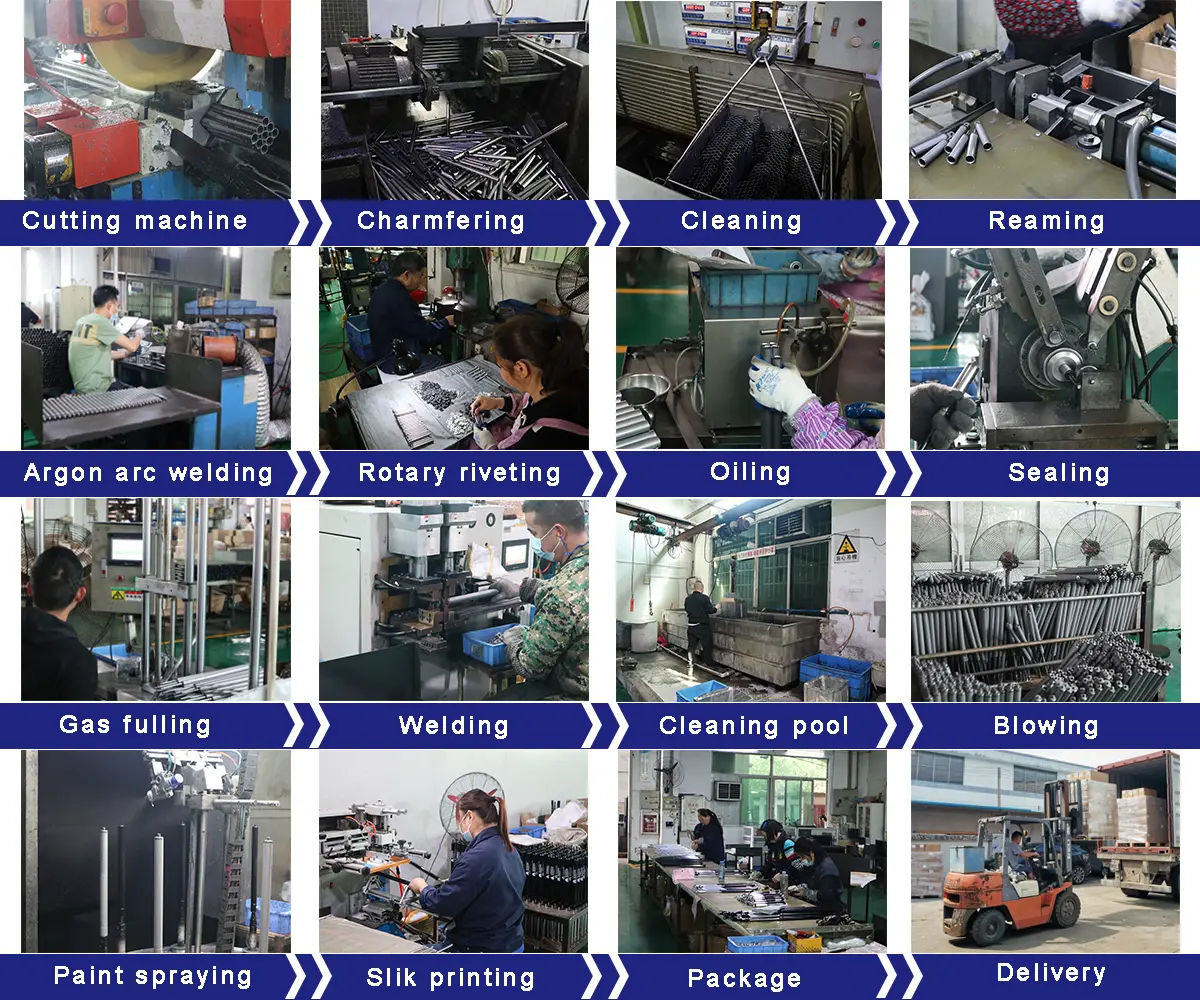
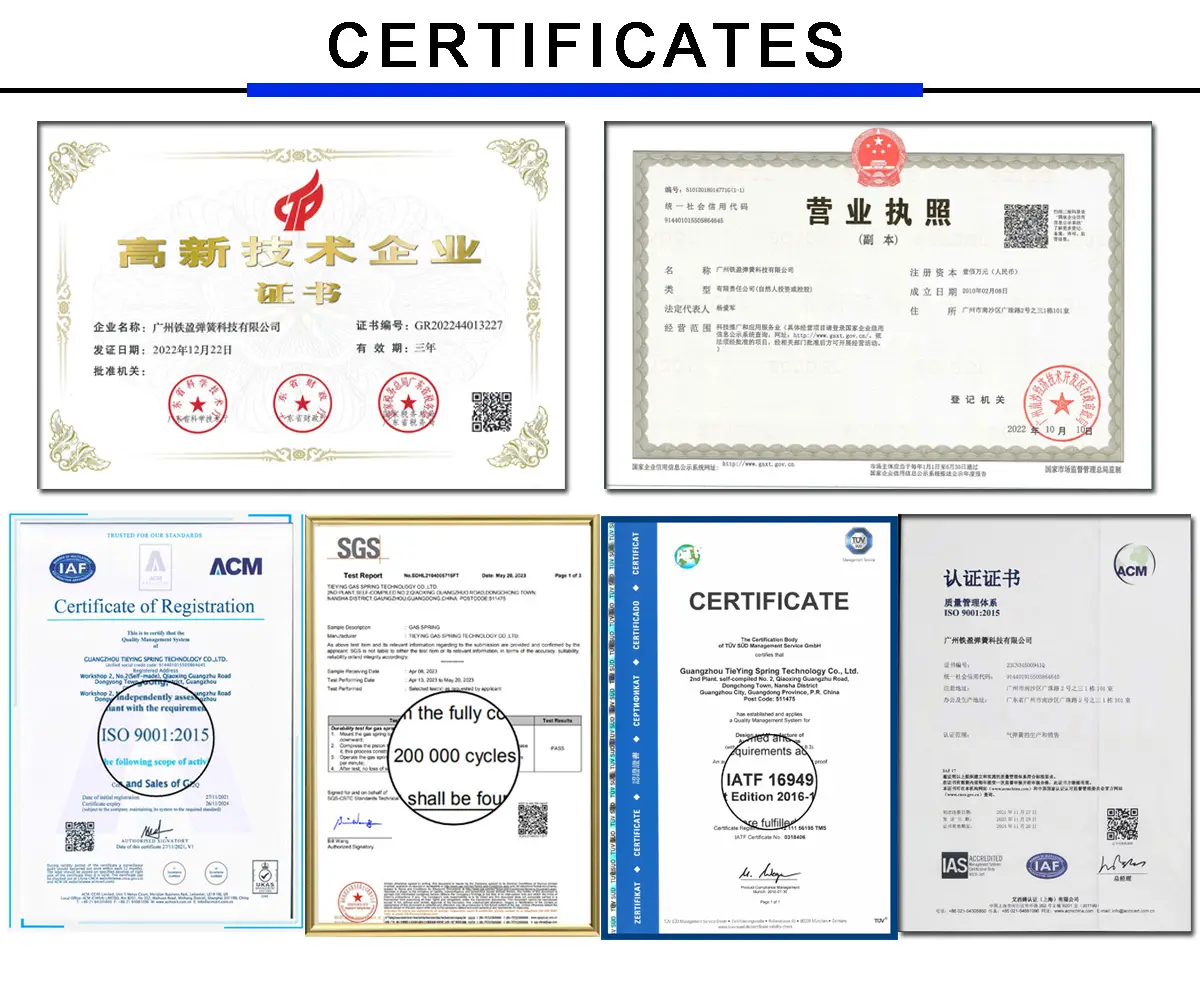
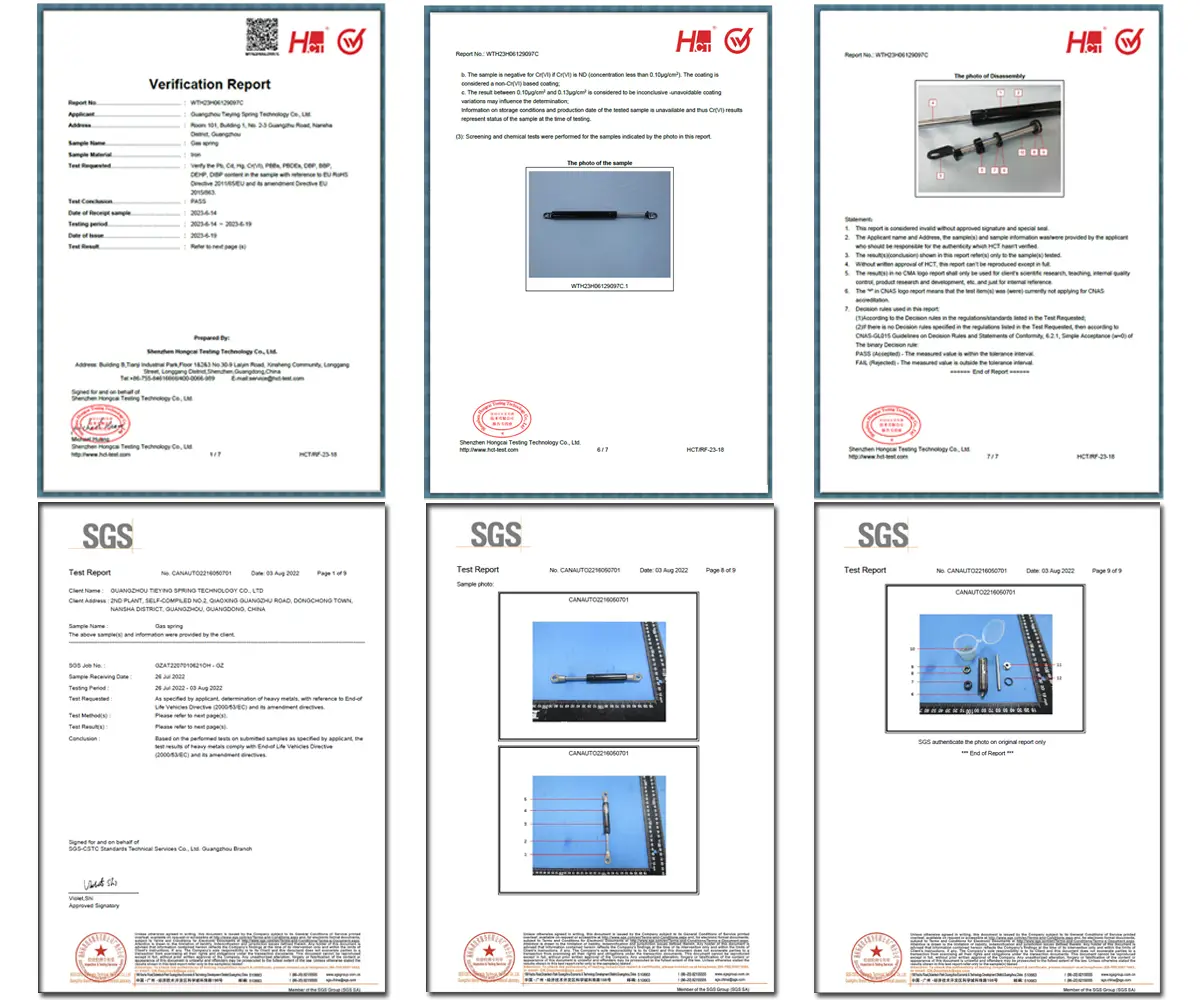
TieYing Factory Video Verified by SGS
Competitive Advantages of TieYing Gas Springs
| Item | TieYing Gas Springs (TieYing Supplier) | Standard Gas Springs (Other Supplier) |
|---|---|---|
| Certificate | SGS 200000 Cycles Durability Test, ROHS, T16949, IS09001 | Maybe just ISO9001 |
| Material | Top seamless steel (Full inspection by Professional testing equipment) | Maybe steel |
| Oil | Anti-wear hydraulic oil from Garmany | Maybe Semi-Synthetic |
| Piston Roughness | Up to Ra 0.696um | Maybe Ra 0.4um |
| Gas spring resistance | 100°C~-40°C | Maybe 60°C |
| Gas | 99.99% nitrogen | Maybe oxygen / Impure nitrogen |
| Uselife | 80,000-200,000 cycles with SGS test report | Maybe 50,000 cycles |
| Salt spray testing | Up to 96 hours | Maybe up to 12 hours |
| Inspection | All procedure sampling inspect, complete inspect before delivery | Maybe sampling inspection |
| Defective product | Re-produce new, If reach 10%, 100% items re-produce new | Maybe Repair |
Frequently Asked Questions (FAQ)
How long do door gas struts last?
Under normal operating conditions, TieYing door gas struts are rated for 200,000+ cycles. For typical residential or light commercial use, this translates to 10–15 years of service life. Actual lifespan depends on usage frequency, load conditions, and environmental factors.
Can I replace just one door gas strut?
While technically possible, we recommend replacing both struts at the same time for balanced performance. A worn strut and a new strut will have different force characteristics, leading to uneven door movement and accelerated wear on the new unit.
How do I know if my door gas shocks need replacement?
Common signs of failing gas struts include:
- Door no longer stays open on its own
- Door slams shut suddenly
- Difficulty opening or closing
- Visible oil leakage from seals
- Piston rod shows corrosion or damage
- Squeaking or grinding noises during operation
Can gas shocks for doors be adjusted?
Standard gas struts come pre-set to a specific force and are not field-adjustable. However, TieYing offers adjustable gas shocks with a release valve that allows you to reduce the force after installation. Force can only be decreased, not increased.
What is the difference between gas shocks and gas struts?
In door applications, the terms are often used interchangeably. Technically, “gas shocks” emphasize the damping function, while “gas struts” emphasize the structural support function. TieYing products provide both lifting support and damping control.
Do you offer stainless steel gas shocks for outdoor doors?
Yes. We offer full 304 and 316 stainless steel door gas struts specifically designed for outdoor, coastal, and corrosive environments. These feature stainless steel cylinders, rods, and end fittings for maximum corrosion resistance.
Get Custom Gas Shocks for Your Doors
Ready to find the perfect gas spring solution for your door application? TieYing offers free technical consultation and custom design services. Our engineering team will review your requirements and recommend the optimal gas shocks for your doors.
What we need from you:
- Door weight and dimensions
- Hinge location and opening angle
- Mounting space constraints
- Environmental conditions
- Required force or performance specifications
Contact us today for:
- Free application analysis
- Custom quote within 24 hours
- Free sample evaluation (conditions apply)
- OEM and ODM capabilities
- Competitive factory-direct pricing
Guangzhou TieYing Spring Technology Co., Ltd. — Your trusted partner for high-quality gas springs and motion control solutions.