Canopy Gas Struts for Truck, Ute, Pickup & RV Canopies
Custom Gas Springs for Canopy Doors, Windows, Lids and Access Panels
Canopy gas struts provide controlled lifting support for vehicle canopies, truck caps, pickup toppers, service bodies, camper shells, RV compartments and other lift-up vehicle panels.
A properly selected gas strut does more than make a canopy door easier to open. It must provide the right amount of lifting force throughout the opening movement, hold the panel securely in position, fit within the available installation space, and withstand vibration and outdoor operating conditions.
TieYing manufactures custom canopy gas struts for OEM manufacturers, vehicle body builders, canopy manufacturers, distributors and aftermarket suppliers. Gas force, stroke, extended length, tube and rod dimensions, end fittings, mounting brackets and surface finishes can be customized according to your application.
Whether you need a replacement canopy gas strut or are developing a new truck canopy system, our engineering team can work from your drawing, sample, dimensions or application requirements.
What Are Canopy Gas Struts?
Canopy gas struts are gas springs designed to assist the opening, lifting and controlled positioning of vehicle canopy doors, windows and access panels.
They are also commonly described as:
Canopy gas springs
Canopy lift supports
Canopy gas shocks
Gas lift supports
Truck canopy struts
Ute canopy gas struts
Camper shell gas struts
Truck cap gas struts
Inside the gas spring cylinder, compressed nitrogen generates a controlled extension force. When the canopy panel is opened, this force helps support the weight of the moving panel and reduces the effort required from the operator.
The gas spring can also help keep the panel open while the user loads equipment, accesses storage or performs service work.
However, the correct canopy gas strut cannot be selected from force rating alone. Door weight, center of gravity, hinge position, mounting points, opening angle and available installation space all affect the final specification.
Where Are Canopy Gas Struts Used?
Canopy gas struts are used wherever a vehicle canopy, cover, hatch or access panel needs controlled lifting and stable open-position support.
Pickup Truck Canopies
Pickup truck canopies and toppers commonly use gas struts on rear doors, side-opening panels and windows.
Typical applications include:
- Pickup canopy side doors
- Rear canopy doors
- Lift-up windows
- Camper shell windows
- Truck cap access panels
- Storage compartment doors
For aftermarket replacement parts, the original force rating and center-to-center length are useful starting points. For new canopy designs, the gas spring should be calculated from the actual panel weight and mounting geometry.
Ute Canopies
Ute canopies are particularly common in work, service and recreational vehicles.
Gas struts can support:
- Side canopy doors
- Rear canopy doors
- Side windows
- Tool storage compartments
- Service access panels
- Equipment compartments
Ute canopy applications can be exposed to dust, vibration, heat, rain and frequent opening cycles. The gas spring specification therefore needs to consider the actual working environment rather than only the dimensions of the panel.
Truck Canopies and Service Bodies
Commercial truck canopies often contain heavier doors, storage systems and equipment.
Gas struts may be used for:
- Service body doors
- Tool compartments
- Equipment storage doors
- Side access panels
- Rear service doors
- Maintenance access covers
For heavy commercial applications, stronger cylinders, larger rod diameters, reinforced end fittings or custom mounting brackets may be required.
Camper Shells and Truck Toppers
Camper shells and truck toppers use gas struts to support rear hatches and side windows while providing convenient access to the vehicle’s cargo or living area.
The additional weight of glass windows, locks, interior trim, racks and accessories should be included when determining the required gas force.
RV and Caravan Canopies
Gas springs can also be used on RV and caravan storage compartments, exterior access doors and lift-up panels.
Depending on the application, customers may require:
- Compact gas springs
- Corrosion-resistant gas springs
- Stainless steel gas springs
- Damped gas springs
- Custom mounting fittings
Canopy Gas Struts for Different Opening Positions
Side Lift-Up Canopy Doors
Side-opening canopy doors are common on work trucks, service bodies and ute canopies.
The gas strut assists the door upward and helps maintain an open position while the operator accesses tools or equipment.
The mounting points should be positioned so the gas spring provides useful support through the majority of the door’s movement without forcing the door beyond its intended opening angle.
Rear Canopy Doors
Rear canopy doors may be larger and heavier than side windows, particularly on camper shells and commercial vehicle bodies.
A correctly selected pair of gas struts can provide balanced support on both sides of the door.
For wider or heavier doors, using matched gas springs is important. Unequal force output can cause the door to twist during opening and place additional stress on hinges and mounting points.
Canopy Windows
Lift-up canopy windows usually have a smaller mass than full doors, but the available installation space can be limited.
Gas springs for windows often require:
Shorter stroke
Compact cylinder dimensions
Lower force ratings
Specific end fittings
Accurate extended and compressed lengths
The correct specification should be based on the window weight and hinge geometry rather than using a standard force simply because the gas spring looks similar.
Service and Equipment Panels
Commercial vehicles often use canopy-style access panels to reach tools, batteries, compressors, electrical equipment and other components.
These panels may be opened many times during a working day. In these applications, cycle durability, mounting strength, vibration resistance and consistent force are particularly important.
Why Does a Canopy Need the Right Gas Strut?
The gas spring is a small component, but its force directly affects how the entire canopy behaves.
Easier Opening
The correct gas spring reduces the manual effort needed to lift a heavy canopy panel.
This is especially useful for large side doors, rear hatches and commercial service compartments that are opened repeatedly during the working day.
Stable Open-Position Support
A canopy door should remain in its intended open position while the operator loads tools, removes equipment or accesses storage.
A correctly specified gas strut provides the support required to counter the panel’s weight under the actual mounting geometry.
Controlled Movement
Gas springs can provide controlled extension rather than allowing the panel to move freely under gravity.
Where additional closing control is required, a damped configuration can be considered.
Reduced Stress on Hinges and Mounting Points
A poorly selected gas spring can create excessive force at the mounting points.
Too little force may allow the panel to fall or require excessive manual effort.
Too much force can make the panel difficult to close and place unnecessary loads on hinges, brackets and the canopy structure.
The goal is not maximum force. The goal is correct force for the complete mechanism.
Better Daily Usability
For a work vehicle, a canopy may be opened dozens of times during normal operation.
Small improvements in opening effort and movement control become important when the same action is repeated every day.
How Do Canopy Gas Struts Work?
A canopy gas strut consists primarily of a pressurized cylinder, piston, piston rod, seals and end fittings.
Compressed nitrogen inside the cylinder produces the extension force.
1. Closed Position
When the canopy door is closed, the gas spring is compressed.
The piston rod moves into the cylinder and the compressed gas stores energy inside the sealed system.
2. Opening Movement
When the operator begins lifting the canopy panel, the gas pressure pushes the piston rod outward.
This force assists the lifting movement and reduces the amount of manual effort required.
3. Controlled Extension
As the gas spring extends, internal damping and the gas spring design influence the movement speed.
The objective is controlled movement rather than uncontrolled opening.
4. Open Position
When the canopy reaches its intended open position, the gas spring continues to provide support against the weight of the panel.
The final behavior depends on the gas force, mounting geometry, panel weight and opening angle.
How to Calculate the Correct Canopy Gas Strut Force?
Gas spring force should be treated as a mechanical geometry problem, not simply a weight-to-Newtons conversion.
The basic relationship is a moment balance around the canopy hinge:
F × dₛ × n ≈ W × g × d𝚌
Where:
F = required gas spring force per strut
dₛ = perpendicular moment arm from the hinge to the gas spring force line
n = number of gas springs sharing the load
W = moving panel mass
g = gravitational acceleration
d𝚌 = hinge-to-center-of-gravity distance
This is a starting engineering relationship. The actual force requirement also depends on the opening angle, gas spring force curve, friction, mounting geometry, temperature and the desired opening and closing feel.
Why Mounting Position Matters
Moving the mounting point can significantly change the required gas force.
For example, two canopy doors can have the same weight but require different gas spring ratings because one gas spring is mounted farther from the hinge.
A gas spring installed closer to the hinge generally has a smaller effective moment arm and therefore needs more force to create the same lifting torque.
This is why simply choosing a stronger gas strut is not always the correct solution.
Do Not Automatically Choose a Higher Newton Rating
An oversized gas spring may create new problems:
The door may become difficult to close.
The panel may open too aggressively.
Hinges may experience unnecessary loading.
Mounting brackets may deform.
The operator may have difficulty controlling the final closing movement.
The correct specification balances lifting assistance with controlled operation.
For OEM projects, TieYing can review the panel weight, dimensions, hinge location and gas spring mounting points to recommend a practical force range.
What Information Is Needed to Select a Canopy Gas Strut?
For an accurate recommendation, provide as many of the following details as possible:
Canopy type
Vehicle type
Door or window weight
Panel dimensions
Hinge position
Opening angle
Number of gas springs
Extended length
Compressed length
Required stroke
Mounting position
End fitting type
Available installation space
Working temperature
Exposure to rain, dust or salt
Expected operating frequency
Existing gas spring model or part number
Estimated order quantity
A clear photo of the existing installation can also be very useful.
If you already have an old gas strut, send us the dimensions and photographs. We can evaluate the specification and discuss a replacement or improved design.
How to Measure an Existing Canopy Gas Strut?
If you are replacing an existing canopy gas strut, measure the original part before ordering.
Extended Length
Measure the distance from the center of one end fitting to the center of the other fitting when the gas spring is fully extended.
Compressed Length
Measure the center-to-center distance between the mounting points when the gas spring is fully compressed.
Stroke
Stroke is the difference between the extended and compressed lengths.
Force Rating
Check the gas spring body for a printed or stamped Newton rating if available.
The force may be shown as a value such as 100 N, 200 N, 300 N or another rating.
End Fittings
Take photographs of both ends.
Common options include:
Ball socket
Eyelet
Fork
Threaded stud
Clevis
Custom bracket
Installation Position
Measure the mounting points on the canopy and vehicle structure.
This is important because a gas spring with the correct length and force may still perform incorrectly if the mounting geometry is different.
Canopy Gas Struts: Standard or Custom?
A standard gas strut can be suitable when the original specification is known and the canopy design has not changed.
Custom gas springs are usually more appropriate when:
The canopy has a new design.
The door weight has changed.
Glass or accessories have been added.
The hinge position is different.
Standard lengths do not fit.
A special end fitting is required.
The vehicle operates in a harsh environment.
The customer needs OEM branding.
A distributor needs a private-label product.
TieYing can manufacture canopy gas springs according to drawings, samples, dimensions and target performance requirements.
Types of Canopy Gas Struts We Manufacture
Standard Canopy Gas Springs
Standard compression gas springs are suitable for common canopy doors, windows, lids and access panels.
They provide lifting assistance and stable support for everyday vehicle applications.
Heavy Duty Canopy Gas Struts
Heavy duty gas springs are designed for larger or heavier panels where a stronger support system is required.
Typical applications include:
Heavy truck canopy doors
Service body compartments
Large rear hatches
Equipment access panels
Commercial vehicle storage systems
The cylinder, rod, force rating and mounting hardware can be selected according to the application.
Stainless Steel Canopy Gas Springs
Stainless steel gas springs are suitable for applications exposed to moisture, coastal environments or increased corrosion risk.
Depending on the application, stainless steel 304 or 316 configurations can be considered.
Damped Canopy Gas Struts
Where the canopy needs more controlled movement, a damped gas spring can help reduce opening or closing speed.
This is useful for larger panels and applications where the operator needs a smoother movement profile.
Lockable Canopy Gas Springs
Lockable gas springs can be considered when additional position control is required.
The locking configuration should be selected according to the canopy mechanism and safety requirements.
Custom OEM Canopy Gas Springs
For canopy manufacturers and vehicle equipment OEMs, TieYing can customize:
Force
Stroke
Extended length
Compressed length
Tube diameter
Rod diameter
End fittings
Mounting brackets
Surface treatment
Branding
Packaging
Canopy Gas Struts for Outdoor and Heavy-Use Vehicles
Vehicle canopy gas springs often operate in conditions that are more demanding than indoor furniture applications.
A commercial vehicle may experience:
Road vibration
Dust
Mud
Rain
Direct sunlight
Temperature changes
Frequent opening cycles
Washing and cleaning
Coastal or salty air
These conditions make material selection, sealing, rod surface quality, end-fitting design and mounting strength important.
For outdoor applications, TieYing can discuss corrosion-resistant finishes and stainless steel configurations according to the working environment.
For coastal or high-corrosion applications, the material and surface treatment should be selected based on the actual exposure rather than using the same specification for every vehicle.
Canopy Gas Struts vs Truck Tailgate Assist
Canopy gas struts and truck tailgate assist systems both use gas springs, but they are not the same application.
| Application | Canopy Gas Struts | Truck Tailgate Assist |
|---|---|---|
| Main moving component | Canopy doors, windows and panels | Vehicle tailgate |
| Typical installation | Canopy frame and door/window | Truck body and tailgate |
| Main function | Lift and support canopy panels | Assist and control tailgate movement |
| Typical buyer | Canopy manufacturer, body builder, distributor | Automotive aftermarket, truck parts supplier |
| Force selection | Panel weight + hinge geometry | Tailgate weight + tailgate geometry |
| Mounting | Application-specific | Vehicle-model-specific or custom |
| Customization | Force, stroke, fittings, brackets | Force, stroke, fittings, vehicle fitment |
Quality and Testing for Canopy Gas Springs
Canopy gas springs are safety-related mechanical components because failure can cause a door or panel to fall unexpectedly.
Quality control should cover more than the appearance of the finished product.
Important checks include:
Gas pressure verification
Leakage inspection
Dimensional inspection
End fitting inspection
Functional testing
Surface quality inspection
Cycle testing
Force consistency
Batch traceability
TieYing’s current product and application pages document pressure/leakage inspection, cycle testing, material and quality-control procedures, with selected gas spring configurations tested up to 200,000 cycles. Corrosion testing and stainless-steel options are also available for applications requiring greater environmental resistance.
Custom Canopy Gas Strut Development Process
Step 1 — Send Your Application Details
Send us your canopy type, vehicle type, panel dimensions, weight, photographs, drawings or existing gas spring.
Step 2 — Engineering Review
Our engineers review the canopy geometry, mounting points, force requirement, stroke and installation space.
Step 3 — Specification Confirmation
We recommend a practical combination of force, stroke, extended length, cylinder size and end fittings.
Step 4 — Sample Development
Samples can be produced for your team to check physical fit, opening behavior and force performance before mass production.
Step 5 — Testing and Approval
The approved specification can be verified through dimensional, pressure, leakage, functional and durability testing according to the project requirements.
Step 6 — Mass Production
After approval, TieYing produces the gas springs according to the confirmed specification.
OEM branding, labeling and packaging can also be discussed for qualified distributor and vehicle-component projects.
Canopy Gas Strut Technical Specifications
The final specification should always be determined according to the actual canopy mechanism.
| Specification | Available Options |
|---|---|
| Gas Spring Type | Compression, damped, lockable and custom configurations |
| Force | Application-specific and customizable |
| Stroke | Custom according to door/window travel |
| Extended Length | Custom center-to-center length |
| Compressed Length | Custom according to installation space |
| Cylinder Diameter | Multiple standard and custom sizes |
| Rod Diameter | Multiple standard and custom sizes |
| Material | Carbon steel, stainless steel 304, stainless steel 316 |
| End Fittings | Ball socket, eyelet, fork, threaded and custom |
| Mounting Brackets | Standard or custom |
| Surface Finish | Zinc-plated, painted and corrosion-resistant options |
| Branding | OEM marking and customized packaging |
| Testing | Pressure, leakage, functional and cycle testing |
| Application | Truck, ute, pickup, camper, RV, caravan and commercial vehicle canopies |
Common Canopy Gas Strut Problems
The Canopy Door Will Not Stay Open
The gas spring may be under-rated, losing pressure, incorrectly mounted or affected by changes to the canopy weight.Added glass, racks, locks or accessories can also change the original force requirement.The Door Is Too Hard to Close
The gas spring may have too much force for the application or the mounting geometry may be incorrect.A stronger gas spring is not always the solution.The Door Opens Too Quickly
The gas spring force or damping behavior may not be suitable for the panel.A damped configuration may be considered where controlled movement is required.One Side Lifts Faster Than the Other
If two gas springs are used, mismatched force output can create uneven movement.The two sides should be checked for equal specification, mounting position and mechanical condition.The Gas Strut Looks Correct but Does Not Fit
Appearance is not enough to confirm compatibility.Check:- Extended length
- Compressed length
- Stroke
- Force
- End fittings
- Mounting centers
- Mounting angle
- Clearance
Why Choose TieYing for Canopy Gas Struts?
Application-Based Engineering
We do not select a canopy gas spring from force rating alone.Our engineers consider the panel weight, hinge position, mounting points, opening angle, available space and working environment.Custom Force and Dimensions
Every canopy design can have different requirements. We can customize force, stroke, length, tube and rod dimensions to suit your mechanism.Custom End Fittings
When standard fittings do not match your canopy structure, custom brackets and connection options can be developed according to your design.OEM and ODM Manufacturing
TieYing supports OEM and ODM projects for canopy manufacturers, vehicle body builders, distributors and automotive component suppliers.Samples Before Bulk Production
Testing a sample before mass production allows your engineering team to confirm fitment and operating performance before committing to a larger production order.Factory-Direct B2B Supply
TieYing works with global OEM customers, wholesalers and distributors that require repeat supply, consistent specifications and technical communication.Long-Term Supply Support
For repeat orders, maintaining consistent force, dimensions, fittings, finish and packaging is just as important as the initial product development.

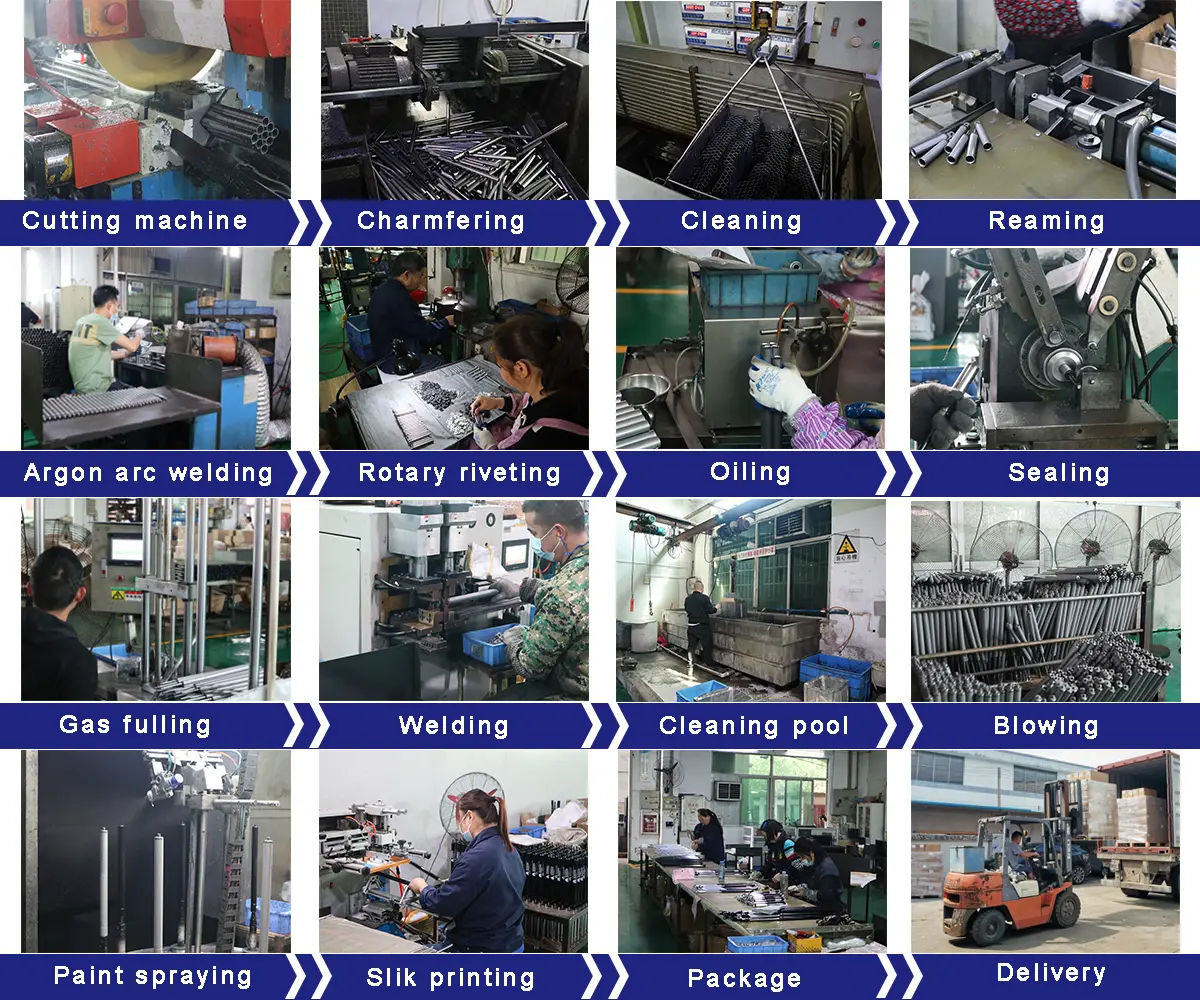

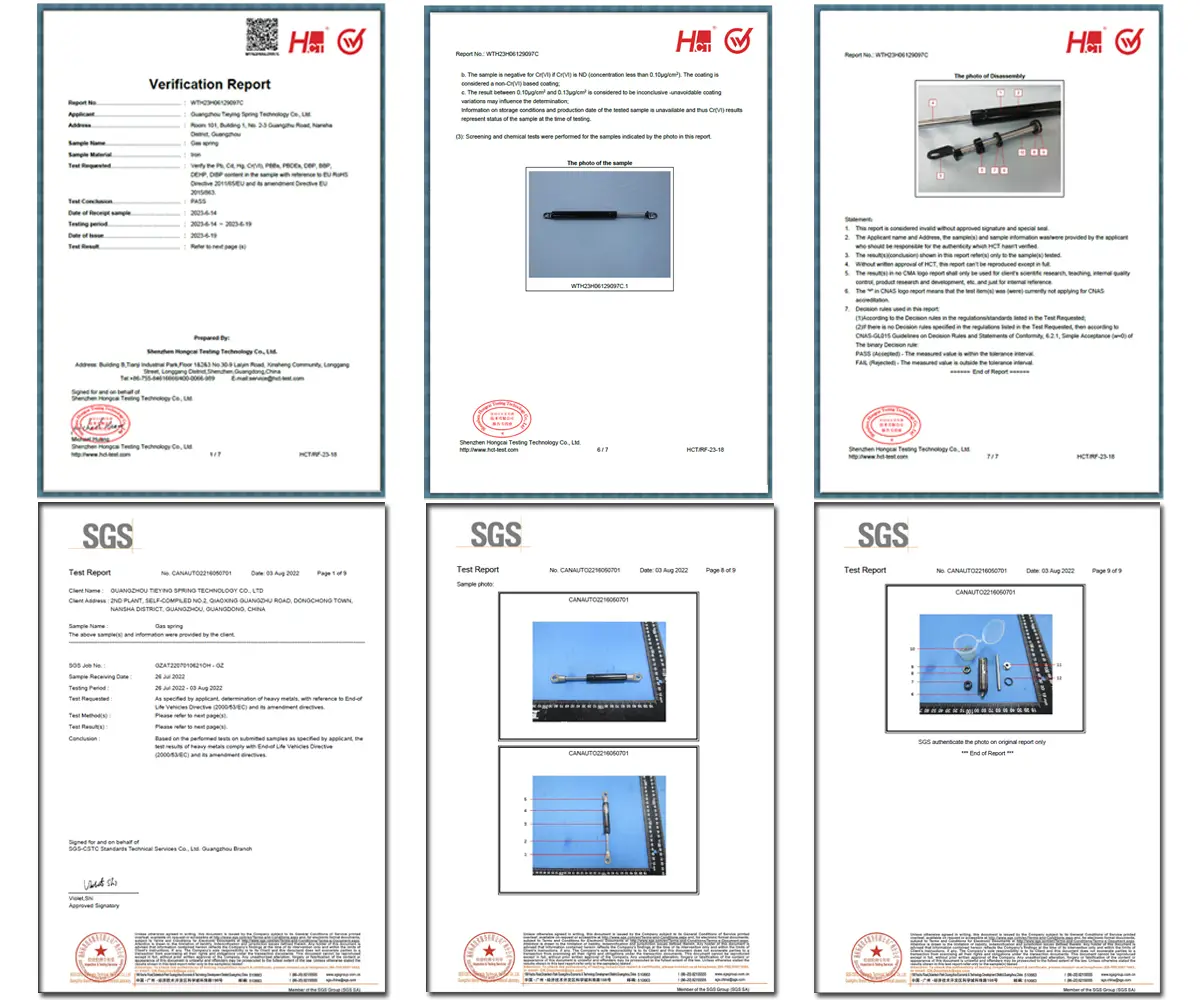
TieYing Factory Video Verified by SGS
Competitive Advantages of TieYing Gas Springs
| Item | TieYing Gas Springs (TieYing Supplier) | Standard Gas Springs (Other Supplier) |
|---|---|---|
| Certificate | SGS 200000 Cycles Durability Test, ROHS, T16949, IS09001 | Maybe just ISO9001 |
| Material | Top seamless steel (Full inspection by Professional testing equipment) | Maybe steel |
| Oil | Anti-wear hydraulic oil from Garmany | Maybe Semi-Synthetic |
| Piston Roughness | Up to Ra 0.696um | Maybe Ra 0.4um |
| Gas spring resistance | 100°C~-40°C | Maybe 60°C |
| Gas | 99.99% nitrogen | Maybe oxygen / Impure nitrogen |
| Uselife | 80,000-200,000 cycles with SGS test report | Maybe 50,000 cycles |
| Salt spray testing | Up to 96 hours | Maybe up to 12 hours |
| Inspection | All procedure sampling inspect, complete inspect before delivery | Maybe sampling inspection |
| Defective product | Re-produce new, If reach 10%, 100% items re-produce new | Maybe Repair |
Frequently Asked Questions (FAQ)
What are canopy gas struts used for?
Canopy gas struts are used to assist and support lift-up canopy doors, windows, hatches, access panels and storage compartments on trucks, pickups, utes, camper shells, RVs, caravans and service vehicles.
Are canopy gas struts the same as canopy gas springs?
Yes. In most vehicle applications, canopy gas strut and canopy gas spring describe the same basic type of nitrogen-charged lifting support. Buyers may also use terms such as lift support or gas lift.
Are canopy gas struts the same as truck tailgate assist struts?
No. They use similar gas spring technology, but the application geometry is different. Canopy struts support canopy doors and panels, while tailgate assist struts are designed around the movement of a vehicle tailgate.
What force canopy gas strut do I need?
There is no single force rating that fits every canopy.
The required force depends on panel weight, center of gravity, hinge position, mounting points, opening angle and the number of gas springs.
Send us your canopy dimensions and mounting information and our engineers can calculate a suitable starting specification.
Can I use a stronger canopy gas strut?
Not automatically.
An oversized gas spring may make the canopy difficult to close and can increase stress on hinges, brackets and the canopy structure.The correct force should be calculated for the complete mechanism.
Should canopy gas struts be replaced in pairs?
When a canopy uses two gas springs, replacing them as a matched pair is generally the better approach.
A new strut combined with a significantly weaker old strut can create uneven movement and loading.
How do I measure a canopy gas strut?
Measure the extended center-to-center length, compressed center-to-center length, stroke, force rating and both end fittings.
Photos of the installed gas spring and mounting points are also helpful.
Can you make custom canopy gas struts?
Yes.
TieYing can customize force, stroke, extended length, cylinder and rod dimensions, end fittings, brackets, surface finish and packaging according to your application.
Can you manufacture replacement canopy gas struts from a sample?
Yes.
You can send an existing gas spring, photographs, dimensions or technical drawings. We can review the sample and discuss a suitable replacement specification.
Do you manufacture gas struts for ute canopies?
Yes.
TieYing can develop gas struts for ute canopy doors, windows, service bodies, tool compartments and other pickup-based applications.
Do you supply gas struts for camper shells?
Yes.
Gas springs can be developed for camper shell rear hatches, side windows and other lift-up panels.
Can canopy gas struts be used on RVs and caravans?
Yes.
RV and caravan applications can include storage doors, external access panels and lift-up compartments. Corrosion-resistant materials can be considered for outdoor and humid environments.
Do you manufacture stainless steel canopy gas struts?
Yes.
Stainless steel 304 and 316 configurations can be considered when the application requires greater corrosion resistance.
Can you add damping to a canopy gas strut?
Can canopy gas struts be customized with our brand?
OEM branding, labeling and customized packaging can be discussed for distributor and OEM projects.
Do you provide samples before bulk orders?
Yes.
Samples can be used to confirm dimensions, mounting compatibility and operating performance before mass production.
What information should I send for a quotation?
For the fastest evaluation, send:
- Canopy or vehicle type
- Door/window weight
- Door dimensions
- Existing gas spring dimensions
- Force rating if known
- Extended length
- Stroke
- End fitting photos
- Mounting-point photos
- Required quantity
- Working environment
Need Custom Canopy Gas Struts?
Whether you are replacing an existing canopy gas spring or developing a new vehicle canopy, the correct specification starts with the actual mechanism.
Send TieYing your canopy dimensions, panel weight, mounting information, photos, drawings or existing gas spring sample.
Our engineering team can help you determine the appropriate force, stroke, length and mounting configuration for your application.