Industrial Tool Cabinet Gas Struts for Workshop Storage
TieYing manufactures custom industrial tool cabinet gas struts for workshop equipment manufacturers, industrial furniture brands, tool storage system suppliers, distributors and OEM customers.
Gas struts help lift hinged cabinet lids with less manual effort and provide support while users access tools, components and equipment. The right gas spring must match the lid’s weight, dimensions, hinge position, opening angle and available installation space.
Whether you manufacture industrial tool chests, workshop storage cabinets, workbench lids or maintenance storage compartments, TieYing can help evaluate the gas spring specifications required for your application.
From lifting force and stroke to extended length, end fittings and mounting brackets, we work with your drawings, existing samples and technical requirements to discuss suitable gas spring configurations.
Why Work with TieYing?
- Custom force, stroke and dimensions
- Application-based gas spring selection
- End fittings and mounting configuration options
- Support for OEM development and bulk supply
- Specification planning for repeat orders
Why Do Industrial Tool Cabinets Need Gas Struts?
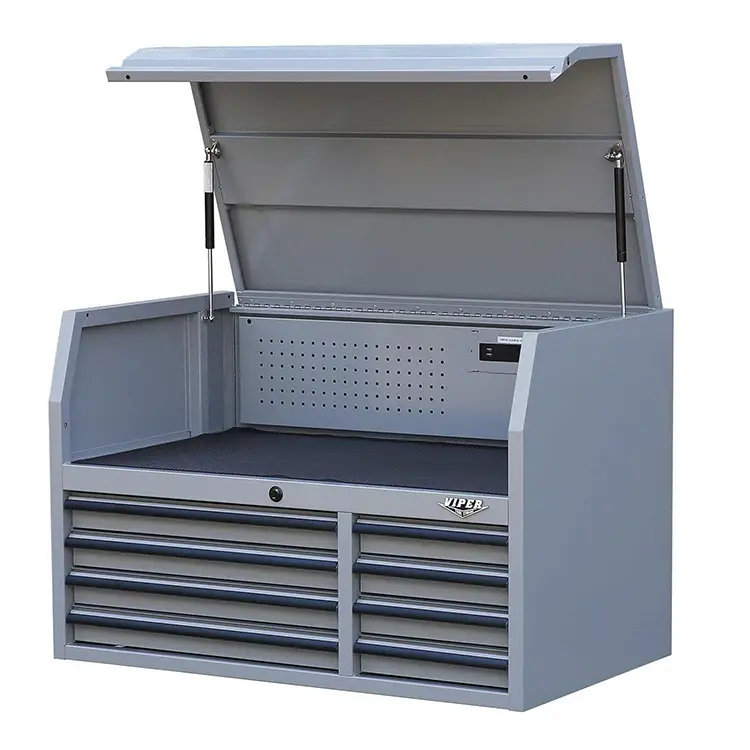
Industrial tool cabinets store hand tools, measuring instruments, maintenance equipment and production accessories. Some designs include hinged top lids, access covers or lift-up storage compartments that need to open frequently during daily workshop operations.
A properly selected gas strut uses internal gas pressure to generate extension force, helping counterbalance the moving lid. This can reduce manual lifting effort and support the lid in its intended open position.
The actual performance depends on the complete mechanism, including the lid weight, centre of gravity, hinge arrangement, mounting points and gas spring specification.
Easier Access to Tools and Equipment
Large metal lids can be awkward to lift, particularly when they are made from thick sheet metal or include additional frames and fittings. A suitable gas strut helps make opening more manageable for technicians and workshop operators.
Support During Maintenance Work
Some tool cabinets and service compartments require users to access equipment with both hands. A correctly specified gas spring can help support the lid while the cabinet is open.
Where a heavy lid could create a safety hazard, an appropriate mechanical safety support or locking mechanism may also be required. A gas spring should not automatically be treated as the sole safety device for maintenance work.
Better Control During Daily Operation
Industrial storage equipment may be opened and closed many times during a working shift. The gas spring should provide suitable lifting assistance without making the lid excessively difficult to close or causing it to rise too aggressively.
Where reduced closing speed or impact is required, the complete mechanism may need an appropriate damping component.
Compact Integration Into Cabinet Structures
Industrial tool cabinets often have limited space around the lid, hinges, internal shelves and storage compartments. The gas spring must fit within the available space while allowing the lid to move through its intended opening range.
Correctly selected dimensions and end fittings help prevent interference with the cabinet structure.
Consistent Performance Across Production Runs
Industrial equipment manufacturers need components that match their approved product specifications across multiple units. Consistent gas spring force, dimensions, end fittings and mounting arrangements help simplify assembly and repeat purchasing.
For OEM projects, these requirements should be confirmed before production specifications are finalized.
Industrial Tool Cabinet Gas Strut Applications
Different industrial storage designs require different lifting arrangements. TieYing can review your cabinet structure and help determine a suitable gas spring configuration for the intended movement.
Industrial Tool Chest Lids
Some industrial tool chests feature a hinged top lid that provides access to frequently used tools and equipment. The lid may be relatively heavy because of its metal construction, reinforcing frame or attached hardware.Gas struts can assist the opening movement and help support the lid when open. The required force and dimensions depend on the complete lid assembly and its hinge geometry.Workshop Storage Cabinet Covers
Workshop storage cabinets may include hinged covers over storage compartments, maintenance areas or specialized equipment. These covers can benefit from lifting assistance when manual opening is inconvenient.The gas spring should match the cover’s weight, mounting space and required opening angle without interfering with the cabinet structure.Industrial Workbench Lids
Certain industrial workbenches include hinged lids that open to reveal internal storage or equipment compartments. Gas struts can help reduce lifting effort and improve access to the space beneath the lid.The design must account for the workbench structure, lid dimensions, hinge position and clearance around the working surface.Mobile Workshop Tool Cabinets
Mobile tool cabinets and service carts may include hinged top covers or storage lids. Their gas spring configuration should suit the cabinet design and the intended operating conditions.The mounting brackets and attachment points should be appropriate for the application. Where equipment is moved frequently, the overall structure and fasteners should also be evaluated for the expected loads and vibration.Maintenance Storage Compartments
Industrial maintenance stations may include storage compartments for spare parts, tools and service equipment. A hinged cover can require lifting assistance when opened repeatedly during maintenance tasks.TieYing can review the lid dimensions, operating frequency and installation space to discuss a suitable gas spring specification.Equipment-Side Storage Cabinets
Tool storage cabinets installed beside machinery or production lines may have restricted mounting space because of adjacent equipment, cables or structural frames.Compact gas spring dimensions and suitable end fittings can help integrate the lifting mechanism without obstructing normal access or equipment operation.Custom Industrial Storage Systems
Industrial furniture manufacturers and equipment OEMs often develop storage systems with non-standard dimensions, lid structures and opening requirements.For these projects, TieYing can review drawings or samples to discuss custom force, stroke, overall length and mounting configurations.Application note: Gas struts are intended for suitable hinged lids, lift-up panels and covers. Conventional sliding drawers do not normally require gas struts for their sliding movement, although separate gas spring applications may be used in other parts of the storage system.
How to Choose the Right Industrial Tool Cabinet Gas Struts?
Selecting the right gas strut involves more than matching a force rating to the lid’s weight. The lid geometry, hinge position, mounting points and operating environment all influence the final specification.
1. Lid Weight and Centre of Gravity
Start with the complete moving lid assembly, including the metal panel, frame, handles and attached hardware.
The centre of gravity determines how much turning moment the lid creates around its hinge axis. Two lids with the same weight can require different gas spring forces because their dimensions and weight distribution differ.
Provide the lid dimensions, approximate weight and hinge arrangement when requesting a quotation.
2. Gas Spring Force
Gas spring force is normally specified in Newtons (N). It determines the extension force available to assist the lid.
The required force depends on the lid’s weight, centre of gravity, number of gas springs, mounting positions and opening angle.
An underspecified gas spring may provide insufficient lifting assistance. Excessive force can make the lid difficult to close or cause it to open too aggressively.
TieYing recommends evaluating the complete cabinet mechanism before confirming the required force rating.
3. Stroke and Overall Length
Stroke is the distance the piston rod travels between the compressed and extended positions. Extended length and compressed length determine whether the gas spring fits within the cabinet and provides the required movement.
An unsuitable stroke may prevent the lid from reaching its intended opening angle. An incorrect overall length may interfere with the cabinet structure or prevent the lid from closing completely.
Both the fully closed and fully open positions should be checked before finalizing the specification.
The cabinet mechanism should also have suitable travel limits so that the gas spring does not unintentionally become the mechanical stop.
4. Hinge Position and Mounting Geometry
The mounting points relative to the hinge axis determine the leverage available to assist the lid.
Changing a bracket position can alter the effective lifting assistance, required stroke, working angle and clearance throughout the opening movement.
For this reason, the mounting arrangement should be evaluated across the complete movement arc rather than only in the closed position.
5. One Gas Strut or Two?
The required number of gas struts depends on the lid’s weight, width, stiffness, hinge arrangement and mounting geometry.
Some smaller lids may be suitable for a single gas strut. Wider or heavier lids may require two matched units to provide more balanced support and reduce uneven loading.
There is no universal lid-weight or width threshold that determines the correct configuration for every industrial tool cabinet. The complete design should be assessed before the final arrangement is confirmed.
6. End Fittings and Mounting Brackets
End fittings connect the gas spring to the cabinet body and lid. Their design must match the mounting points and allow the gas spring to move freely throughout its working range.
Depending on the application, suitable options may include ball-joint fittings, eyelet connections, threaded ends or other mounting configurations.
Bracket strength, fastener selection and the material supporting the mounting points are also important. Thin cabinet panels may require reinforcement to withstand repeated operating loads.
7. Operating Frequency and Service Requirements
A tool cabinet used occasionally may have different requirements from a workstation or maintenance station opened repeatedly throughout the day.
Consider the expected operating frequency, maintenance requirements and intended service life when defining the specification.
For OEM projects, these requirements should be discussed before sample evaluation and production approval.
8. Dust, Oil and Environmental Conditions
Industrial workshops may expose storage equipment to dust, oil, moisture, cleaning agents and temperature variation.
The appropriate gas spring material and surface finish should be selected according to the actual operating environment. Where corrosion resistance is important, suitable protective finishes or stainless steel options can be evaluated.
The final selection should be based on the exposure conditions and available product specifications rather than assuming that every gas spring is suitable for every workshop environment.
9. Closing Behaviour and Damping
Some industrial tool cabinet lids require lifting assistance only. Others need additional control to reduce closing speed or impact.
A gas spring generates extension force, while a damper resists movement and helps control speed. These components serve different functions.
If the cabinet design requires controlled closing, the gas spring, hinge arrangement and damping components should be evaluated together.
10. Mounting Strength and Structural Compatibility
The cabinet structure must withstand the loads generated during opening, closing and normal use. Mounting brackets should be securely attached to suitable structural points rather than relying on an inadequately supported thin panel.
For larger lids, the design should also consider lid stiffness and the potential for twisting when support is applied unevenly.
The mounting arrangement should be reviewed as part of the complete cabinet design.
Custom Industrial Tool Cabinet Gas Struts for OEM Projects
Industrial tool cabinet manufacturers use different lid dimensions, materials, hinge systems and installation spaces. A standard gas spring may fit one design but may not suit another.
TieYing supports custom gas spring projects based on application requirements, technical drawings, existing samples and dimensional specifications.Custom Force and Stroke
Gas spring force and stroke can be evaluated according to the lid load, required movement and mounting geometry.Custom Extended and Compressed Lengths
Overall dimensions can be reviewed against the available cabinet space and intended opening range.End Fittings and Mounting Configurations
Suitable end fittings and mounting arrangements can be discussed according to the cabinet structure, lid design and installation requirements.Material and Surface Finish Options
Material and surface finish options can be evaluated according to the workshop environment, corrosion exposure and product requirements.Damping Requirements
Where additional closing control is needed, TieYing can discuss whether a suitable gas damper or another compatible damping arrangement is appropriate.OEM and Bulk Supply
For industrial furniture manufacturers, workshop equipment suppliers, distributors and OEM customers, TieYing supports project-based customization discussions and bulk supply arrangements.Specifications, sample requirements, packaging, labeling and repeat-order needs can be discussed according to the project and available manufacturing options.The final configuration should be confirmed against the actual cabinet design before mass production.Common Industrial Tool Cabinet Gas Strut Problems and Solutions
Poor lid movement is not always caused by a defective gas spring. The force rating, mounting geometry, hinge arrangement and available travel should be checked together.
The Cabinet Lid Is Difficult to Lift
The gas spring may provide insufficient assistance for the lid’s weight and geometry. Hinge friction or unsuitable mounting positions may also contribute.What to check: Lid weight, centre of gravity, hinge condition, gas spring force and mounting locations.
The Lid Opens Too Aggressively
Excessive force or unsuitable leverage can make the lid rise too quickly or require too much effort to close.What to check: Gas spring force, mounting positions, opening path and any required damping components.
The Lid Will Not Stay in Its Intended Open Position
The gas spring may be underspecified, or the mounting geometry may not provide enough support at the relevant opening angle.What to check: Actual lid load, centre of gravity, gas spring condition and support throughout the movement.
The Lid Cannot Close Fully
An unsuitable compressed length, incorrect stroke or interference with the cabinet structure may prevent the lid from closing completely.What to check: Closed-position dimensions, mounting points, available clearance and the complete movement path.
The Lid Moves Unevenly
A wide lid supported by mismatched gas springs or poorly aligned brackets may twist or move unevenly.What to check: Force matching, symmetrical mounting, hinge alignment and bracket stiffness.
The Gas Spring or Mounting Hardware Shows Corrosion
The selected material or surface finish may not suit the actual environment. Damage to protective finishes or unsuitable mounting hardware can also contribute.What to check: Environmental exposure, rod and cylinder condition, end fittings and appropriate corrosion-resistant options.
The Lid Slams During Closing
A standard gas spring does not automatically guarantee soft-close performance. If reduced closing speed or impact is required, the damping arrangement should be reviewed.What to check: Gas spring function, hinge compatibility and whether a suitable damping component is needed.
If the problem persists, provide TieYing with photographs, lid dimensions, existing gas spring specifications and the mounting arrangement. Reviewing the complete mechanism is generally more useful than simply replacing the component with a higher-force model.
Why Choose TieYing as Your Industrial Tool Cabinet Gas Strut Supplier?
Choosing an industrial tool cabinet gas strut supplier involves more than comparing product prices. Manufacturers need suitable specifications, compatible mounting hardware and a supply arrangement that supports their production requirements.
TieYing manufactures gas springs and dampers for industrial machinery, workstations, storage covers and other equipment applications. We support B2B customers who need application-based specifications and custom manufacturing discussions for their projects.Application-Based Gas Spring Selection
Every tool cabinet lid has its own weight, dimensions, hinge arrangement and mounting space. TieYing can review drawings, photographs or existing samples to help evaluate the appropriate force, stroke, overall length and mounting configuration.This approach helps establish a clearer specification before prototype evaluation or production.Custom Solutions for Different Cabinet Designs
Standard gas springs may not fit every industrial tool cabinet. Some projects require different dimensions, force ratings, end fittings or mounting brackets.TieYing supports customization discussions according to project requirements and available manufacturing options, helping customers identify a configuration suited to their cabinet design.Support for OEM and ODM Projects
Industrial furniture brands and equipment manufacturers often develop products around their own cabinet structures and storage requirements.TieYing can work with technical drawings, samples and application details to discuss specifications for custom development and production planning.Consistent Specifications for Repeat Orders
For manufacturers and distributors, consistent dimensions, force ratings, end fittings and product identification help simplify assembly and replacement part management.Agreeing on the specification before production provides a clearer basis for repeat orders and inventory planning.Gas Springs for Different Industrial Applications
In addition to tool cabinet lids, TieYing supports gas spring and damper applications for industrial workstations, maintenance covers, access panels and machinery enclosures.For broader industrial equipment applications, visit our Industrial Machinery & Automation page.Direct Communication With the Manufacturer
Working directly with a gas spring manufacturer allows buyers to discuss application requirements, mounting dimensions and customization needs at the source.Drawings, photographs and existing samples can help make technical discussions more specific and reduce uncertainty during quotation and specification review.Practical Support for Long-Term B2B Supply
For industrial equipment manufacturers, distributors and OEM customers, a suitable supplier should understand both the product requirements and the purchasing process.TieYing can discuss specifications, sample evaluation, order quantities, packaging and repeat-supply arrangements according to the project.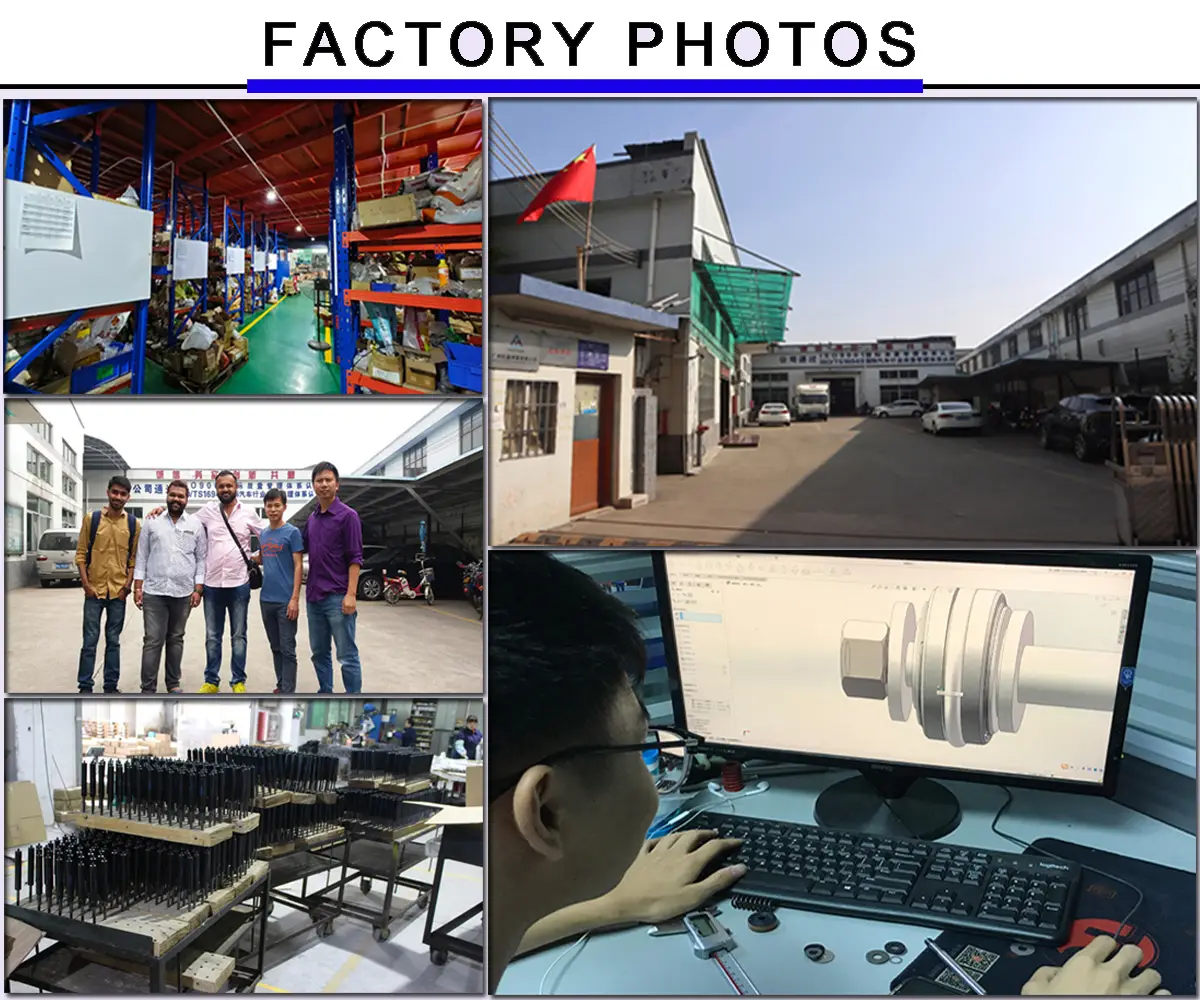

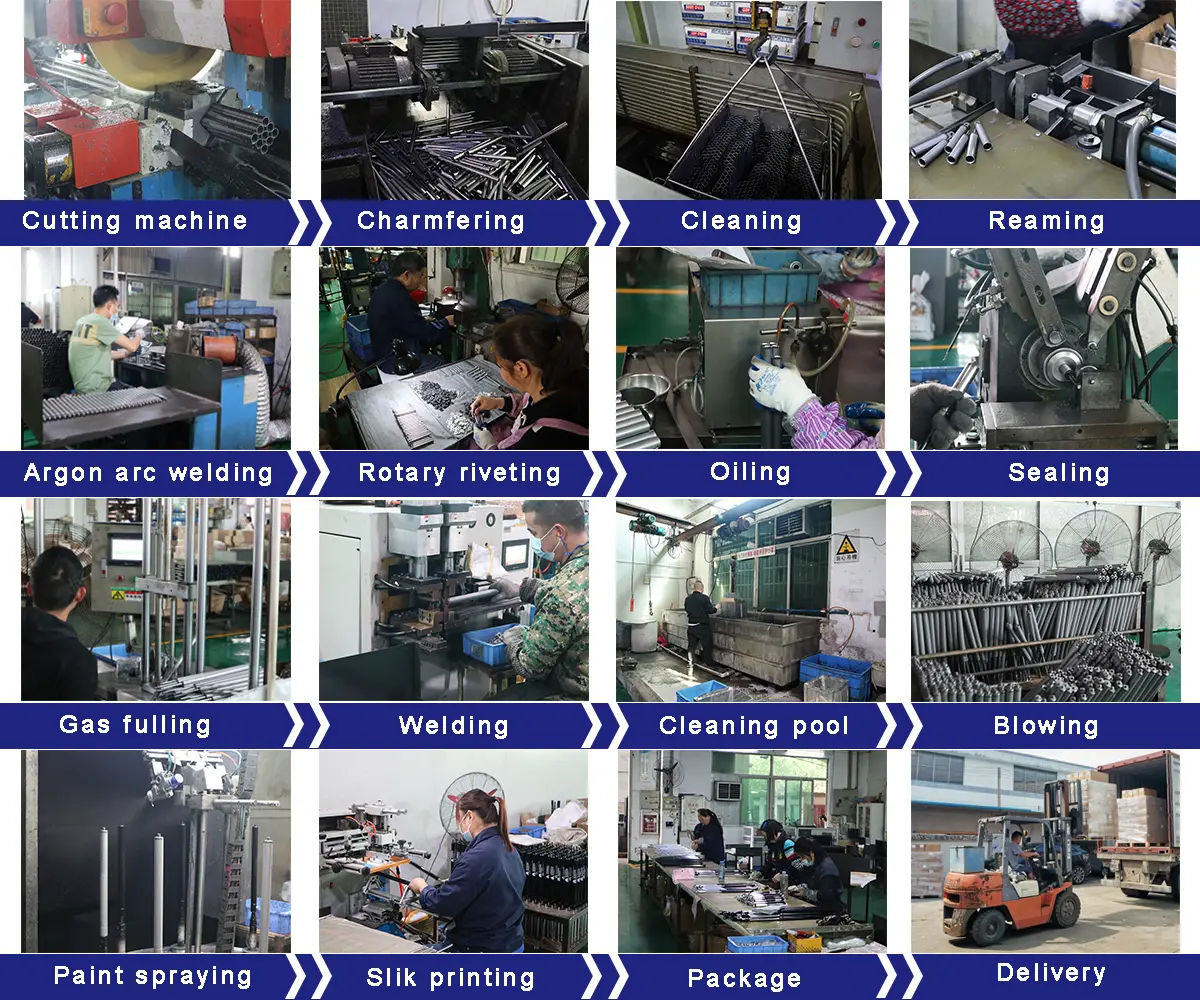
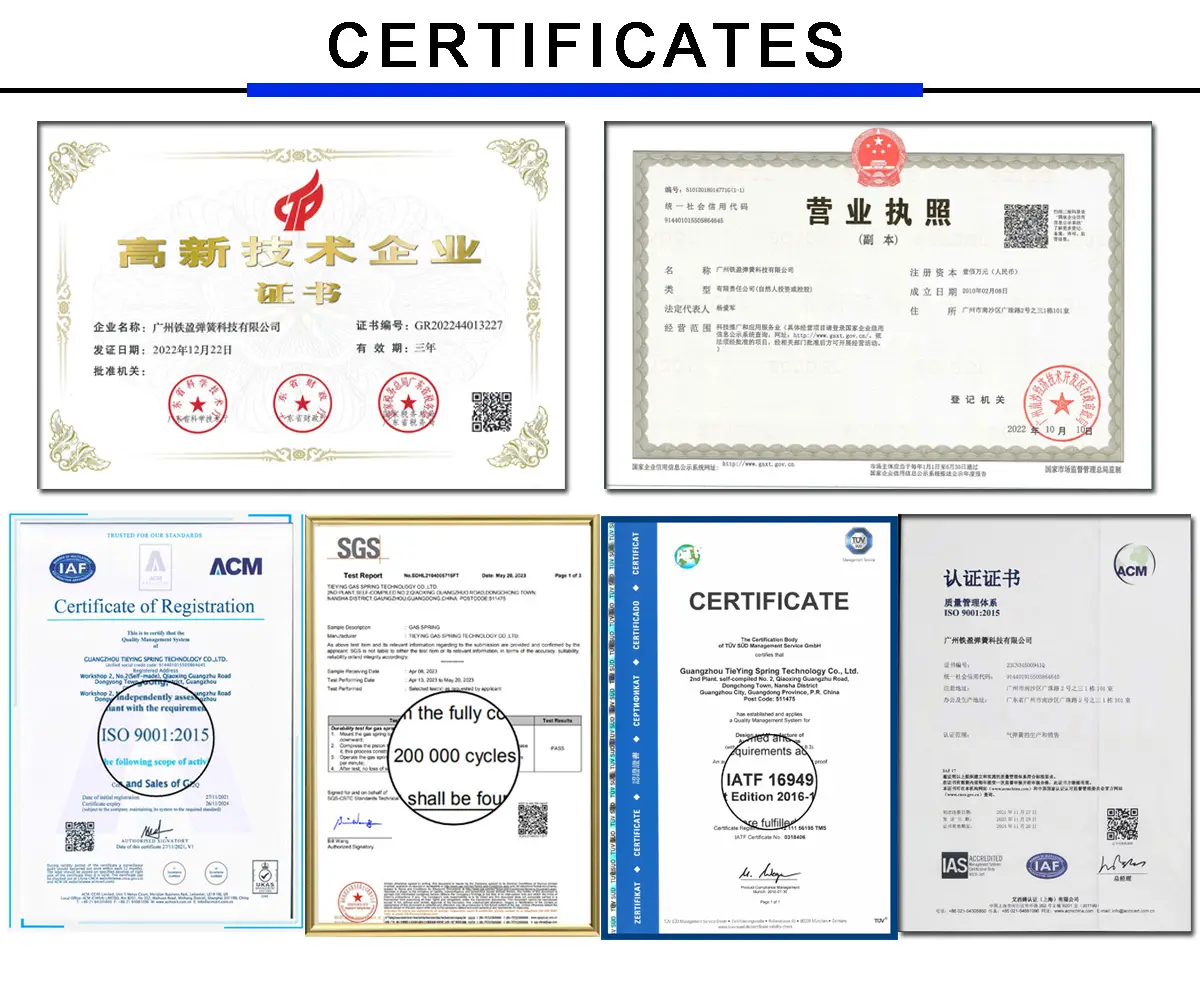
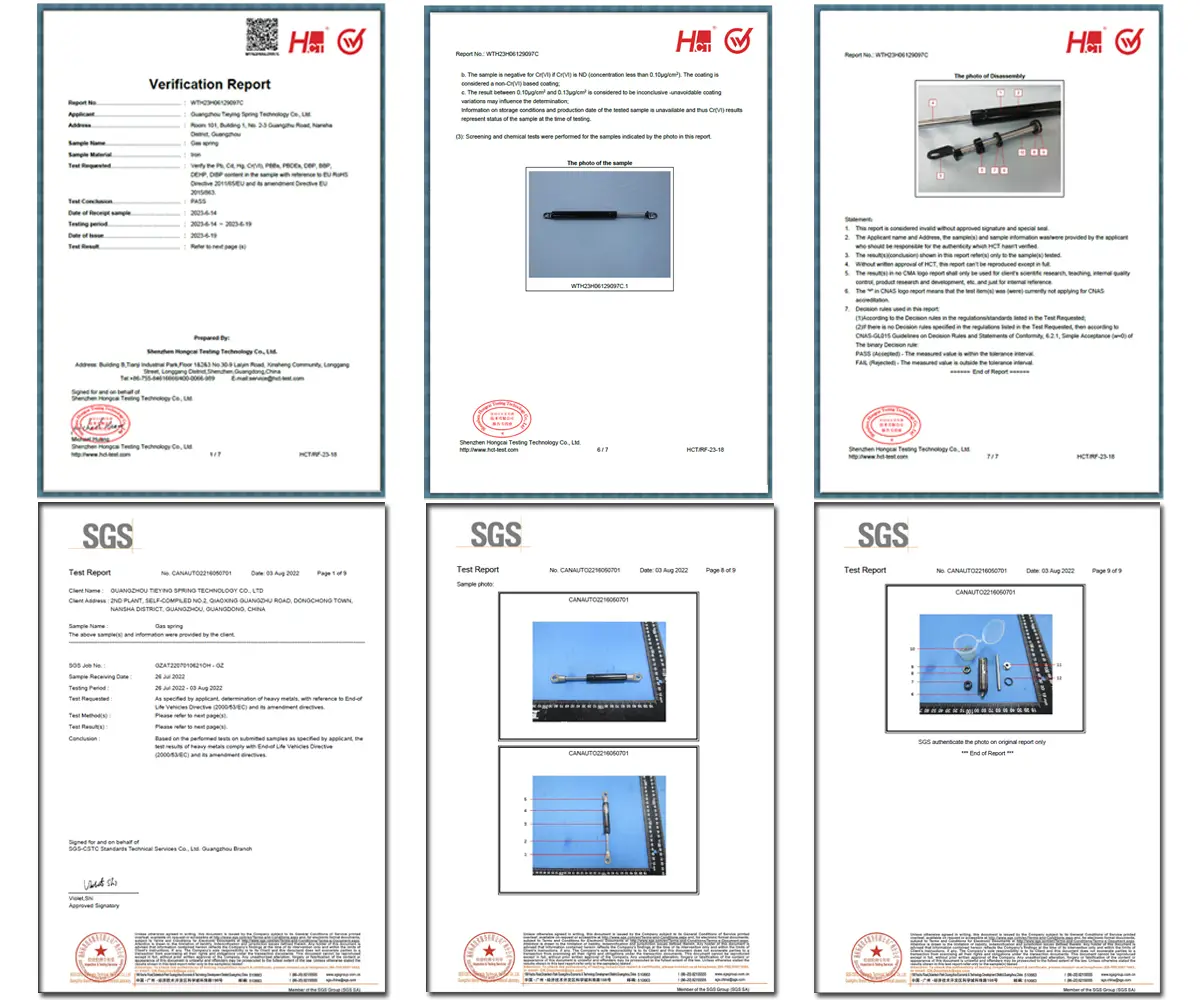
TieYing Factory Video Verified by SGS
Competitive Advantages of TieYing Gas Springs
| Item | TieYing Gas Springs (TieYing Supplier) | Standard Gas Springs (Other Supplier) |
|---|---|---|
| Certificate | SGS 200000 Cycles Durability Test, ROHS, T16949, IS09001 | Maybe just ISO9001 |
| Material | Top seamless steel (Full inspection by Professional testing equipment) | Maybe steel |
| Oil | Anti-wear hydraulic oil from Garmany | Maybe Semi-Synthetic |
| Piston Roughness | Up to Ra 0.696um | Maybe Ra 0.4um |
| Gas spring resistance | 100°C~-40°C | Maybe 60°C |
| Gas | 99.99% nitrogen | Maybe oxygen / Impure nitrogen |
| Uselife | 80,000-200,000 cycles with SGS test report | Maybe 50,000 cycles |
| Salt spray testing | Up to 96 hours | Maybe up to 12 hours |
| Inspection | All procedure sampling inspect, complete inspect before delivery | Maybe sampling inspection |
| Defective product | Re-produce new, If reach 10%, 100% items re-produce new | Maybe Repair |
How TieYing Supports Your Industrial Tool Cabinet Gas Strut Project?
A clear development process helps establish the requirements before a gas spring enters production.
Step 1: Share Your Cabinet Design
Provide photographs, drawings, lid dimensions, estimated weight, hinge positions and the required opening angle.Step 2: Review the Technical Requirements
Evaluate the lid load, mounting geometry, available installation space, required stroke and any damping requirements.Step 3: Discuss the Proposed Specification
Review the proposed force, dimensions, end fittings and mounting configuration against the cabinet design.Step 4: Evaluate Samples
Where required, use samples to check fitment, opening effort, closing behaviour and compatibility with the cabinet structure.Step 5: Confirm Production Requirements
Once the configuration is approved, confirm the agreed specifications, order quantity, packaging and other production requirements.Step 6: Plan Repeat Supply
For ongoing OEM and distributor programs, agreed specifications and packaging requirements help support consistent repeat purchasing.What Information Is Needed for an Industrial Tool Cabinet Gas Strut Quote?
Providing the right information helps TieYing evaluate your application and determine which specifications need further confirmation.
Cabinet and Lid Details
- Cabinet type and intended application
- Lid width, height and approximate weight
- Lid material and frame construction
- Hinge type and hinge position
- Required opening angle
- Available installation space
Gas Spring Requirements
- Existing gas spring model, if applicable
- Force rating, if known
- Stroke and extended length, if known
- Compressed length, if known
- End fittings and mounting bracket requirements
Operating Requirements
- Expected operating frequency
- Required opening and closing behaviour
- Whether additional damping is needed
- Exposure to dust, oil, moisture or cleaning products
- Corrosion-resistance requirements
Purchasing Requirements
- Estimated order quantity
- Expected annual demand, if available
- Sample or prototype requirements
- Packaging, labeling and OEM branding requirements
Frequently Asked Questions About Industrial Tool Cabinet Gas Struts
What are industrial tool cabinet gas struts?
Industrial tool cabinet gas struts are gas springs used to assist the lifting of suitable hinged cabinet lids, covers and access panels. Their force, dimensions and mounting arrangements must match the lid’s weight, hinge position and required movement.
How do I choose the right gas strut for a tool cabinet?
Start with the lid’s dimensions, complete moving weight, centre of gravity, hinge position, required opening angle and available installation space. The required force, stroke and overall length should then be evaluated against the mounting geometry.
Lid weight alone is not enough to determine the correct specification.
Can gas struts be used on industrial tool chests?
Yes. Gas struts can be suitable for hinged top lids and other lifting covers on industrial tool chests when the force, dimensions and mounting arrangement match the design.
They are not normally used to provide the sliding movement of conventional drawers.
How many gas struts does an industrial tool cabinet lid need?
The number depends on the lid’s weight, width, stiffness, hinge arrangement and mounting geometry. Some smaller lids may use one gas strut, while wider or heavier lids may require two matched units.
The final configuration should be confirmed for the specific cabinet design.
Do industrial tool cabinet gas struts provide soft closing?
Not all gas struts provide soft-close performance. A gas spring assists lifting and supports the lid, while a damper helps control movement speed. If controlled closing is required, a suitable damping arrangement should be selected for the complete mechanism.
Can TieYing customize gas struts for industrial tool cabinets?
TieYing supports custom gas spring projects based on drawings, samples, dimensions and application requirements. Available options for force, stroke, overall length, end fittings and mounting configurations should be confirmed for each project.
Are gas struts suitable for oily or dusty workshop environments?
Suitability depends on the actual exposure conditions and product specification. Material, surface finish, rod protection and mounting hardware should be evaluated according to the workshop environment.
Can I replace an existing industrial tool cabinet gas strut?
Yes, but the replacement should match the required force, stroke, overall length, end fittings and mounting geometry. If the existing gas spring performs poorly, review the complete mechanism before selecting a replacement with a different force rating.
What information should I provide for a quotation?
Provide the cabinet type, lid dimensions, approximate weight, hinge position, required opening angle, available installation space, photographs or drawings, and estimated order quantity. Existing gas spring specifications or samples are also useful.
Does TieYing support OEM and bulk orders?
TieYing supports OEM-oriented customization discussions and bulk supply for B2B customers. Product specifications, samples, packaging and repeat-order arrangements can be discussed according to the project and available manufacturing options.
Looking for an Industrial Tool Cabinet Gas Strut Manufacturer?
The right gas spring should fit your cabinet structure, provide suitable lifting assistance and operate reliably within the intended working environment.
TieYing works with industrial furniture manufacturers, workshop equipment suppliers, tool storage system brands, distributors and OEM customers to evaluate gas spring requirements and discuss suitable configurations.
Send us your cabinet drawing, lid dimensions, existing gas spring sample or technical requirements. Our team can review the application and discuss the next steps for your project.