
RV Door Shocks: Smooth Entry Door Control & Reliable Baggage Door Support
An entry door that flies wide open in a gust and slams against the side of your motorhome. A baggage compartment door that won’t stay up while you’re unloading. A compartment “shock” that has lost its pressure after years of road vibration, leaving you propping the door with one hand and reaching for gear with the other.
If you search for an RV door shock, you’re usually looking for one of two things: the hydraulic door check that controls your side-opening entry door, or the gas strut that holds an upward-opening baggage or compartment door. TieYing manufactures both, engineered for the vibration, weather, and everyday use that recreational vehicles endure.
As a China-based OEM gas spring manufacturer with 23+ years of engineering experience, TieYing supplies RV door shocks to motorhome manufacturers, RV builders, service centers, and aftermarket distributors worldwide. Every unit is built to exact force, stroke, and fitting requirements and backed by global quality certifications.
Not sure which RV door shock you need? Send a photo of the fitted unit or your existing part number → Get a free fitment recommendation within 24 hours.
What Is an RV Door Shock? "Shock" vs "Strut" Explained
The word “shock” is used loosely in the RV aftermarket, and understanding the terminology helps you order the correct part.
- In everyday language, RV owners call almost any gas-filled door support a “shock,” even though it is technically a gas strut / gas spring / lift support.
- In engineering terms, a shock absorber damps movement, while a gas strut generates lifting and holding force. On a recreational vehicle, the relevant hardware falls into two functional groups.
The Two Types of RV Door Hardware
1. Entry Door Shock / Door Check / Door Closer (side-opening doors) Your main RV entry door swings on vertical hinges and often includes a screen door. The entry door shock (door check) is a hydraulic or gas-filled damper mounted between the door and frame. It does not lift the door — instead it:
- Controls how fast the door opens and closes
- Prevents the door from being flung fully open by wind
- Holds the door at a usable position on many models
- Cushions closing to avoid a bang and protect the frame and screen door
2. Baggage / Compartment Door Gas Strut (upward-opening doors) The small exterior baggage doors and larger “basement” storage compartments hinge horizontally and open upward. These use nitrogen gas struts that lift and hold the door open, leaving your hands free. Most RV owners refer to these as baggage door “shocks.”
Quick Reference
| Feature | Entry Door Check / Closer | Baggage Door Gas Strut |
|---|---|---|
| Door type | Side-opening, vertical hinges | Upward-opening, horizontal hinges |
| Primary job | Control speed / wind check / hold | Lift & hold the door |
| Mounting | Between entry door and frame | On compartment door and body |
| Lifting force | No | Yes |
| Common name | Entry door shock | Baggage door shock |
How RV Door Shocks Work?
Entry Door Check
A sealed hydraulic or gas-filled damper resists the door’s motion through a calibrated internal valve. As the door swings, the damper creates controlled resistance so the door cannot surge open in wind, and it cushions the final movement. Hold-open variants keep the door at a set angle until you move it.
Baggage Door Strut
Compressed nitrogen drives the piston rod outward, counterbalancing the weight of the upward-opening door so it lifts easily and stays open. On closing, the door moves in a controlled motion; optional damping cushions the final travel to prevent slamming.
Because gas pressure responds to temperature, units can feel firmer in heat and softer in cold — a normal characteristic worth accounting for in winter use.
Core Benefits of TieYing RV Door Shocks
✅ Wind-resistant entry door control — Stops the main door from being thrown open and striking the RV body, protecting the frame, hinges, and screen door.
✅ Anti-slam, quiet operation — Damped movement removes sharp bangs at entry and compartment doors.
✅ Hands-free baggage access — Compartment and baggage doors stay held open while you load and unload.
✅ Anti-pinch protection — Controlled closing reduces the risk of trapped fingers at entry and storage doors.
✅ Vibration & weather resistant — Built for road vibration, rain, dust, UV, and temperature swings.
✅ Direct OEM replacement — Cross-references common RV part numbers for bolt-on fitment with no modification.
✅ Long service life — Rated for 150,000+ cycles, far outlasting budget aftermarket units.
✅ Matched pairs where required — Balanced struts keep large doors traveling square without hinge twist.
RV Door Shock Size Chart & Standard Dimensions
TieYing RV door shocks carry the TY-RVS prefix. Most units use 10mm ball-socket or pin-style fittings; confirm your existing fittings before ordering.
Entry Door Checks & Closers
| TieYing Model | Length Range | Force / Damping | Typical Application |
|---|---|---|---|
| TY-RVS-ED-10 | ~10 in (254 mm) | Low-force hydraulic check | Compact travel trailer entry doors |
| TY-RVS-ED-12 | ~12 in (305 mm) | Adjustable door check | Standard motorhome & fifth-wheel entry doors |
| TY-RVS-ED-14 | ~14 in (356 mm) | Door closer with hold-open | Large Class A/C entry doors with screen door |
Baggage & Compartment Door Struts
| TieYing Model | Extended Length | Compressed Length | Force (per strut) | Typical Application |
|---|---|---|---|---|
| TY-RVS-100-20 | 10 in (254 mm) | 6.4 in (163 mm) | 20–30 lb / 89–133 N | Small baggage doors |
| TY-RVS-120-30 | 12 in (305 mm) | 7.6 in (193 mm) | 30–40 lb / 133–178 N | Standard side compartments |
| TY-RVS-150-40 | 15 in (381 mm) | 9.3 in (236 mm) | 40–55 lb / 178–245 N | Larger baggage & utility doors |
| TY-RVS-200-60 | 20 in (508 mm) | 12.2 in (310 mm) | 60–80 lb / 267–356 N | Basement / pass-through storage |
Sizing Notes
- Forces are stated per strut; large doors may use two units, doubling total support.
- Standard sizes are stocked for fast shipment. Fully custom units are available from 5 in (127 mm) to 28 in (711 mm) extended length with force from 10 lb (45 N) to 150 lb (667 N).
- Match both length/stroke and force — the correct length with the wrong force will either fail to hold or make the door hard to close.
- For the full range of recreational vehicle door supports, see our dedicated camper door strut application page.
Samples are available for fit and hold-force validation before volume orders.
End Fittings & Mounting Hardware
Common Fittings
- 10mm ball socket (female) — The standard fitting for compartment struts; a reinforced socket with a retaining clip snaps onto a 10mm ball stud and pivols through the door arc.
- 8mm / 13mm ball socket — Smaller fittings for light compartments; larger for heavy basement doors.
- Pin / eyelet / clevis — Used on entry door checks and heavy-duty installations.
- Door-specific brackets — Mounts designed to attach a check arm to the entry door and screen door frame.
Mounting Brackets
- L-brackets with integrated ball studs for surface mounting
- Flat-base brackets for low-profile installation
- Adjustable sliding brackets for fine-tuning position and effective hold force
All fittings and brackets are available in zinc-plated carbon steel, black powder coat, or 304/316 stainless steel. For maximum corrosion resistance, explore our stainless steel gas struts.
Common RV Applications
- Entry / access doors — Main side-opening doors on Class A, B, and C motorhomes, travel trailers, and fifth wheels
- Screen doors — Entry door checks that work with the screen door without interference
- Baggage doors — Exterior side storage compartments of all sizes
- Basement / pass-through storage — Large lower compartments on motorhomes
- Utility & propane compartment doors — Small exterior access panels
- Under-seat & console storage — Interior compartments on motorhomes and camper vans
- Cargo & trailer doors — Enclosed trailer and toy hauler doors
For broader recreational vehicle door applications beyond the parts described here, our camper door strut page covers additional motorhome, caravan, and trailer doors.
RV Door Shock vs Manual Prop vs Generic Strut
| Feature | TieYing RV Door Shock | Manual Prop / Strap | Generic Undamped Strut |
|---|---|---|---|
| Entry door wind protection | Yes | No | No |
| Hands-free hold | Yes | Manual set | Yes |
| Controlled / anti-slam close | Yes | No | No |
| Baggage door lift support | Yes | Limited | Yes |
| Vibration & weather rated | Yes | Prone to wear | Yes |
| Best for | Daily-use RVs | Temporary / budget | Basic lift only |
How to Choose the Right RV Door Shock
- Identify the door and its hinges Vertical hinges (side-opening) indicate an entry door check; horizontal hinges (upward-opening) indicate a gas strut.
- Weigh upward-opening doors Include the door, frame, and hardware, then choose strut force targeting roughly 60–80% of the door weight.
- Measure extended length and stroke Measure center-to-center between mounting points at full open, then the travel from closed to open. Measure mounting points, not the old strut body.
- Confirm the fitting Check ball stud size (typically 10mm) or pin/eyelet style, and whether mounting brackets are included.
- Consider the environment Choose corrosion-resistant finishes for wet, coastal, or winter-road use.
- Replace in pairs where designed for two Mismatched force causes uneven travel and hinge stress.
30-Second RV Door Shock Selector
Send these details for an exact recommendation:
- Door type: ☐ entry (side-opening) ☐ baggage/compartment (upward)
- Door weight (if upward-opening): ____ lb / kg
- Extended length (center-to-center): ____ in / mm
- Fitting: ☐ 10mm ball ☐ pin ☐ eyelet ☐ custom
Installation Guide & Safety Precautions
Before You Start
- Secure upward-opening doors with a prop or a helper before removing old struts; never rely on a person alone to hold a heavy door.
- Tools required: a flathead screwdriver for retaining clips and a wrench/socket for fasteners.
- Verify orientation. Install gas struts with the piston rod pointing downward in the closed position so internal oil lubricates the seal. Entry door checks follow their marked orientation.
Step-by-Step Installation
- Pry up the retaining clip and pull ball sockets straight off the stud; avoid twisting or levering sideways.
- Compare the new unit to the old one to confirm length, force, damping, and fittings.
- Attach the body end first, pressing until it clicks, then the rod end, moving the door slightly to align.
- Confirm both ends are locked, then cycle the door slowly through its full range, checking for smooth motion and no binding.
- For entry door checks, confirm the screen door still operates freely and the door cannot over-open.
Critical Mistakes to Avoid
- ❌ Do not manually force or compress a gas strut.
- ❌ Do not twist or bend the piston rod.
- ❌ Do not use the strut as a mechanical end stop; fit bump stops that contact before full extension.
- ❌ Do not over-torque fasteners, which can warp brackets and cause binding.
- ❌ Do not fit an entry door check where a lift strut is required, or vice versa.
Maintenance to Extend Service Life
Routine Inspection (Every 6 Months)
- Wipe the exposed piston rod with a clean, dry cloth to remove dust, dirt, and road salt.
- Check brackets and fasteners for tightness; road vibration can loosen hardware.
- Inspect rods for scratches, pitting, or corrosion, and replace damaged units.
- On entry door checks, confirm the screen door and latch operate without interference.
Do’s & Don’ts
✅ Do cycle doors periodically during long storage to keep seals lubricated.
✅ Do use a light silicone product only if specified, wiping away excess.
❌ Don’t apply oil, grease, WD-40, or petroleum lubricants to the piston rod.
❌ Don’t paint, powder coat, or coat the piston rod.
❌ Don’t expose units to open flame or temperatures above their rated limit.
Storage
Store spare units horizontally in a cool, dry place away from chemicals, and never keep them fully compressed for extended periods.
Custom RV Door Shocks From TieYing
When a standard unit does not match your vehicle, our OEM/ODM engineering team develops a fully custom solution:
- Force: 10–150 lb (45–667 N), calibrated to your door weight and geometry
- Length & stroke: 5–28 in (127–711 mm) with custom stroke and opening angle
- Hardware: Entry door checks, closers, and gas struts with custom end fittings and brackets
- Materials & finishes: Carbon steel (zinc, black oxide, powder coat) or 304/316 stainless steel
- Damping: End-of-stroke, linear, or adjustable closing speed
- Special features: Custom branding, private label, bespoke packaging, and matched pairs
We support prototypes, fitment validation, and smooth scaling into high-volume production with automated, cost-efficient manufacturing.
Why Choose TieYing as Your RV Door Shock Supplier?
23+ Years of Gas Spring Engineering
Founded in 2002, TieYing has focused exclusively on gas spring design and manufacturing for more than two decades, building deep application knowledge across RV, automotive, marine, and industrial markets.
Certified, Traceable Quality
Our factory operates under ISO 9001 and IATF 16949 systems. Units are tested for cycle life, force consistency, leak integrity, and damping, with SGS test reports available on request, and all products are RoHS and REACH compliant. Every unit undergoes 100% inspection before shipment.
Scalable Capacity & Fast Lead Times
Our Guangzhou facility runs automated assembly lines with an annual output of millions of units, supporting fast shipment of standard sizes and dependable lead times for custom OEM production.
Global Export Experience
We supply customers in 56+ countries, including the USA, Germany, Australia, Canada, and the UK, handling export documentation, customs coordination, and flexible shipping terms including DDP.
Dedicated End-to-End Support
A dedicated account manager and engineering team support you from initial consultation and samples through after-sales service, with prompt responses to inquiries.


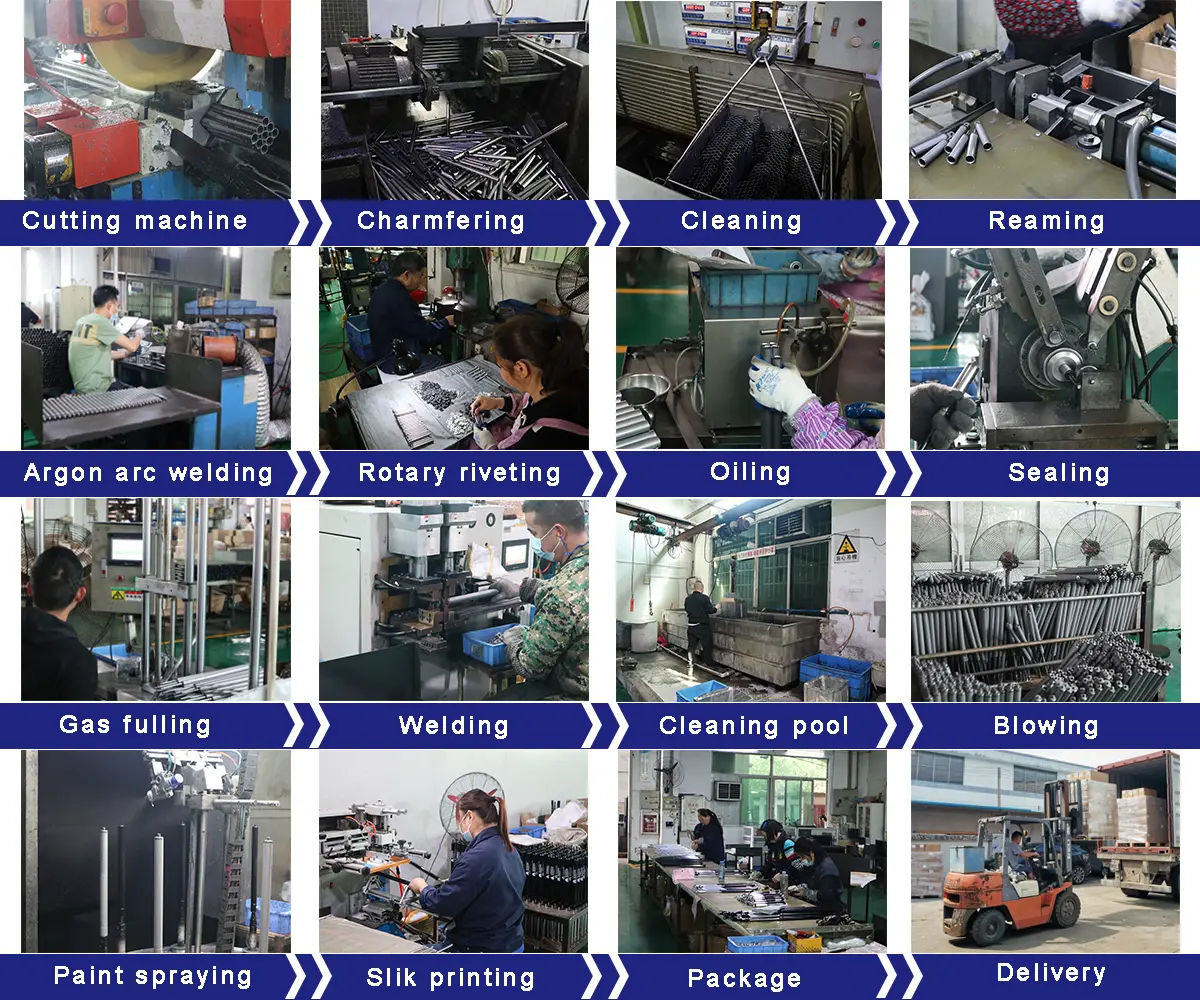
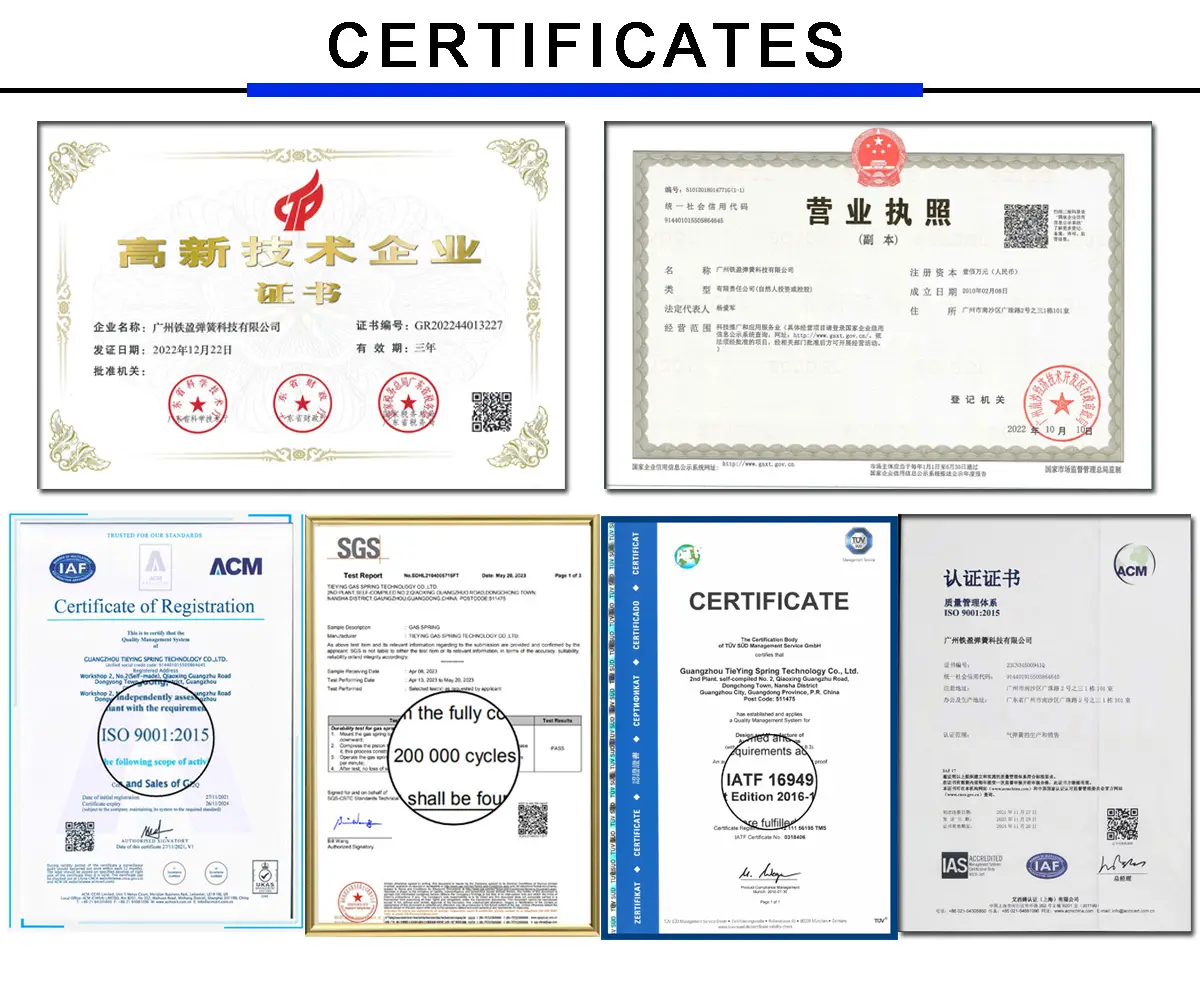
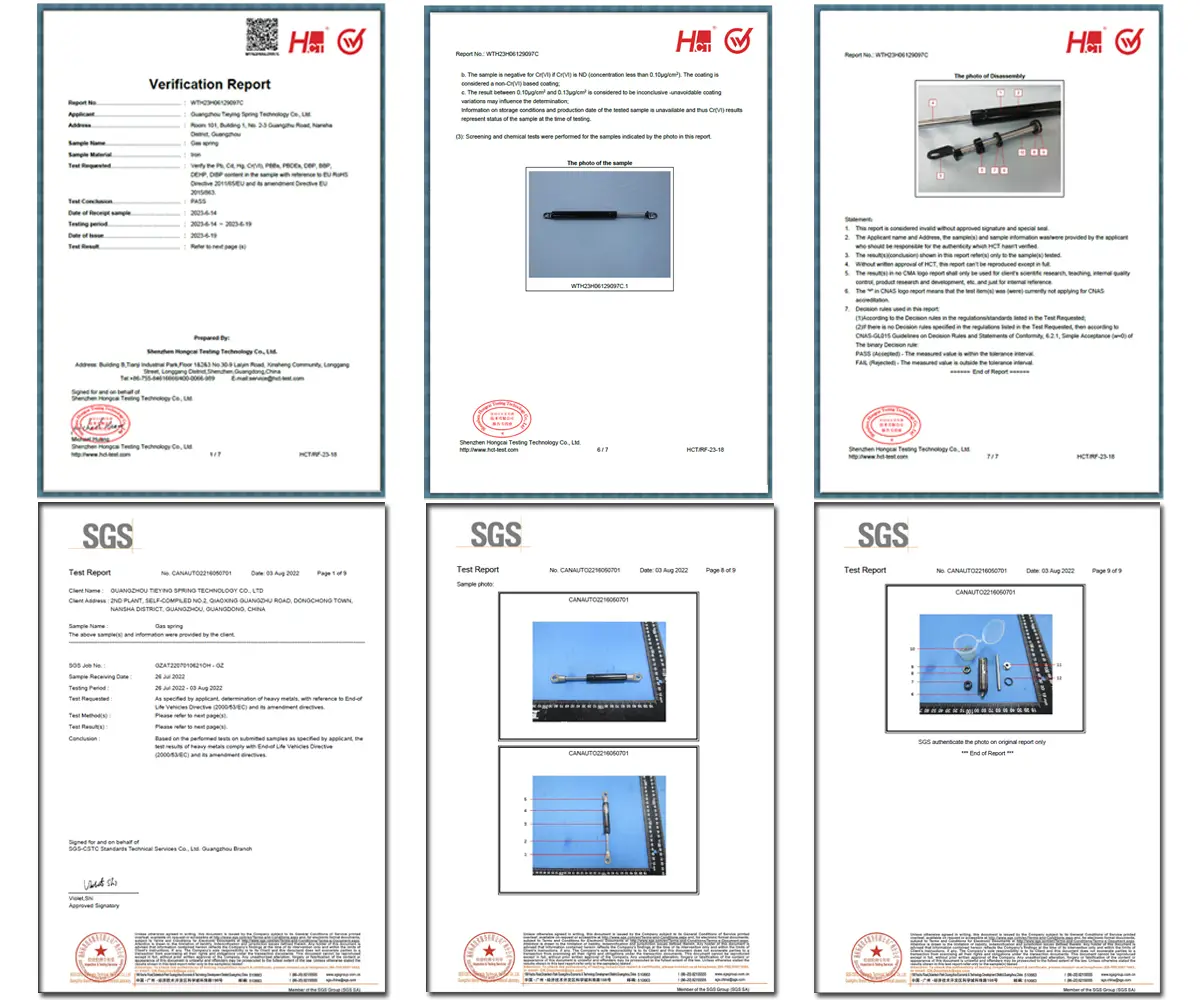
TieYing Factory Video Verified by SGS
Competitive Advantages of TieYing Gas Springs
| Item | TieYing Gas Springs (TieYing Supplier) | Standard Gas Springs (Other Supplier) |
|---|---|---|
| Certificate | SGS 200000 Cycles Durability Test, ROHS, T16949, IS09001 | Maybe just ISO9001 |
| Material | Top seamless steel (Full inspection by Professional testing equipment) | Maybe steel |
| Oil | Anti-wear hydraulic oil from Garmany | Maybe Semi-Synthetic |
| Piston Roughness | Up to Ra 0.696um | Maybe Ra 0.4um |
| Gas spring resistance | 100°C~-40°C | Maybe 60°C |
| Gas | 99.99% nitrogen | Maybe oxygen / Impure nitrogen |
| Uselife | 80,000-200,000 cycles with SGS test report | Maybe 50,000 cycles |
| Salt spray testing | Up to 96 hours | Maybe up to 12 hours |
| Inspection | All procedure sampling inspect, complete inspect before delivery | Maybe sampling inspection |
| Defective product | Re-produce new, If reach 10%, 100% items re-produce new | Maybe Repair |
Frequently Asked Questions (FAQ)
Is an RV door shock the same as a gas strut?
In everyday RV terminology, yes — many owners call gas struts “shocks.” Technically, a side-opening entry door uses a hydraulic door check that controls motion, while an upward-opening baggage door uses a gas strut that lifts and holds. This page covers both.
What stops my entry door from slamming open in the wind?
An entry door check (door shock) provides controlled resistance so the door cannot be flung wide open, and many models hold it at a set angle. It also protects the screen door and frame from impact.
Why won't my baggage door stay open?
The gas strut has lost internal pressure through seal wear or age. Cold weather can also temporarily reduce force. If it still drifts when warm, replace the unit — in pairs where the door uses two.
How do I measure an RV door shock?
For upward doors, measure center-to-center between mounting points at full open, then the stroke from closed to open. For entry door checks, match the overall length and mounting style, ideally against the original part number.
Can I replace the door shock myself?
Yes, most replacements take 10–15 minutes with a flathead screwdriver. Always prop upward doors securely, and for gas struts install with the rod pointing down.
Do you offer stainless steel or heavy-duty RV door shocks?
Yes. We offer 304/316 stainless units for corrosion resistance and heavy-duty high-force models for large basement compartments and commercial vehicles.
Can you match my existing OEM part number?
Yes. We cross-reference common RV part numbers and supply equivalents with matching force, stroke, and fittings. Provide the number stamped on the old unit for the fastest match.
How long do RV door shocks last?
TieYing units are rated for 150,000+ cycles under normal use. Actual life depends on load, weather, and maintenance; proper orientation and regular cleaning maximize service life.
What is the minimum order quantity?
MOQs are flexible. Standard sizes support small batch and sample orders, while fully custom units typically begin at a low production MOQ. Contact us for exact terms.
Get Your RV Door Shock Quote Today
Whether you need an entry door check, a baggage door strut, or high-volume OEM production for RV manufacturing, TieYing provides a complete solution:
- Free engineering consultation and force/fitment calculation
- Entry door checks, closers, and compartment struts
- Samples for fit and hold-force validation
- Matched pairs with optional anti-slam damping
- Competitive factory-direct pricing and dependable lead times
- Global shipping and dedicated after-sales support
Contact our RV gas spring specialists with your door details, part number, or required quantity. We’ll respond within 24 hours with a detailed specification and tailored recommendation.