Custom Gas Shocks for Lids and Hinged Covers
TieYing manufactures custom gas shocks for lids that require assisted opening and reliable support in the open position. Our gas springs and gas struts can be specified for hinged storage lids, equipment covers, access panels, utility compartments and other applications where manual lifting needs to be easier and more controlled.
Every lid has its own weight, dimensions, hinge position, opening angle and available mounting space. Selecting the right gas shock requires more than matching a force rating to the lid’s weight. The gas spring must work with the complete mechanism to provide suitable lifting assistance throughout the intended range of movement.As a gas spring manufacturer, TieYing supports OEM manufacturers, industrial equipment suppliers, hardware brands, wholesalers and distributors with application-based specifications and custom manufacturing solutions.- Custom gas spring force, stroke and dimensions
- End fittings and mounting configurations for different lid designs
- Solutions for furniture, industrial equipment and storage systems
- OEM manufacturing, sample evaluation and bulk supply support
Gas Shocks for Lids Designed Around Your Application
A lid gas shock is a gas spring or strut selected to assist the opening of a hinged lid and help support it during normal use. The component generates extension force that works against the lid’s closing moment, making the lid easier to lift and helping maintain the intended open position when correctly specified.
However, a gas spring does not work independently of the lid structure. Its performance depends on the relationship between the lid, hinge axis, mounting points and gas spring geometry.
For example, two lids with the same weight may require different gas spring specifications if one is wider, has a different centre of gravity or uses a different hinge arrangement. A gas spring that works well on one design may provide insufficient assistance or excessive closing resistance on another.
TieYing evaluates lid gas spring requirements according to the application, available installation space and intended movement. This helps manufacturers establish a more suitable specification before proceeding with sample evaluation or production.
Applications of Gas Shocks for Lids
Different lid designs place different demands on lifting hardware. TieYing supports gas spring applications across a range of furniture, industrial and commercial products.
1. Storage Boxes and Hinged Storage Lids
Storage boxes, large storage chests and hinged containers often have lids that need to be opened repeatedly throughout the day. Depending on the lid’s size and construction, lifting it manually may require considerable effort, particularly when the hinge is positioned along one edge of a wide panel.
Gas struts can assist the opening movement and help support the lid in its intended open position. The correct configuration depends on the lid material, total moving weight, hinge geometry and available mounting space inside the box.
For manufacturers developing new storage products, the gas spring should be considered alongside the lid, hinges and supporting structure rather than added after the design has been finalized.
2. Industrial Equipment Covers and Machine Enclosures
Industrial machines may have hinged covers that provide access to internal components, service points or maintenance areas. These covers can be made from metal panels or assemblies incorporating reinforcement, handles and other hardware.
Gas shocks can reduce the manual effort required to lift a suitable hinged cover and help support it during routine access. The mounting arrangement must fit the machine structure without interfering with moving parts, cables or nearby components.
For these applications, manufacturers should consider the cover’s weight, operating frequency, opening angle, environmental conditions and the loads transferred to the mounting brackets.
Where maintenance personnel work beneath a raised cover, a suitable independent safety support or mechanical locking arrangement may also be necessary. A standard gas spring should not be treated as a safety lock.
3. Access Panels and Service Compartments
Access panels are used in equipment housings, technical installations and service compartments where components need to remain accessible for inspection or maintenance.
A well-matched gas spring can make a hinged panel easier to open while helping keep it in the intended working position. Compact dimensions may be particularly important when the panel is surrounded by a frame, insulation, electrical components or other equipment.
TieYing can review the panel layout, opening direction and mounting dimensions to discuss a suitable gas spring configuration for the application.
4. Electrical Cabinets and Utility Enclosures
Certain electrical cabinets, utility enclosures and technical housings use hinged lids or covers that need assisted opening. The gas spring must fit the enclosure design and provide appropriate support without obstructing access or interfering with installed equipment.
The operating environment is especially important for enclosures installed outdoors or in humid, dusty or corrosive conditions. Material and surface finish requirements should be evaluated according to the actual exposure conditions.
Gas spring selection should also account for the complete cover assembly, including any attached handles, reinforcement and components that move with the lid.
5. Furniture Storage Lids and Lift-Up Seating
Furniture applications include storage benches, ottoman-style furniture, lift-up seats and other designs with concealed storage compartments.
In these products, gas struts need to fit within a limited space while remaining compatible with the frame, upholstery, hinges and lifting mechanism. The goal is to make the lid or seat easier to raise without making it unnecessarily difficult to close.
The required force and mounting positions depend on the moving section’s dimensions, centre of gravity, hinge arrangement and intended opening range.
For dedicated furniture projects, see our custom furniture gas struts solutions.
6. Vehicle Storage Compartments and Toolboxes
Vehicle-mounted storage compartments and toolboxes may use hinged lids to provide access to tools, parts and equipment. Their requirements can differ from those of stationary storage boxes because the assembly may experience vibration, repeated movement and changing environmental conditions.
The gas spring should be selected for the actual lid design, mounting arrangement and intended operating conditions. Brackets and attachment points must also be suitable for the loads generated during operation.
For specialized vehicle storage applications, explore our truck toolbox gas struts.
7. Industrial Tool Chests and Workshop Storage
Industrial tool chests, workshop cabinets and storage workstations may incorporate hinged top lids or covers that need lifting assistance during regular use.
These applications often involve metal lids, reinforced panels and repeated opening cycles. The gas spring specification should therefore be considered together with the cabinet construction, hinge strength, mounting brackets and expected operating frequency.
For dedicated industrial storage projects, visit our industrial tool cabinet gas struts page.
8. Custom OEM Lids and Equipment Covers
Many OEM products use non-standard lids that do not match a conventional furniture, toolbox or cabinet design. Examples include specialized equipment housings, custom storage systems and purpose-built enclosures.
These projects may require particular mounting dimensions, unusual opening angles or compact gas spring arrangements.
TieYing can review application photographs, drawings, existing samples and technical specifications to discuss the required force, stroke, overall length and end fittings. The final configuration should be evaluated against the actual mechanism before it is approved for production.
What Makes a Suitable Gas Shock for a Lid?
The right gas spring should match both the mechanical requirements of the lid and the intended user experience. Several factors determine whether the lid opens comfortably, remains supported and closes as intended.
Balanced Opening Assistance
The gas spring needs to provide sufficient assistance to reduce the effort required to lift the lid. If its force is too low, the lid may remain difficult to open or fail to stay in the intended position.Excessive force can make the lid difficult to close and increase loads on the hinges, brackets and supporting structure.The objective is not simply to choose a stronger gas spring. It is to establish a suitable balance between the lid’s weight, geometry and required movement.Support Throughout the Opening Range
The leverage available to a gas spring changes as a hinged lid moves. A configuration that provides useful assistance near the closed position may behave differently as the lid approaches its maximum opening angle.For this reason, the mounting points and gas spring dimensions should be checked across the intended movement range, not just in the fully open position.Compatibility With the Lid Structure
A suitable gas spring must fit the available installation space without interfering with the lid, hinges, frame or surrounding components.The brackets and attachment points must also withstand the forces generated during opening and closing. Correct mounting geometry is essential to avoid unsuitable loading, binding or interference.Consistent Performance for Repeat Production
For OEM manufacturers and distributors, the specification must remain consistent across production batches. Confirmed force ratings, dimensions, fittings and mounting requirements help establish a reliable basis for assembly, product testing and repeat orders.How to Choose the Right Gas Shocks for Lids?
Choosing a gas shock requires more information than the lid’s weight alone. The following factors should be reviewed before a specification is confirmed.
1. Lid Weight and Centre of Gravity
Start with the total moving weight, including the lid panel, reinforcement, handles and any other components that move with it.The centre of gravity is equally important. A wide lid with its mass distributed far from the hinge can create a different turning moment from a compact lid of the same weight.This difference directly affects the assistance required from the gas spring.2. Hinge Position and Opening Angle
The hinge axis determines how the lid rotates. The gas spring mounting points determine how effectively its force assists that rotation.Share the hinge location, intended opening angle and available mounting positions whenever possible. These details help establish whether a proposed gas spring arrangement can provide suitable assistance throughout the movement.3. Gas Spring Force and Number of Units
Gas spring force is generally specified in Newtons (N). The required force depends on the lid’s moving load, centre of gravity, mounting geometry and number of gas springs.Some designs may use one gas spring, while wider or heavier lids may require a matched pair. The correct arrangement must be evaluated for the specific structure rather than determined by weight alone.Where two gas springs are used, the mounting arrangement and lid structure should be suitable for the resulting loads.4. Stroke and Overall Length
Stroke is the distance the piston rod travels between its compressed and extended positions.The extended length, compressed length and stroke must fit the available space and required lid movement. The gas spring should not reach its travel limit before the mechanism reaches its intended endpoint unless the assembly has been specifically designed and validated for that condition.Confirming these dimensions early can help prevent interference and installation problems.5. End Fittings and Mounting Brackets
End fittings connect the gas spring to the lid and its supporting structure. Depending on the design, suitable options may include ball-joint fittings, eyelet fittings, fork ends or application-specific mounting arrangements.The fitting type, pivot dimensions, bracket geometry and attachment strength should be checked against the available mounting space.The gas spring should also be installed in a way that avoids unintended side loading or misalignment.6. Operating Environment and Frequency
A gas spring used in a frequently opened industrial cover may have different requirements from one used in a household storage lid.Consider the expected opening frequency, operating temperature, humidity, exposure to water or corrosive substances, and any relevant vibration or contamination.Material and surface finish options should be discussed according to the intended environment and the product’s service requirements.7. Opening Support, Locking and Closing Control
Before selecting a component, establish exactly what the mechanism needs to do.A standard compression gas spring provides extension force and can assist opening. It does not automatically provide positive locking or a dedicated soft-closing function.If the lid must lock at a selected position, a suitable locking gas spring or separate mechanical locking arrangement may be required. If slower closing or reduced impact is important, a suitable damper or engineered soft-closing mechanism should be specified.These functions should be treated as separate requirements during product selection.Gas Springs, Gas Struts or Gas Shocks: Which Product Do You Need?
The terms gas spring, gas strut and gas shock are often used interchangeably when buyers search for lid support products. However, the required function matters more than the name used in an enquiry.
Compression Gas Springs
Compression gas springs generate extension force to assist lifting and opening. They are a common starting point for hinged lids, covers and panels that require opening assistance.
The appropriate force, stroke, overall length and mounting arrangement must be matched to the mechanism.
Explore our compression gas springs for more information.
Gas Dampers
Gas dampers are used when controlled movement or reduced movement speed is required. Their function differs from that of a standard gas spring designed primarily to provide lifting assistance.
If the project requires slower closing or reduced impact, specify the required motion behaviour so the appropriate product and mechanism can be evaluated.
Locking Gas Springs
Locking gas springs may be appropriate for applications that require a locking function in addition to support force. The locking principle and operating requirements should be confirmed for the particular design.
Where the lid creates a risk of injury if it falls, the complete safety arrangement must be assessed rather than relying on the gas spring alone.
Custom Gas Shocks for Lids From TieYing
Standard gas springs may not suit every lid design. Differences in weight, hinge geometry, mounting space and required movement can call for application-specific configurations.
TieYing supports custom gas spring projects for OEM manufacturers, equipment suppliers, hardware brands, wholesalers and distributors.Depending on the project and available manufacturing options, customization can include:- Force rating: Select a suitable force according to the moving load and mechanism geometry.
- Stroke and overall length: Match the gas spring dimensions to the required travel and installation space.
- Compressed and extended dimensions: Check compatibility with the closed and open positions.
- Cylinder and piston rod dimensions: Evaluate the configuration against the application’s mechanical requirements.
- End fittings and mounting arrangements: Discuss suitable attachment points and connection hardware.
- Materials and surface finish: Consider the intended operating environment and corrosion exposure.
- OEM packaging and labelling: Discuss product identification, packaging and project-specific requirements.
Drawing and Sample Evaluation
If you already have a lid mechanism, an existing gas spring or a technical drawing, these materials can help clarify the required specification.For new product development, application photographs, lid dimensions, hinge positions and the intended opening range provide a useful starting point.Where appropriate, sample evaluation can be used to check installation compatibility and operating behaviour before proceeding with production.Manufacturing and Repeat Supply
For B2B customers, the initial product specification is only one part of the sourcing process. The agreed dimensions, force requirements, fittings and quality requirements must also be maintained across repeat orders.TieYing works with OEM and ODM customers, hardware suppliers, distributors and equipment manufacturers to discuss customization, production quantities, packaging and ongoing supply arrangements.Why Choose TieYing as Your Gas Shock Supplier for Lids?
Choosing a gas spring supplier involves more than comparing prices. Manufacturers need a component that fits the mechanism, performs as intended and can be supplied according to the agreed specification.
Direct Manufacturing Experience
TieYing is a gas spring manufacturer based in Guangzhou, China, with manufacturing experience dating back to 2002. We support different industrial and commercial applications through gas spring design, development, production and customization.Working directly with a manufacturer gives OEM buyers a practical route for discussing product specifications, custom requirements and repeat supply arrangements.Custom Specifications for Different Lid Designs
Lid mechanisms vary in their dimensions, hinge arrangements, available mounting space and operating requirements. TieYing can review application drawings, photographs, existing samples and technical details to discuss a suitable configuration.This is particularly useful for projects where a standard gas spring cannot be selected confidently from a catalogue alone.Quality Management and Inspection
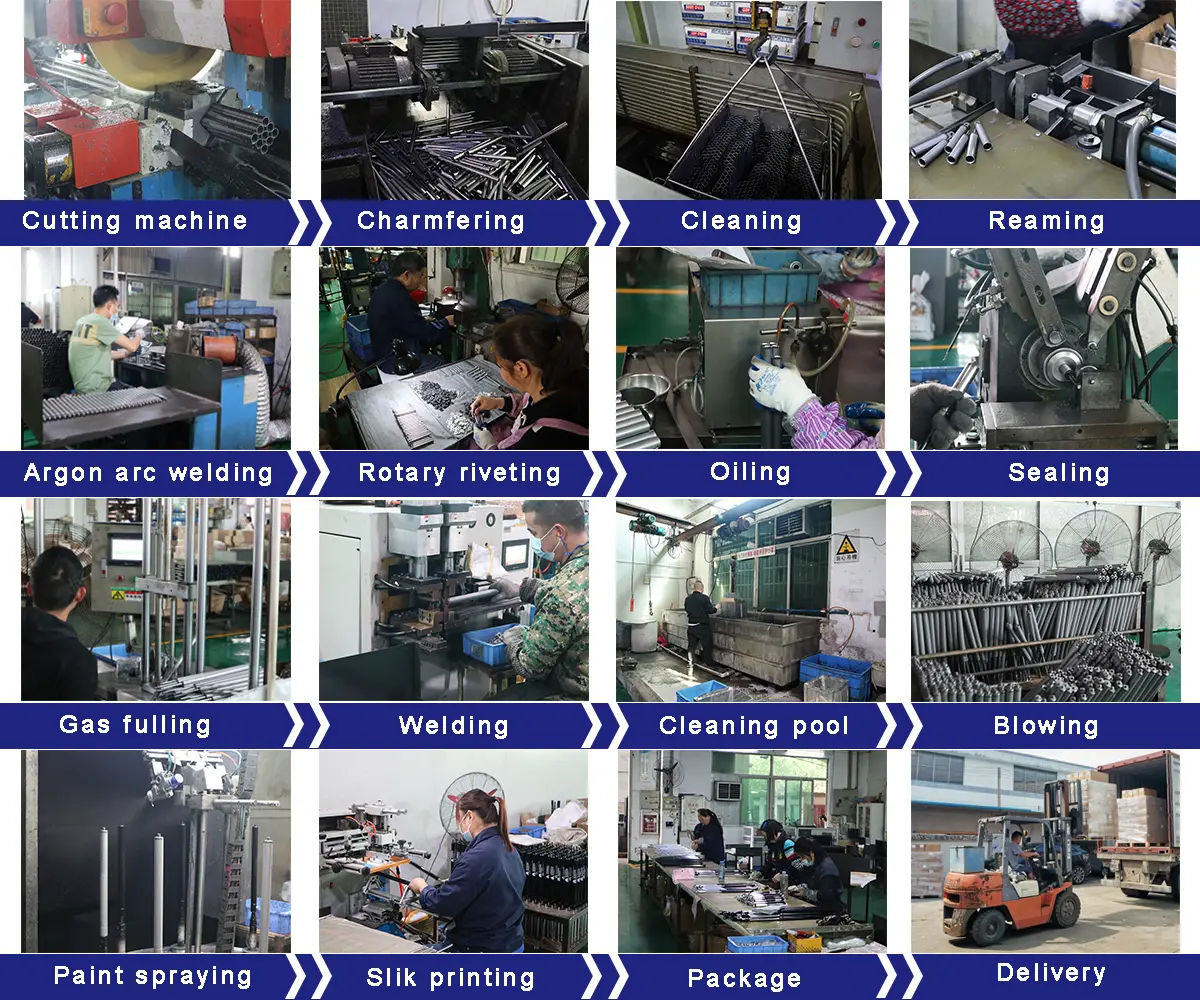
Consistent specifications and appropriate inspection procedures are important when gas springs are incorporated into products manufactured in multiple batches.TieYing’s manufacturing process includes product inspection activities such as dimensional checks, appearance inspection, sealing and pressure-related checks, according to the applicable product requirements.The inspection requirements and agreed product specifications should be confirmed for each project.OEM and Wholesale Support
TieYing works with equipment manufacturers, hardware brands, wholesalers, distributors and other B2B customers.Whether you are developing a new product, sourcing a replacement component or planning repeat purchases, our team can discuss technical requirements, estimated quantities, customization and packaging arrangements.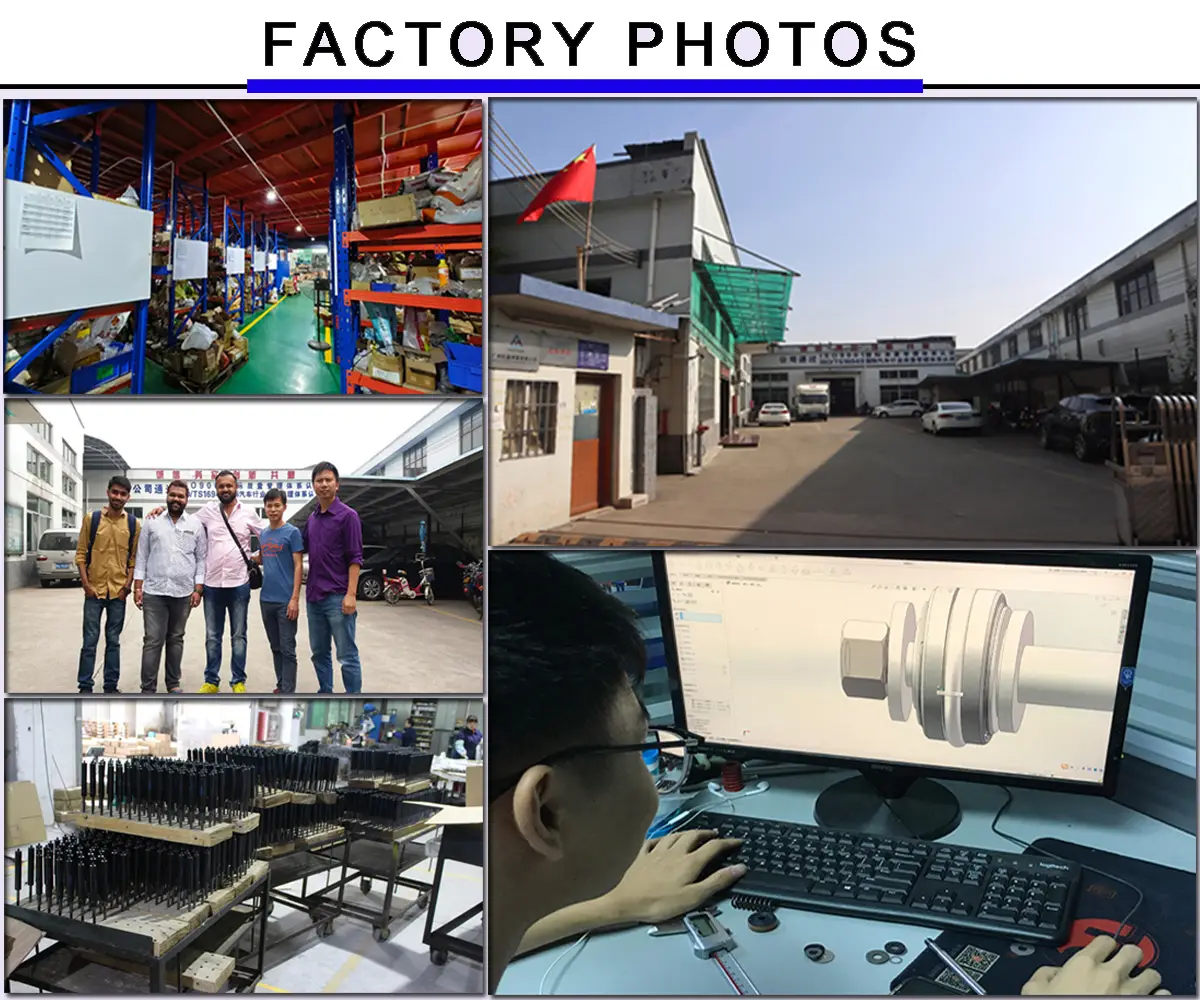

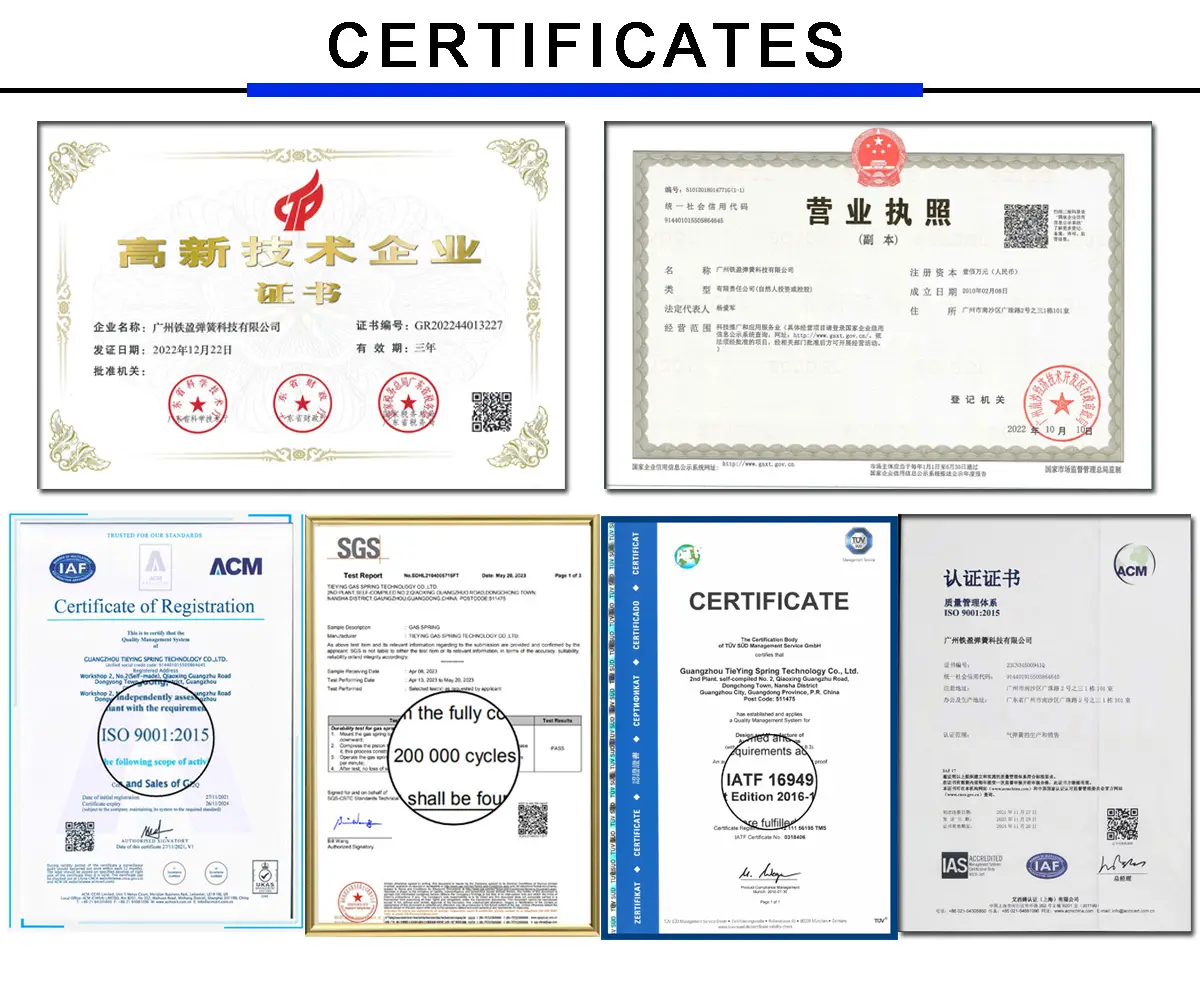
TieYing Factory Video Verified by SGS
Competitive Advantages of TieYing Gas Springs
| Item | TieYing Gas Springs (TieYing Supplier) | Standard Gas Springs (Other Supplier) |
|---|---|---|
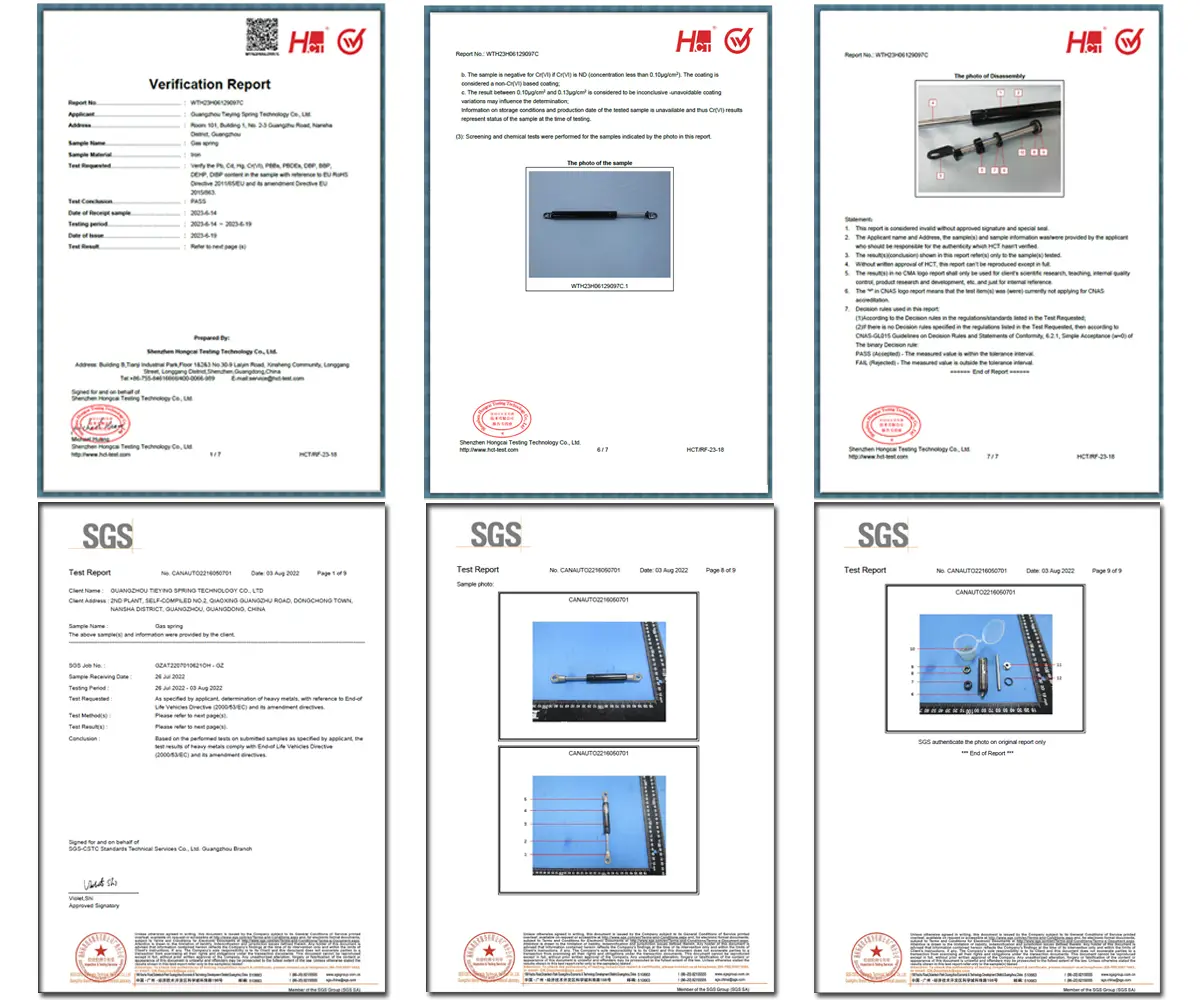
| Certificate | SGS 200000 Cycles Durability Test, ROHS, T16949, IS09001 | Maybe just ISO9001 |
| Material | Top seamless steel (Full inspection by Professional testing equipment) | Maybe steel |
| Oil | Anti-wear hydraulic oil from Garmany | Maybe Semi-Synthetic |
| Piston Roughness | Up to Ra 0.696um | Maybe Ra 0.4um |
| Gas spring resistance | 100°C~-40°C | Maybe 60°C |
| Gas | 99.99% nitrogen | Maybe oxygen / Impure nitrogen |
| Uselife | 80,000-200,000 cycles with SGS test report | Maybe 50,000 cycles |
| Salt spray testing | Up to 96 hours | Maybe up to 12 hours |
| Inspection | All procedure sampling inspect, complete inspect before delivery | Maybe sampling inspection |
| Defective product | Re-produce new, If reach 10%, 100% items re-produce new | Maybe Repair |
From Application Details to Gas Spring Supply
A clear specification process helps reduce uncertainty before production.
Step 1: Share Your Lid Design
Provide photographs, drawings or a description of the lid and its supporting structure. Explain what the lid covers and how it opens and closes.Step 2: Confirm the Technical Requirements
Share the lid’s weight and dimensions, hinge position, opening angle, mounting space and intended operating conditions.Step 3: Review the Gas Spring Configuration
TieYing can review the available information and discuss suitable force, stroke, overall length, end fittings and mounting arrangements.Step 4: Evaluate the Proposed Specification
Where appropriate, evaluate a sample or proposed configuration against the actual lid mechanism. Confirm fitment, movement and the agreed performance requirements before approving the design.Step 5: Discuss Production and Supply
Once the specification is agreed, discuss order quantities, inspection requirements, packaging, labelling and production arrangements.This process gives both parties a clearer understanding of the required component before proceeding with bulk orders or repeat supply.What Information Do We Need for a Custom Quote?
To help TieYing review your gas shock requirements, please provide as much of the following information as possible:
- Application type: Storage lid, equipment cover, access panel, toolbox or another hinged lid.
- Lid weight: Total weight of the moving assembly, including attached hardware.
- Lid dimensions: Width, length and other relevant measurements.
- Hinge position: Location of the hinge axis relative to the lid.
- Opening angle: The required travel range and intended open position.
- Mounting positions: Available locations and dimensions for the gas spring brackets.
- Existing gas spring details: Force rating, part number, dimensions and photographs, if available.
- Operating environment: Temperature, humidity, corrosion exposure and expected operating frequency.
- Required function: Opening assistance, position locking, controlled closing or other specific requirements.
- Order quantity: Estimated sample, trial or production quantity.
- OEM requirements: Packaging, labelling or other project-specific needs.
Frequently Asked Questions About Gas Shocks for Lids
What are gas shocks for lids used for?
Gas shocks for lids are used to assist the opening of suitable hinged lids and help support them in their intended open position. Applications include storage boxes, industrial equipment covers, access panels, furniture storage compartments and vehicle-mounted storage systems.
The correct specification depends on the lid’s weight, hinge geometry, opening angle, mounting positions and required movement.
How do I calculate the required force for a lid gas strut?
The required force depends on the lid’s total moving weight, centre of gravity, hinge position, gas spring mounting points and number of gas springs.
Weight alone is not enough to establish a reliable force rating. Providing a drawing or application photographs with the relevant dimensions helps clarify the mechanism for technical evaluation.
Should I use one gas strut or two for a lid?
The answer depends on the lid’s width, weight, stiffness, mounting geometry and operating requirements.
A smaller lid may be suitable for one gas spring, while a wider or heavier lid may need a matched pair. The final arrangement should be evaluated for the specific design.
Can gas shocks keep a lid open?
A correctly specified gas spring can assist opening and help support a lid in its intended open position. The result depends on the gas spring force, mounting geometry and lid design.
A standard gas spring is not a positive safety lock. Where a falling lid could cause injury, use an appropriate independent safety support or locking arrangement.
Can gas struts provide soft closing for lids?
A standard gas strut should not automatically be assumed to provide soft closing. Its primary function is to generate extension force and assist movement.
If the lid needs slower closing or reduced impact, specify that requirement separately so a suitable damper or engineered closing mechanism can be evaluated.
Can TieYing manufacture custom gas shocks for lids?
TieYing supports custom gas spring projects according to application requirements and available manufacturing options. Customization may include force, stroke, overall length, end fittings, mounting arrangements and other agreed specifications.
You can send drawings, photographs, an existing gas spring sample or technical requirements for review.
Can I replace an existing lid gas strut with the same size?
Existing dimensions are a useful starting point, but matching length alone does not guarantee compatibility. Force rating, stroke, end fittings and mounting geometry must also be considered.
If the lid or hinge arrangement has changed, the original specification should be reviewed rather than copied without checking the new design.
What is the difference between a gas shock and a gas spring?
In many purchasing contexts, gas shock, gas strut and gas spring are used as alternative names for a gas-powered support component. However, terminology can vary by industry and region.
When sourcing a replacement or developing a new product, confirm the component’s function, force, dimensions, stroke and end fittings. A gas spring intended to assist opening is not necessarily equivalent to a damper designed to control movement speed.
What information should I send for a quotation?
Useful information includes the application type, lid weight and dimensions, hinge position, opening angle, mounting space, intended operating environment and estimated order quantity.
If available, include a technical drawing, photographs of the installed component or details of the existing gas spring. These materials can help TieYing review the requirements more effectively.
Looking for a Gas Spring Manufacturer for Your Lid Application?
The right gas spring should fit your lid structure, provide suitable opening assistance and work within the intended movement range.
TieYing supports OEM manufacturers, industrial equipment suppliers, hardware brands, wholesalers and distributors with custom gas spring solutions for hinged lids and covers.
Send us your application photos, technical drawings, existing samples or known specifications. Our team can review your requirements and discuss a suitable configuration for your project.