Soft Close Gas Struts: Controlled, Quiet & Anti-Slam Dampened Gas Spring Solutions
A heavy lid that slams shut the moment you let go. A toy box that nearly catches a child’s fingers. A tool box lid that rattles and bangs over every mile of road. A cabinet door that closes with a sharp crack instead of a quiet, controlled motion.
These are the problems a standard gas strut cannot fully solve — and exactly what TieYing soft close gas struts are engineered to eliminate. Combining nitrogen-charged lifting support with an integrated hydraulic damping system, our soft close gas springs hold lids open securely, then guide them through a slow, smooth, controlled closing action right to the final inch. No slamming, no jarring impact, no pinched fingers, no noise.
As a China-based OEM gas spring manufacturer with 23+ years of engineering experience, TieYing designs and produces soft close dampened gas struts for furniture makers, tool box manufacturers, RV and caravan builders, automotive suppliers, medical equipment companies, and aftermarket distributors worldwide. Every unit is built to your exact force, stroke, and damping-speed requirements and backed by global quality certifications.
Not sure which soft close specification your application needs? Send us your lid weight, dimensions, and desired closing speed → Get a free engineering recommendation within 24 hours.
What Is a Soft Close Gas Strut?
A soft close gas strut (also called a soft close gas spring, slow close gas strut, or dampened gas strut) is a sealed, nitrogen-charged gas spring with a built-in hydraulic damping mechanism. It performs two jobs in a single cylinder:
- Lifting & holding — compressed nitrogen generates the force that assists opening and securely holds the lid, hatch, or door in the open position.
- Controlled closing — hydraulic oil is forced through a precision metering orifice in the piston, creating velocity-dependent resistance that slows and cushions the closing motion.
The result is a lid that opens easily, stays where you leave it, and then closes gently and silently under its own weight — even when released from the fully open position. This is fundamentally different from a conventional gas strut, which provides lifting force but offers no controlled damping on the way down.
Key Terms You’ll Encounter
- Damping / dampening: The controlled resistance that regulates movement speed.
- Metering orifice / damping valve: The precision channel through which oil flows to create resistance.
- End-of-stroke damping: Cushioning concentrated in the final portion of travel, just before the lid seats.
- Velocity-sensitive damping: Resistance increases with speed — a fast-released lid is automatically slowed more aggressively.
How a Soft Close Gas Strut Works?
Understanding the internal mechanics helps explain why soft close struts behave differently from ordinary gas springs.
The Dual-Chamber Principle
Inside the sealed cylinder, a piston divides the unit into a nitrogen-filled gas side and an oil-filled damping side. The piston rod passes through a high-performance guide bushing and seal system.
- On opening, the nitrogen charge pushes the piston rod outward, assisting the user in lifting the lid and reducing the effective weight they feel.
- On closing, as the rod is pushed back in, hydraulic oil must transfer from one side of the piston to the other through a calibrated orifice. The restricted oil flow generates a controlled, measurable resistance.
- Because the resistance is velocity-dependent, a gently lowered lid moves smoothly, while a suddenly dropped lid encounters stronger damping and is automatically slowed before it can slam.
Damping Profiles
Different applications require different closing characteristics. TieYing engineers can tune the damping curve to match your product:
- Linear (full-travel) damping: Even, consistent slow-close speed across the entire stroke — ideal for heavy tool boxes and equipment lids.
- End-of-stroke damping: Free movement through most of the travel, with cushioning concentrated in the final inches — common for cabinet doors and furniture.
- Adjustable damping: A regulating screw or valve allows the closing speed to be fine-tuned on the installed unit.
Core Benefits of TieYing Soft Close Gas Struts
✅ Anti-slam protection — Lids cannot crash shut, even when released from full open, protecting hinges, frames, seals, and finished surfaces from impact damage.
✅ Anti-pinch safety — Slow, controlled closing dramatically reduces the risk of trapped fingers, making soft close struts the preferred choice for toy boxes and child-accessible furniture.
✅ Quiet operation — Eliminates the sharp bang of closing lids in homes, offices, vehicles, medical rooms, and marine cabins.
✅ Effortless opening & secure hold — Nitrogen assistance reduces lifting effort and holds lids reliably in the open position without drift.
✅ Extended hardware life — By removing repeated shock loading, soft close damping reduces hinge wear, frame fatigue, and maintenance costs over the product’s lifetime.
✅ Perceived premium quality — A smooth, silent close is a tangible, high-end feature that differentiates your product in competitive furniture, automotive, and equipment markets.
✅ Long service life — Rated for 150,000+ cycles with precision seals and stable gas/oil charge.
Standard Soft Close Gas Strut Size Chart & Dimensions
TieYing manufactures a full range of soft close dampened gas struts covering the most common furniture, tool box, automotive, and industrial dimensions. Soft close models are identified by the TY-SC prefix.
| TieYing Model | Extended Length | Compressed Length | Stroke | Force Rating | Damping Type | Typical Applications |
|---|---|---|---|---|---|---|
| TY-SC-060-10 | 6 in (152 mm) | 4.0 in (102 mm) | 2.0 in (51 mm) | 10–20 lbs / 45–89 N | End-of-stroke | Small cabinets, toy boxes, compact furniture lids |
| TY-SC-080-20 | 8 in (203 mm) | 5.2 in (132 mm) | 2.8 in (71 mm) | 20–30 lbs / 89–133 N | End-of-stroke | Kitchen cabinets, overhead lockers, display cases |
| TY-SC-100-30 | 10 in (254 mm) | 6.4 in (163 mm) | 3.6 in (91 mm) | 30–45 lbs / 133–200 N | Linear / adjustable | Tool boxes, RV compartments, under-bed storage |
| TY-SC-120-40 | 12 in (305 mm) | 7.6 in (193 mm) | 4.4 in (112 mm) | 40–60 lbs / 178–267 N | Linear | Truck tool boxes, chest lids, equipment enclosures |
| TY-SC-150-60 | 15 in (381 mm) | 9.5 in (241 mm) | 5.5 in (140 mm) | 60–90 lbs / 267–400 N | Linear / adjustable | Heavy tool boxes, automotive hoods, machinery covers |
| TY-SC-200-100 | 20 in (508 mm) | 12.0 in (305 mm) | 8.0 in (203 mm) | 90–130 lbs / 400–578 N | Linear | Large hatches, RV rear doors, industrial access panels |
Sizing Notes
- Force ratings are stated per strut. Large or heavy lids commonly use two struts, doubling total support and ensuring even, symmetrical closing.
- Standard units are in stock for fast shipment. Fully custom soft close struts are available from 4 in (100 mm) to 28 in (710 mm) extended length, with force from 5 lbs (22 N) to 150 lbs (667 N) and tailored damping speed.
- Damping performance is matched to the lid weight and geometry — a strut that is correctly sized for force but mismatched in damping may close too fast or too slowly. Our engineering team confirms both parameters for you.
- We can cross-reference existing OEM part numbers and supply direct equivalents with matching force, stroke, end fittings, and damping profile.
Request free samples for fit and closing-speed validation before committing to production.
End Fittings & Mounting Hardware
Soft close gas struts use the same standardized mounting families as conventional gas springs, allowing them to retrofit existing installations.
Common End Fittings
- 10mm ball socket (female) — The most widely used fitting; a reinforced nylon socket with a spring-steel retaining clip snaps onto a 10mm ball stud and allows full angular movement through the lid’s arc.
- 8mm / 13mm ball socket — Smaller 8mm fittings for lightweight cabinets; larger 13mm fittings for heavy industrial and automotive lids.
- Eyelet end — A ring fitting secured with a bolt and lock nut, used where a rigid pivot is preferred.
- Clevis fork end — A U-shaped fork with cross pin offering high lateral stability for heavy, high-vibration applications.
- Blade / tang end — A flat blade with quick-release pin, common on custom OEM equipment.
Mounting Brackets
- L-brackets for 90° surface mounting on flat frames
- Flat-base brackets for low-profile or recessed mounting
- Adjustable sliding brackets for fine-tuning mounting position and effective force
All fittings and brackets are available in zinc-plated carbon steel, black powder coat, or full 304/316 stainless steel for corrosive and marine environments.
Common Applications for Soft Close Gas Struts
The versatility of soft close damping makes these struts valuable across a wide range of industries:
Furniture & Cabinetry
- Kitchen wall cabinets and overhead units
- Under-bed and lift-up storage
- Display cases, curios, and showcase cabinets
- Wardrobe lift doors and AV/entertainment cabinets
Toy Boxes & Children’s Furniture
- Soft close toy chests and storage benches
- Anti-pinch safety lids for nurseries, schools, and playrooms
- A key compliance and selling feature for child-focused products
Tool Boxes & Storage
- Portable and stationary tool boxes
- Truck and pickup bed tool boxes
- Workshop chests, service carts, and equipment cases
RV, Caravan & Marine
- Overhead lockers and storage compartments
- Exterior hatches and access doors
- Boat cabin lockers and marine storage where noise and corrosion matter
Automotive
- Tailgates and rear hatch doors
- Engine hoods and bonnets
- Tonneau covers and cargo compartments
Medical, Laboratory & Industrial Equipment
- Diagnostic and medical device lids requiring quiet, controlled motion
- Laboratory equipment and inspection machine covers
- Industrial machinery guards and access panels where controlled closing protects both operators and equipment
Soft Close Gas Strut vs Standard Gas Strut vs Soft Close Hinge
| Feature | Soft Close Gas Strut | Standard Gas Strut | Soft Close Hinge |
|---|---|---|---|
| Lifting assistance | Yes | Yes | Limited / none |
| Holds lid open | Yes | Yes | Usually no (or mechanical prop) |
| Controlled slow close | Yes, hydraulic damping | No | Yes, built into hinge |
| Anti-slam / anti-pinch | Yes | No | Yes |
| Supports heavy lids | Yes, up to high force | Yes | Limited by hinge capacity |
| Retrofittable to existing mounts | Yes | Yes | Requires hinge change |
| Tunable closing speed | Adjustable models available | N/A | Often fixed |
| Best for | Lids needing lift + soft close | Lids needing lift only | Light doors with no lift requirement |
Recommendation: Choose a soft close gas strut when the lid is heavy enough to need lifting assistance and you want controlled, quiet closing. Choose a soft close hinge only for relatively light doors where lift support is not required.
How to Choose the Right Soft Close Gas Strut?
Correct selection involves both the support force and the damping characteristic. Follow these steps:
- Weigh the lid accurately Weigh the complete lid, including panels, seals, and any mounted hardware. The total strut force typically targets 60–80% of the lid weight for balanced, easy operation. For two-strut setups, divide the required force across both units.
- Determine extended length and stroke Measure the center-to-center distance between mounting points at full open (extended length) and the travel distance from closed to open (stroke). Matching the stroke prevents over-compression and over-extension.
- Select the damping profile Specify end-of-stroke damping for furniture and cabinets, linear damping for heavy tool boxes and equipment, or adjustable damping where closing speed must be tuned on site.
- Confirm end fittings and mounting geometry Identify the existing fitting (ball socket, eyelet, clevis, etc.) and bracket type. Mounting position affects effective force, so geometry should be validated rather than guessed.
- Consider the operating environment For coastal, marine, or wet environments, select stainless steel or corrosion-resistant finishes. For extreme temperatures, specify a gas and oil formulation rated for your operating range.
- Replace in pairs When retrofitting, replace both struts together so damping and force remain balanced; mismatched units cause uneven closing and hinge stress.
30-Second Soft Close Selector
Send us these four details and we’ll return an exact model and closing-speed recommendation:
- Total lid weight: ____ lbs / kg
- Extended length (mount center to center, full open): ____ in / mm
- Desired damping: ☐ end-of-stroke ☐ linear ☐ adjustable
- Environment: ☐ indoor ☐ vehicle/RV ☐ marine/coastal ☐ industrial
Installation Guide & Safety Precautions
Before You Start
- Secure the lid fully open with a prop rod or a helper before removing any existing strut. Never rely on a person alone to hold a heavy lid.
- Tools required: a small flathead screwdriver for retaining clips, and a wrench or socket for mounting bolts.
- Verify orientation. Soft close struts should be installed with the piston rod pointing downward in the closed position so oil keeps the seal and guide bushing lubricated. Incorrect orientation can cause noisy operation and premature seal failure.
Step-by-Step Installation
- Pry up the retaining clip on each ball socket and pull the socket straight off the stud — avoid twisting or side leverage.
- Compare the new strut against the old one to confirm length, force, damping, and fittings.
- Attach the cylinder (body) end to the lower mounting point first, pressing until the socket clicks into place.
- Attach the rod end to the upper mounting point, moving the lid slightly to align the fittings.
- Confirm both ends are locked, then slowly cycle the lid through its full travel, checking for smooth opening, secure hold, and controlled soft closing.
Critical Mistakes to Avoid
- ❌ Do not manually force or compress the strut; the internal pressure and damping are designed to operate within the installed geometry.
- ❌ Do not twist or bend the piston rod, which damages the guide bushing, seal, and damping action.
- ❌ Do not use the strut as a mechanical end stop; fit separate bump stops so the lid never impacts at full extension.
- ❌ Do not over-torque mounting bolts (typical recommendation 8–12 Nm for M8), which can warp brackets and cause binding.
- ❌ Do not assume a standard strut is a soft close strut — only a dampened unit provides controlled closing.
Maintenance to Extend Service Life
Routine Inspection (Every 6 Months)
- Wipe the exposed piston rod with a clean, dry cloth to remove dust, dirt, and salt; abrasive particles can scratch the seal and cause gas or oil leakage.
- Check that brackets and bolts remain tight, since vibration can loosen hardware and create misalignment.
- Inspect the rod for scratches, pitting, or corrosion, and replace if damaged.
- On adjustable models, verify the closing speed still meets your requirement and re-tune if necessary.
Do’s & Don’ts
✅ Do cycle the lid periodically during long periods of storage to keep seals lubricated.
✅ Do use a light silicone-based product only if specified, wiping away excess.
❌ Don’t apply oil, grease, WD-40, or petroleum lubricants to the piston rod, as they attract dirt and degrade the seal.
❌ Don’t paint, powder coat, or apply coatings to the piston rod.
❌ Don’t expose the strut to open flame or temperatures above its rated limit, as pressurized contents can rupture.
Storage
Store spare units horizontally in a cool, dry location, away from sunlight and corrosive chemicals, and avoid keeping them fully compressed for extended periods.
Custom Soft Close Gas Struts From TieYing
When an off-the-shelf strut does not match your product, our OEM/ODM engineering team develops a fully custom solution:
- Force: 5–150 lbs (22–667 N), calibrated to your lid weight and geometry
- Length & stroke: 4–28 in (100–710 mm) extended length with custom stroke and opening angle
- Damping: End-of-stroke, linear, or adjustable closing speed tuned to your exact requirement
- End fittings & brackets: Ball sockets, eyelets, clevis, blades, and custom stamped brackets
- Materials & finishes: Carbon steel (zinc, black oxide, powder coat) or 304/316 stainless steel
- Special features: Locking positions, custom branding and logo printing, bespoke packaging, and private-label options
We support functional prototypes, fitment and damping validation, and smooth scaling into high-volume production, with automated manufacturing lines delivering strong factory-direct cost efficiency.
Why Choose TieYing as Your Soft Close Gas Strut Supplier?
23+ Years of Gas Spring Engineering
Founded in 2002, TieYing has specialized exclusively in gas spring design and manufacturing for more than two decades, building deep application expertise across furniture, automotive, RV, marine, medical, and industrial markets.
Certified, Traceable Quality
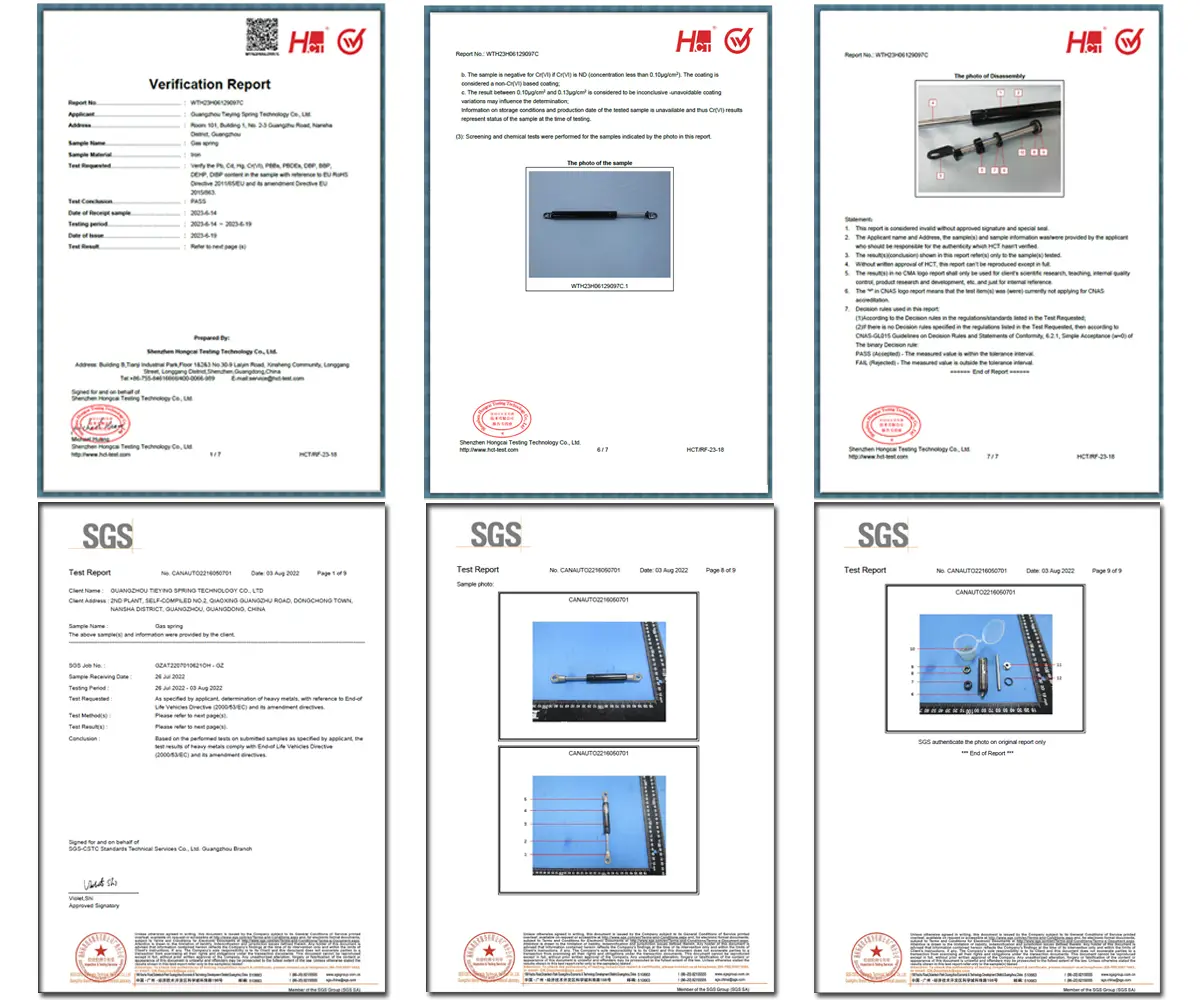
Our factory operates under ISO 9001 and IATF 16949 quality systems. Soft close struts are tested for cycle life, force consistency, leak integrity, and damping performance, with SGS test reports available on request. All products are RoHS and REACH compliant, and every unit undergoes 100% inspection before shipment.
Scalable Capacity & Fast Lead Times
Our Guangzhou facility runs automated assembly lines with an annual output of millions of units. Standard sizes ship quickly for small and bulk orders, while custom prototypes and production runs are delivered on dependable lead times.
Global Export Experience
We supply customers across 56+ countries, including the USA, Germany, Australia, Canada, and the UK, handling export documentation, customs coordination, and flexible shipping terms including DDP to major markets.
Dedicated End-to-End Support
You work with a dedicated account manager and engineering support from initial consultation and samples through after-sales service, with prompt responses to technical and commercial inquiries.
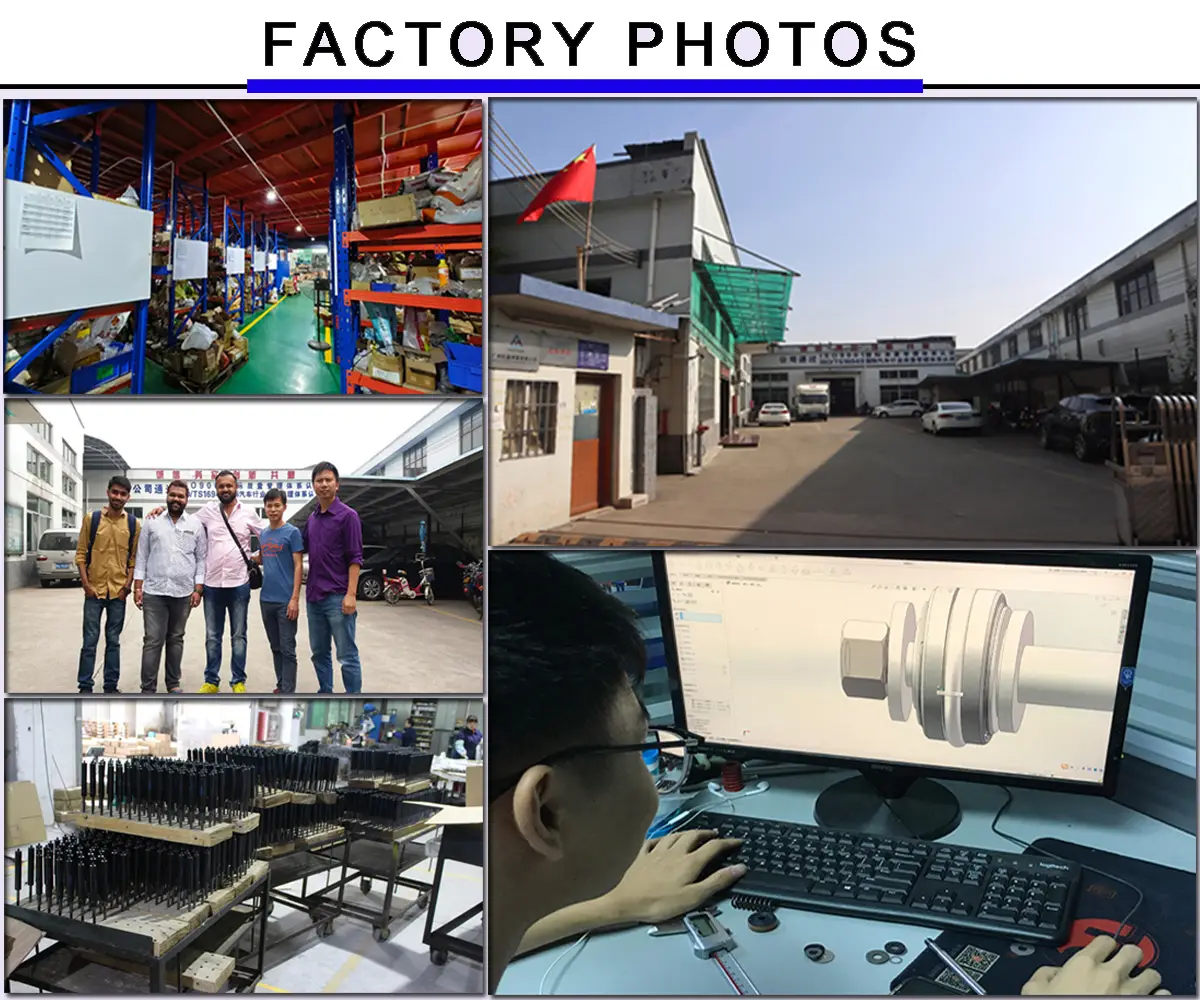

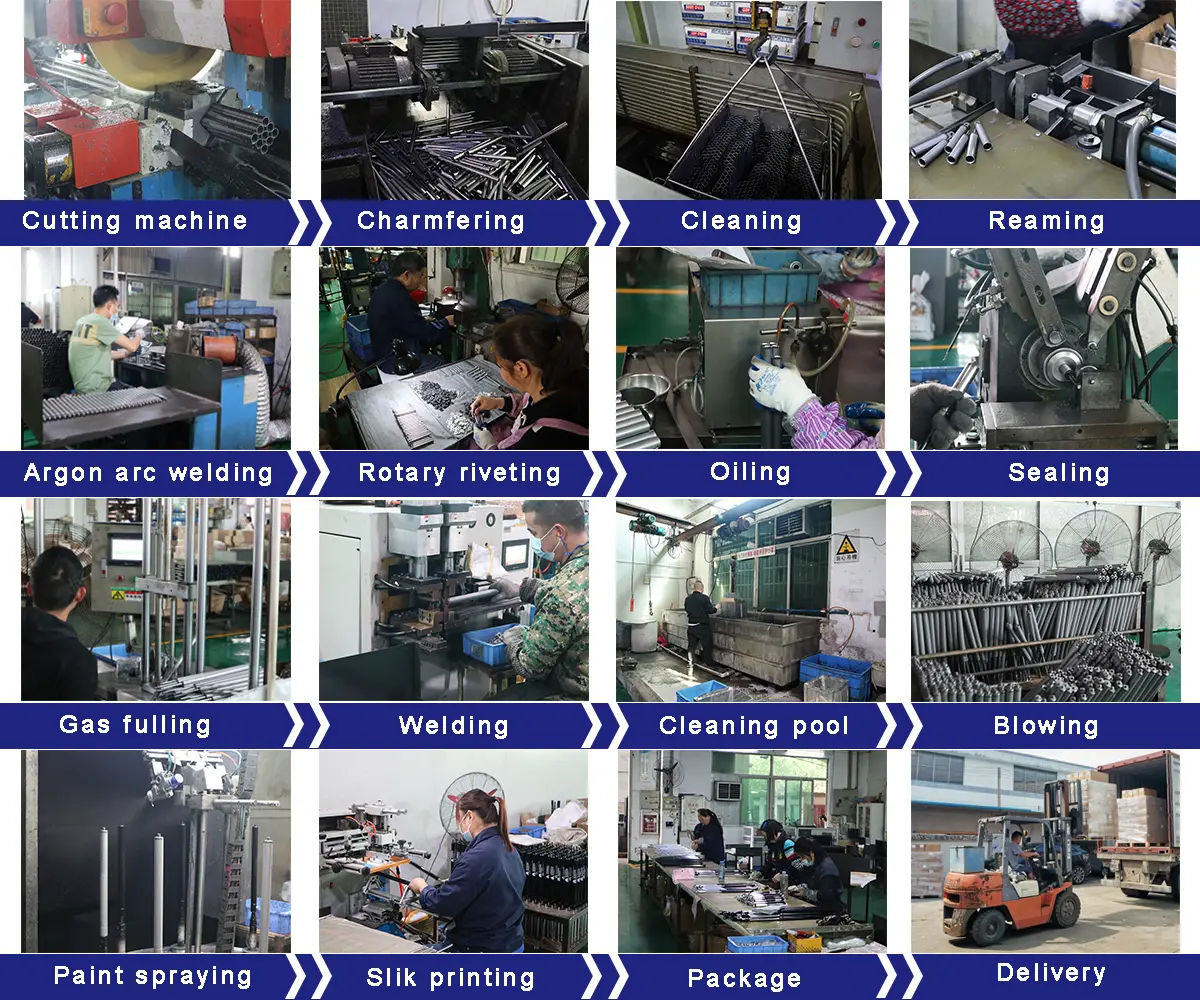
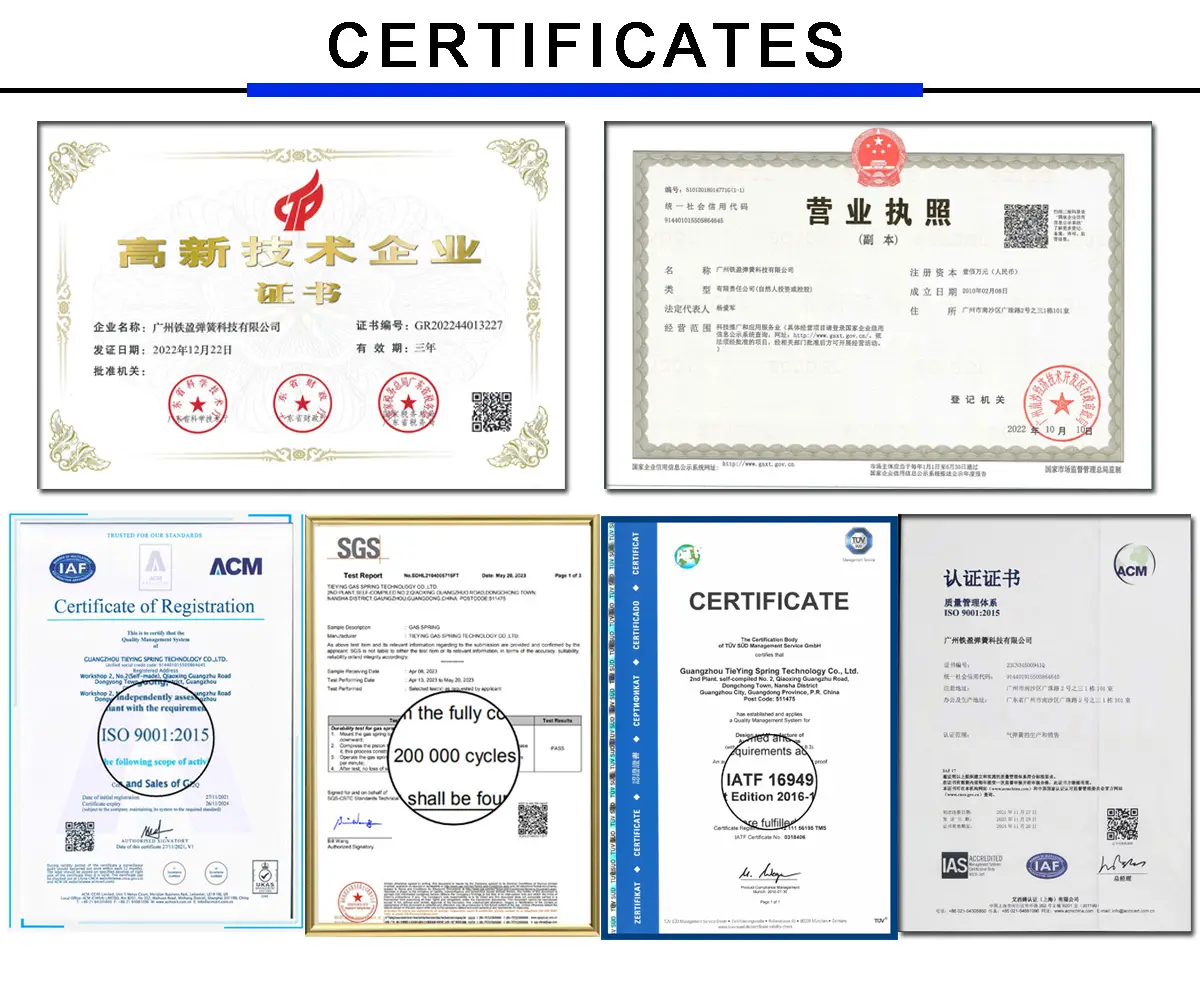
TieYing Factory Video Verified by SGS
Competitive Advantages of TieYing Gas Springs
| Item | TieYing Gas Springs (TieYing Supplier) | Standard Gas Springs (Other Supplier) |
|---|---|---|
| Certificate | SGS 200000 Cycles Durability Test, ROHS, T16949, IS09001 | Maybe just ISO9001 |
| Material | Top seamless steel (Full inspection by Professional testing equipment) | Maybe steel |
| Oil | Anti-wear hydraulic oil from Garmany | Maybe Semi-Synthetic |
| Piston Roughness | Up to Ra 0.696um | Maybe Ra 0.4um |
| Gas spring resistance | 100°C~-40°C | Maybe 60°C |
| Gas | 99.99% nitrogen | Maybe oxygen / Impure nitrogen |
| Uselife | 80,000-200,000 cycles with SGS test report | Maybe 50,000 cycles |
| Salt spray testing | Up to 96 hours | Maybe up to 12 hours |
| Inspection | All procedure sampling inspect, complete inspect before delivery | Maybe sampling inspection |
| Defective product | Re-produce new, If reach 10%, 100% items re-produce new | Maybe Repair |
Frequently Asked Questions (FAQ)
How does a soft close gas strut differ from a regular gas strut?
A regular gas strut provides nitrogen-based lifting and holding force but no controlled damping, so a lid can still slam when released. A soft close gas strut adds an internal hydraulic damping mechanism that regulates closing speed, delivering a slow, quiet, anti-slam, anti-pinch close while still providing full lifting support.
Can a soft close gas strut hold my lid open?
Yes. Like a standard gas strut, the nitrogen charge holds the lid securely in the open position. The soft close feature specifically governs the closing motion; it does not reduce the holding capability. If you need a mechanically locked position, we also offer lockable gas spring models.
Are soft close gas struts safe for children's toy boxes?
Yes — soft close struts are widely used on toy boxes and children’s furniture precisely because the controlled closing reduces the risk of pinched fingers and sudden impact. Correct force and damping sizing is essential, and we recommend units matched to the specific lid weight and geometry.
Can the closing speed be adjusted?
On adjustable soft close models, a regulating screw or valve allows the damping rate and closing speed to be fine-tuned after installation. Fixed-damping units are pre-set at the factory to the specified profile.
How long do soft close gas struts last?
TieYing soft close struts are rated for 150,000+ cycles under normal use. Actual service life depends on load, operating temperature, environment, and maintenance. Proper rod-down orientation and regular cleaning help maximize lifespan.
Do soft close struts work in cold or hot temperatures?
Damping and gas pressure can be affected by temperature, which changes oil viscosity and gas pressure. We offer formulations rated for extended temperature ranges, including low-temperature options, so specify your expected operating environment during selection.
Can you match my existing OEM part number?
Yes. We maintain cross-reference data for many OEM gas spring part numbers and can supply equivalents with matching force, stroke, end fittings, and damping profile. Provide your part number or a sample drawing and our engineering team will confirm the match.
What is the minimum order quantity?
MOQs are flexible. Standard catalog sizes support small batch and sample orders for validation, while fully custom engineered soft close struts typically begin at a low production MOQ. Contact us with your requirements for exact terms.
Can I use a soft close hinge instead of a soft close gas strut?
Soft close hinges work well on light doors but generally provide little or no lifting assistance and cannot hold a heavy lid open. For heavy lids, tool boxes, and equipment covers that need both lift support and controlled closing, a soft close gas strut is the more capable solution.
Get Your Soft Close Gas Strut Quote Today
Whether you need standard slow-close struts, a fully custom dampened gas spring, prototype samples, or high-volume OEM production, TieYing provides a complete solution:
- Free engineering consultation and force/damping calculation
- Samples for fit and closing-speed validation
- Custom end-of-stroke, linear, or adjustable damping profiles
- Competitive factory-direct pricing and dependable lead times
- Global shipping and dedicated after-sales support
Contact our gas spring specialists with your lid weight, dimensions, mounting details, and required closing speed. We’ll respond within 24 hours with a detailed specification and tailored recommendation.