Heavy Duty Gas Struts for Doors – Industrial-Grade Door Gas Springs
Custom High-Force Gas Struts for Heavy Equipment, Machinery, Electrical Enclosures & Vehicle Doors — Factory-Direct from TieYing, Since 2002
Heavy doors are a daily challenge in industrial plants, commercial vehicles, and machinery: they are too heavy to lift comfortably, too dangerous to let fall, and too punishing on hinges when unsupported. Heavy duty gas struts for doors solve exactly this problem — they are high-force gas springs engineered to lift, hold, and control doors from roughly 30 kg up to 250 kg and beyond, with smooth damping that protects both the operator and the door structure.
As a 23-year OEM gas spring manufacturer, TieYing designs and builds custom heavy duty door gas struts with force ratings from 500 N to 5,000 N+, reinforced cylinders, and application-specific end fittings — delivered factory-direct for OEMs, distributors, and industrial buyers worldwide.
What Is a Heavy Duty Gas Strut for Doors?
A heavy duty gas strut for doors is a sealed, self-contained pneumatic cylinder that uses compressed nitrogen gas to generate a controlled pushing force. It replaces the raw muscle and unmanaged weight of a heavy door with a balanced lifting system that:
- Reduces the force needed to open the door by up to 80%
- Holds the door securely at the fully open position
- Dampens the closing movement to prevent slamming
- Relieves continuous stress from hinges, frames, and mounting points
Where a standard door gas shock tops out around 500 N, a heavy duty door gas strut is built with a larger cylinder (Ø28–40 mm), a thicker hard-chrome or nitride piston rod (Ø12–20 mm), and higher nitrogen pressure — delivering 500 N to 5,000 N+ of reliable force over 100,000+ cycles.
Heavy Duty vs. Standard Door Gas Struts: What's the Difference?
| Parameter | Standard Door Gas Shock | Heavy Duty Door Gas Strut |
|---|---|---|
| Typical Force Range | 50 N – 500 N | 500 N – 5,000 N+ (custom to 8,000 N) |
| Cylinder Diameter | 15 / 18 / 22 mm | 28 / 35 / 40 mm |
| Piston Rod Diameter | 6 / 8 / 10 mm | 12 / 14 / 16 / 20 mm |
| Stroke Length | 50 – 500 mm | 100 – 800 mm (extended on request) |
| Typical Door Weight | Under 30 kg | 30 – 250 kg+ |
| Recommended Applications | Cabinets, furniture, light access panels | Machine guards, enclosure doors, vehicle luggage doors, heavy panels |
| Cycle Life | 200,000+ cycles | 100,000 – 200,000+ cycles (SGS tested) |
| End Fittings | Ball joint, eyelet, bracket | Clevis, ball stud, flange bracket, threaded, custom |
| Materials | Seamless carbon steel | High-strength seamless steel, stainless 304/316 option |
Why Heavy Doors Fail Without a Gas Strut System?
A heavy door without gas struts does not just feel heavy — it actively damages itself and puts people at risk:
- Hinge and frame fatigue. An unsupported 80 kg door concentrates its full weight on two or three hinge points. Over time, hinges bend, welds crack, and the door sags permanently.
- Sudden, uncontrolled movement. Wind, vibration, or a slight push can send a heavy door swinging or slamming, with enough force to injure hands and fingers.
- Operator strain. Repeatedly lifting a heavy door is a leading cause of workplace strain injuries, especially in maintenance and logistics roles.
- Premature seal and latch wear. Misaligned, sagging doors cause seals, gaskets, and latches to wear unevenly and leak.
A properly engineered heavy duty door gas strut system eliminates these failure modes: it carries most of the door’s weight, controls the motion, and locks the door safely in the open position.
How Heavy Duty Door Gas Struts Work?
The working principle is the same as any gas spring, but scaled for load:
- Energy storage. When the door is closed, the piston rod is pushed into the cylinder, compressing the nitrogen gas and storing energy.
- Lifting assistance. As the door opens, the compressed gas pushes the rod outward, counterbalancing the door’s weight so the operator needs only minimal effort.
- Hold-open. At full extension, the strut’s force is still high enough to hold the door open against its own weight and moderate wind loads.
- Controlled closing. Precision damping in the piston meters the gas flow, so the door closes smoothly instead of free-falling.
Why rod-down mounting matters. On upward-opening doors, the strut should be installed with the piston rod pointing downward when the door is closed. This keeps the rod’s seals lubricated, ensures consistent damping, and dramatically extends service life.
The over-center principle. To prevent a heavy door from opening itself (or slamming shut on its own), the strut’s mounting line must pass just beyond the hinge centerline when the door is closed. Our engineers calculate this geometry for every application — it is one of the most common causes of field failures when done wrong.
Heavy Duty Door Gas Strut Applications by Industry
TieYing supplies heavy duty door gas struts across industries where door weight, duty cycles, and environment demand more than a standard strut.
1. Industrial Machinery & Equipment Doors
- CNC and lathe machine guard doors
- Press and machine safety covers
- Electrical cabinet and control panel doors
- Automation enclosure access panels
Typical door weight: 30–80 kg · Recommended: 2 × 600–1,200 N struts
2. Power & Electrical Enclosures
- Transformer cabinet doors
- Generator set (genset) enclosure doors
- Switchgear and distribution panel doors
- Substation access doors
Typical door weight: 40–120 kg · Recommended: 2 × 800–1,800 N struts
3. Commercial Vehicle Doors
- Bus and coach luggage compartment doors
- Truck body side and rear doors
- Reefer (refrigerated) box doors
- Van and delivery vehicle rear doors
Typical door weight: 40–100 kg · Recommended: 2 × 800–1,500 N struts
4. Agricultural & Construction Equipment Doors
- Tractor hood and engine covers
- Combine harvester access doors
- Excavator cab and engine compartment doors
- Loader and dozer service doors
Typical door weight: 30–150 kg · Recommended: 2 × 600–2,400 N struts
5. Marine & Offshore Access Doors
- Engine room access doors
- Deck hatches and bulkhead doors
- Jet ski and boat storage compartments
For saltwater environments, choose our stainless steel gas struts with 316-grade construction and 96-hour salt spray certification.
6. Food, Pharma & Cleanroom Doors
- Washdown-rated equipment doors
- Stainless processing machinery doors
- Cleanroom panel and access doors
Requires full stainless construction, smooth surfaces, and FDA-compatible seals for hygiene-critical environments.
7. Other Heavy Access Doors
- Server room floor access panels
- Mining and quarry equipment doors
- Airport ground support equipment (GSE) doors
- Heavy gates and service hatches
Heavy Duty Door Gas Strut Technical Specifications
| Specification | Heavy Duty Series | Extreme Series (Custom) |
|---|---|---|
| Force Range | 500 N – 5,000 N | Up to 8,000 N+ |
| Stroke Length | 100 – 800 mm | Extended on request |
| Extended Length | 250 – 1,200 mm | Custom per application |
| Cylinder Diameter | Ø28 / Ø35 / Ø40 mm | Ø40 mm+ reinforced |
| Piston Rod Diameter | Ø12 / Ø14 / Ø16 mm | Ø20 mm+ |
| Rod Finish | Hard chrome / black nitride | Corrosion-resistant options |
| Body Material | High-strength seamless steel | Stainless 304/316 |
| Working Temperature | -30°C to +80°C | High-temp version to +120°C |
| Cycle Life | 100,000+ cycles | 200,000+ (SGS tested) |
| Salt Spray Resistance | Up to 96 hours | Stainless: marine grade |
| Gas Purity | 99.99% nitrogen | — |
| End Fittings | Clevis, ball stud, eyelet, threaded, flange, custom bracket | OEM fittings accepted |
Force Selection Guide: How Much Force Does a Heavy Door Need?
Use this table as a starting point for typical upward-opening doors with standard mounting geometry. Final force depends on mounting position, opening angle, and door balance — send us your door specifications for a precise calculation.
| Door Weight | Struts per Door | Force per Strut | Recommended Rod / Cylinder |
|---|---|---|---|
| 30 – 50 kg | 2 | 500 – 800 N | Ø12 / Ø28 mm |
| 50 – 80 kg | 2 | 800 – 1,200 N | Ø14 / Ø28–35 mm |
| 80 – 120 kg | 2 | 1,200 – 1,800 N | Ø14 / Ø35 mm |
| 120 – 180 kg | 2 | 1,800 – 2,600 N | Ø16 / Ø35–40 mm |
| 180 – 250 kg | 2 | 2,600 – 3,600 N | Ø16–20 / Ø40 mm |
| 250 kg+ | 2 – 4 | 3,600 N+ per strut | Custom engineered |
Rule of thumb: always use two struts (one per side) on heavy doors — a single strut creates asymmetric load and shortens hinge life. For doors wider than 1.2 m or with offset centers of gravity, use four struts or consult our engineering team.
Sizing Formula & Mounting Rules for Heavy Doors

Force calculation
F = (W × d) / (n × h) × SF
- F = required force per strut (Newtons)
- W = door weight (kg × 9.81 = N)
- d = horizontal distance from hinge to the door’s center of gravity (mm)
- h = perpendicular distance from hinge to the strut’s centerline (mm) — your leverage
- n = number of struts
- SF = safety factor, typically 1.1 – 1.25 for reliable hold-open
Critical mounting rules
- Rod down when closed — keeps seals lubricated and damping consistent.
- Over-center geometry — the strut line must pass just beyond the hinge centerline when closed, so the door stays closed and doesn’t self-open.
- Reserve stroke — leave approximately 10 mm of unused stroke at full compression to prevent bottoming out.
- Avoid side loading — gas struts are designed for axial force only; misalignment causes premature rod and seal wear.
- Balance in pairs — both struts must have matched force ratings; replace in pairs, never one at a time.
- Secure the door before servicing — always support a heavy door fully before removing or installing struts.
Custom Engineering & OEM Support
Every heavy door is different — weight, hinge position, opening angle, environment, and duty cycle. TieYing’s in-house engineering team designs the strut around your door, not the other way around:
- Custom force tuning from 500 N to 5,000 N+ with ±5% precision
- Custom dimensions — stroke, extended length, and tube/rod sizes
- End fittings & brackets — clevis, ball stud, eyelet, threaded, flange, and custom brackets, including our full range of gas spring end fittings
- Surface treatment — zinc, black oxide, white epoxy, or stainless
- OEM / ODM & private labeling for brands and distributors
- Flexible MOQ — samples of 1–20 pcs for evaluation; standard MOQ from 100 pcs per model
Why Choose TieYing for Heavy Duty Door Gas Struts?
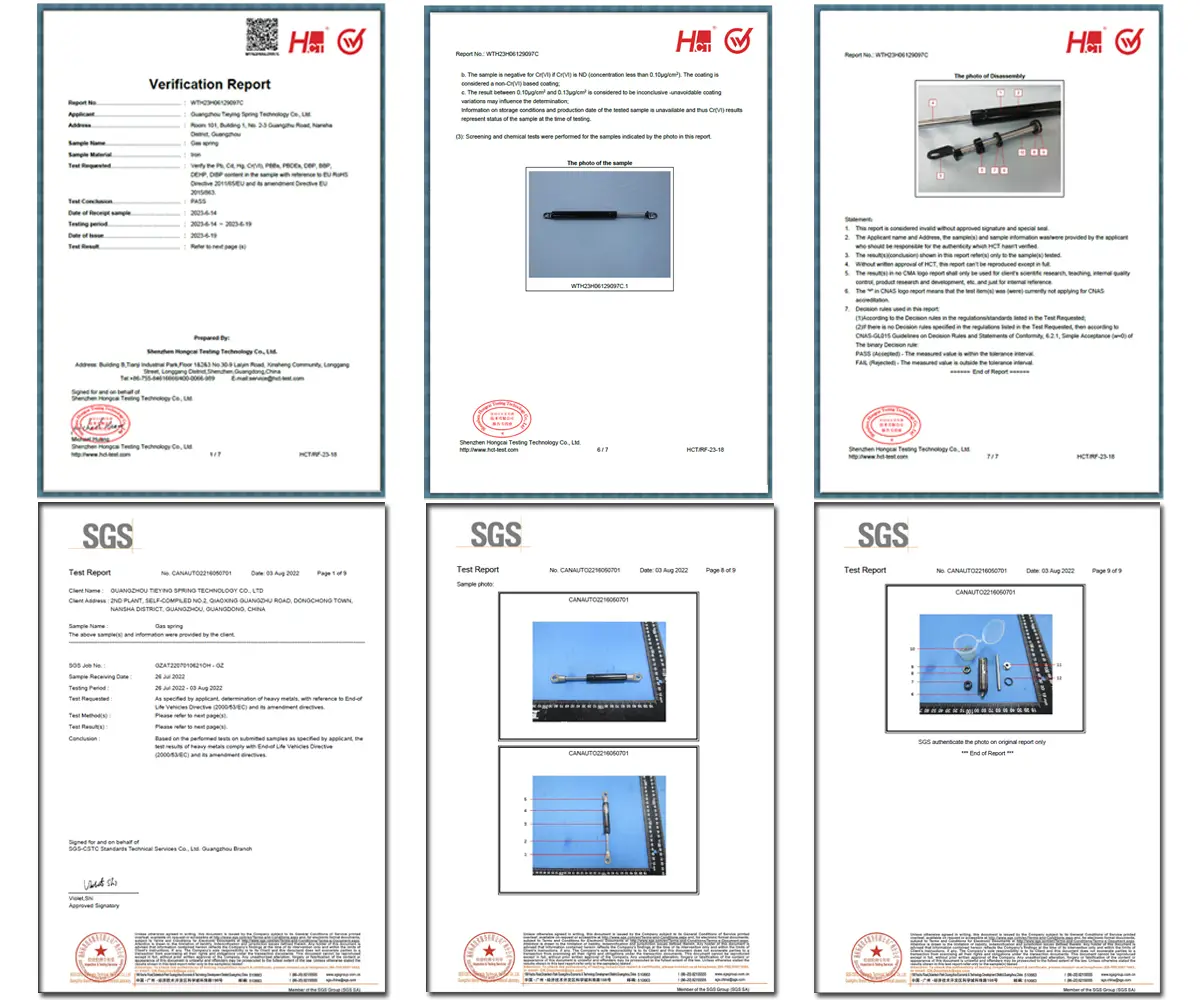
- 23+ years of gas spring manufacturing since 2002, IATF 16949 and ISO 9001 certified, with a factory verified by SGS
- SGS 200,000-cycle durability test — heavy duty door struts rated for 100,000–200,000+ cycles
- 99.99% pure nitrogen with anti-wear hydraulic oil for consistent force over the product’s life
- Precision machining — piston surface roughness up to Ra 0.696 µm for smooth, leak-free operation
- Temperature resistance from -40°C to +100°C (high-temp option to +120°C)
- Salt spray tested up to 96 hours — suitable for outdoor and coastal installations
- 100% pressure and leak testing before delivery, complete inspection on every batch
- Global exports to North America, Europe, Australia, the Middle East and beyond, with quotes within 24 hours
TieYing Factory Photos Show
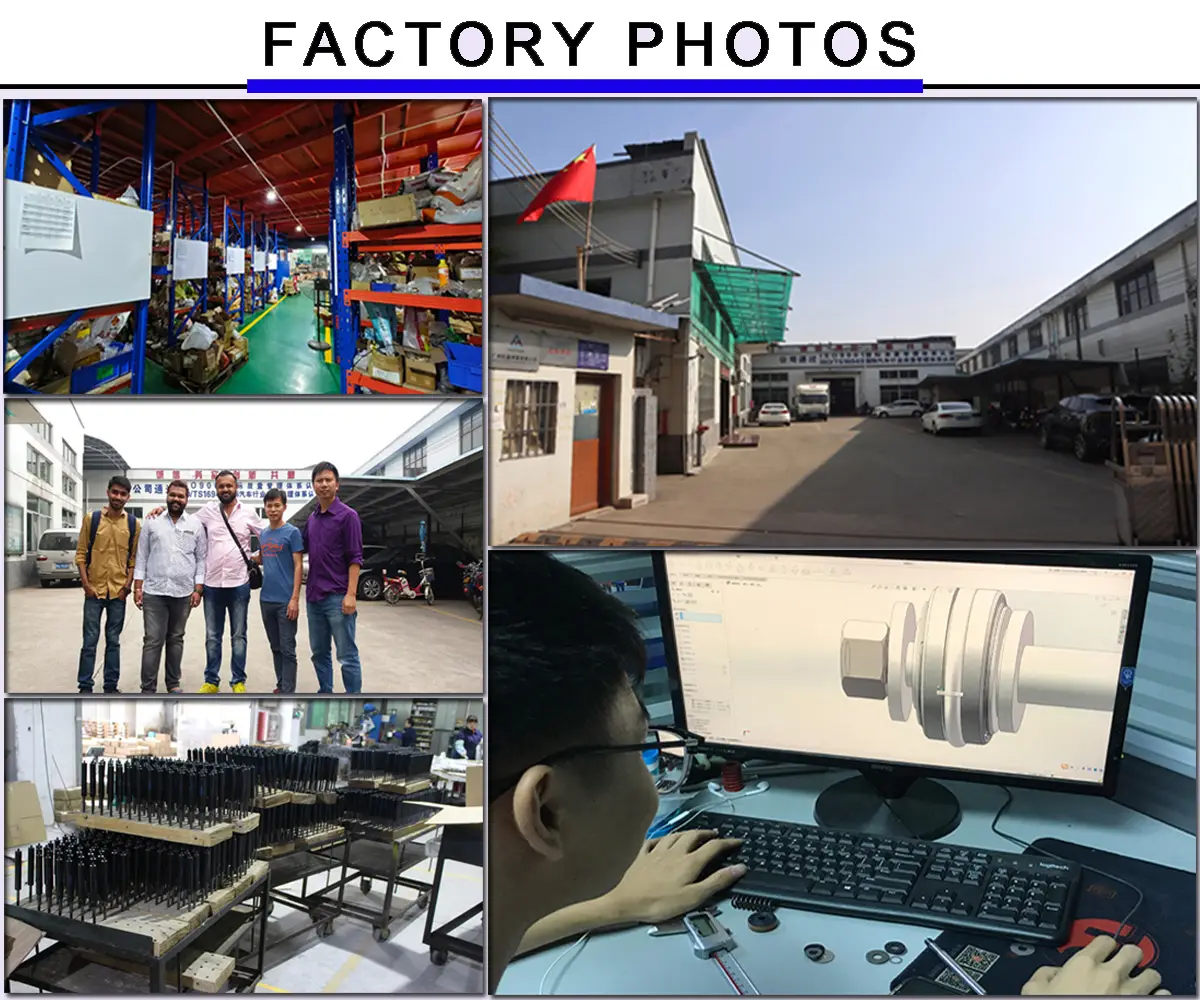
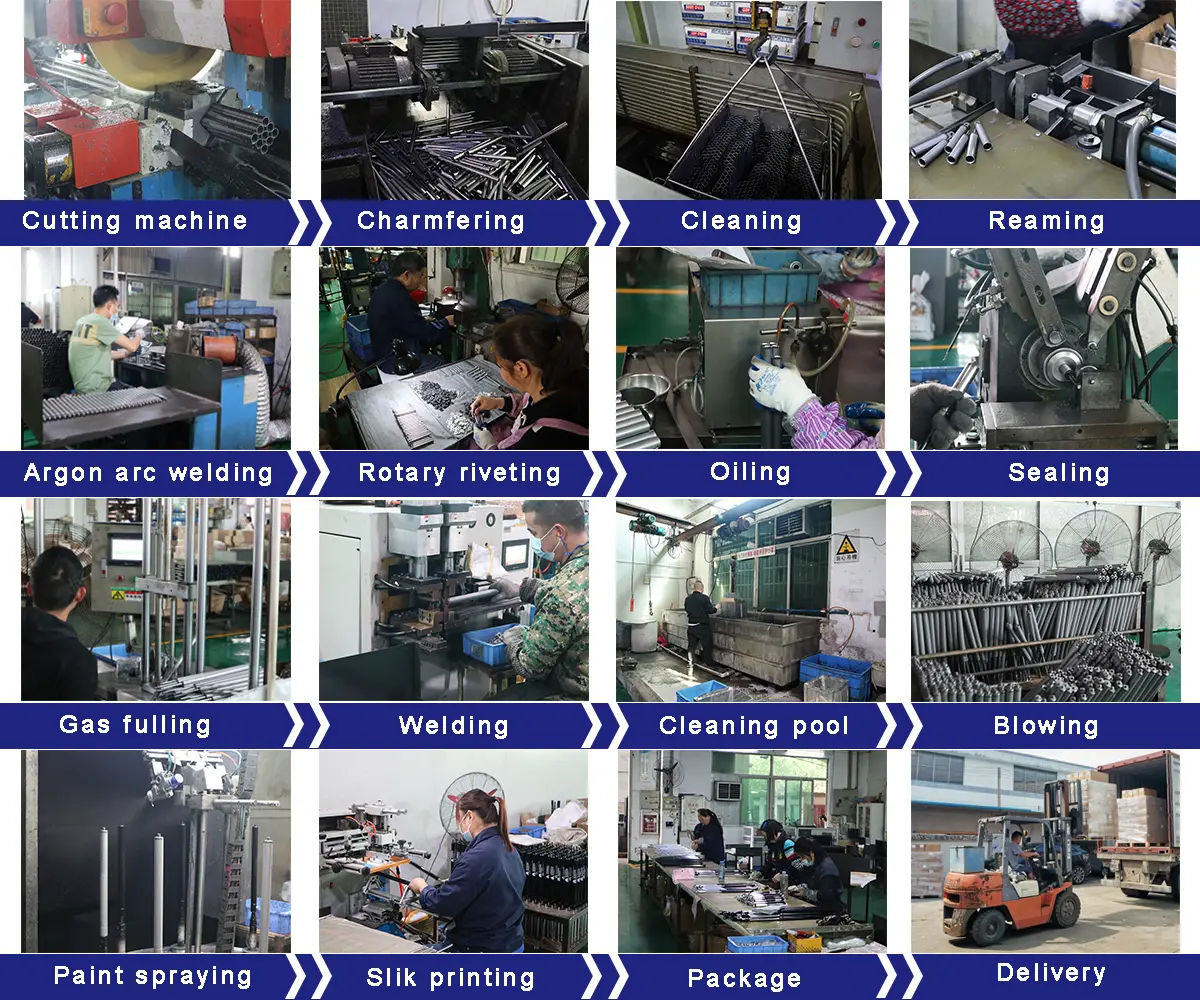
TieYing Factory Gas Springs Production Flow

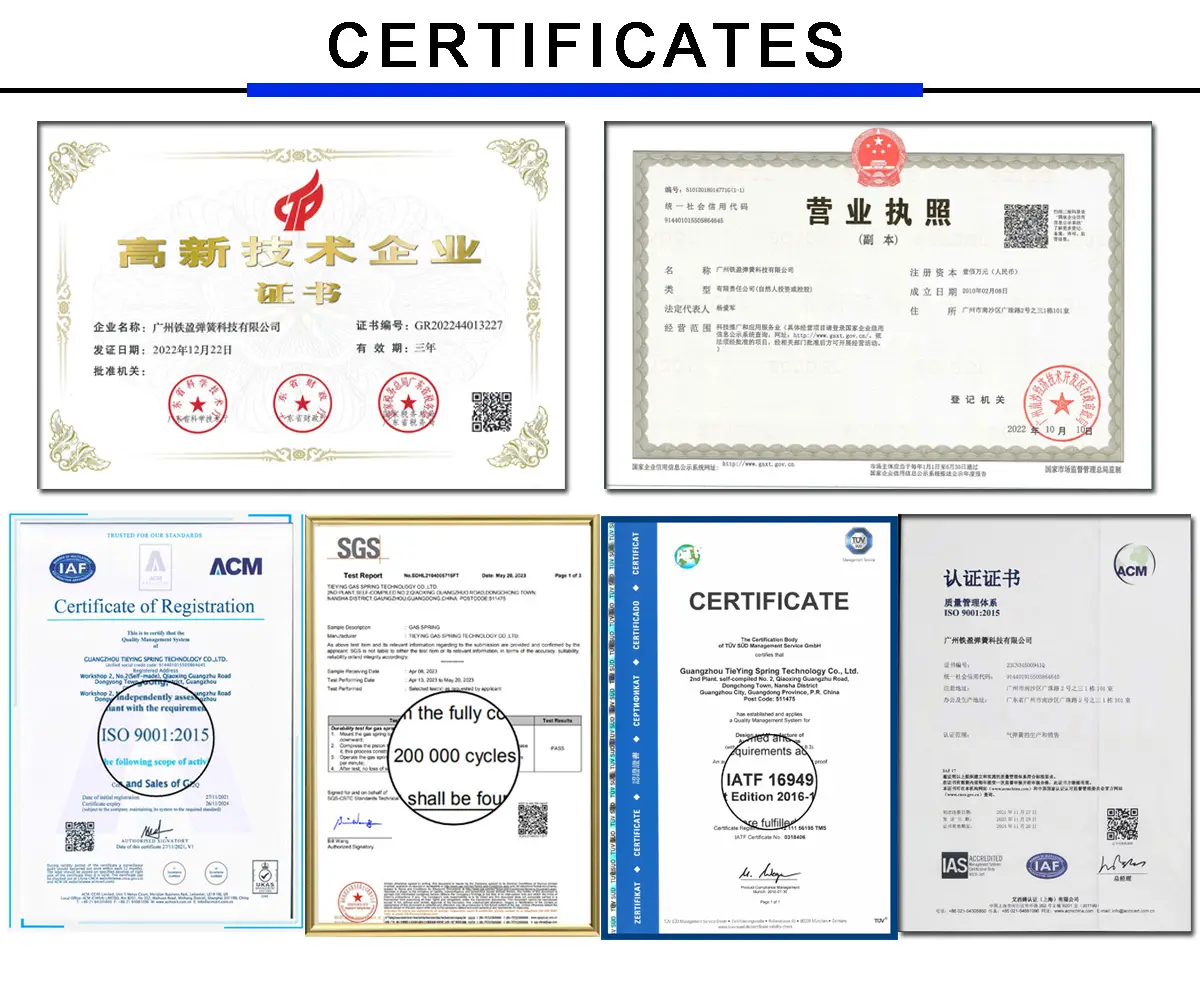
TieYing Factory Certifications & Quality Assurance
Factory Management System Certifications:
ISO 9001 – Quality Management System;IATF 16949 – Automotive Quality Management System
Product Testing & Compliance:
SGS – 200,000-Cycle Durability Test;RoHS – Restriction of Hazardous Substances
TieYing Factory Video Verified by SGS
Competitive Advantages of TieYing Factory Gas Springs
| Item | TieYing Gas Springs | Standard Gas Springs (Other Supplier) |
|---|---|---|
| Certificate | SGS 200000 Cycles Durability Test, ROHS, T16949, IS09001 | Maybe just ISO9001 |
| Material | Top seamless steel (Full inspection by Professional testing equipment) | Maybe steel |
| Oil | Anti-wear hydraulic oil from Garmany | Maybe Semi-Synthetic |
| Piston Roughness | Up to Ra 0.696um | Maybe Ra 0.4um |
| Gas spring resistance | 100°C~-40°C | Maybe 60°C |
| Gas | 99.99% nitrogen | Maybe oxygen / Impure nitrogen |
| Uselife | 80,000-200,000 cycles with SGS test report | Maybe 50,000 cycles |
| Salt spray testing | Up to 96 hours | Maybe up to 12 hours |
| Inspection | All procedure sampling inspect, complete inspect before delivery | Maybe sampling inspection |
| Defective product | Re-produce new, If reach 10%, 100% items re-produce new | Maybe Repair |
Frequently Asked Questions About Heavy Duty Door Gas Struts
How much weight can a heavy duty door gas strut support?
With two struts, a standard heavy duty setup supports doors from 30 kg to 250 kg. For heavier doors — up to 400 kg+ — we engineer custom multi-strut systems with larger cylinders and higher force.
Can one heavy duty gas strut hold a door open?
Technically yes, but we strongly recommend two struts for doors over 30 kg. A single strut applies asymmetric force that stresses hinges and causes the door to twist over time.
What force do I need for a 100 kg door?
For a typical side-hinged, upward-opening door with standard mounting geometry, use 2 × 1,200–1,800 N struts. The exact value depends on the distance from the hinge to the door’s center of gravity and the strut mounting position — send us your dimensions and we will calculate it for free.
What is the difference between a gas shock and a heavy duty gas strut for doors?
A standard gas shock (50–500 N) is sized for cabinets and light access panels. A heavy duty gas strut (500–5,000 N+) uses larger cylinder and rod diameters, higher nitrogen pressure, and reinforced fittings to carry industrial door loads with the same smooth, controlled motion.
How long do heavy duty door gas struts last?
Our heavy duty struts are tested to 100,000–200,000 cycles with an SGS durability report. In a typical industrial door used 20–30 times a day, that translates to 10–20 years of service.
Can heavy duty door gas struts be used outdoors?
Yes. Specify zinc, black oxide, or full stainless 304/316 construction, and our 96-hour salt spray tested struts will hold up in coastal, humid, or washdown environments.
Get Custom Heavy Duty Gas Struts for Your Doors
Tell us about your door and our engineers will design the right strut system — force, stroke, fittings, and finish — and send you a factory-direct quote within 24 hours.
What we need from you:
- Door weight and dimensions (or material + thickness)
- Hinge position and opening angle
- Mounting space constraints
- Environment (indoor / outdoor / marine / washdown)
- Quantity and target price