Custom Hatch Gas Struts for Industrial Access Hatches
Access hatches provide essential entry points to concealed spaces, machinery, service areas and building infrastructure. Whether installed in industrial floors, equipment enclosures, ceilings or maintenance compartments, these hinged panels must be easy to operate while providing reliable access when inspection or servicing is required.
However, large or heavy access hatches can be difficult to lift manually. Without suitable support, a raised hatch may become unstable, place excessive loads on its hinges or create an uncomfortable working environment for maintenance personnel.
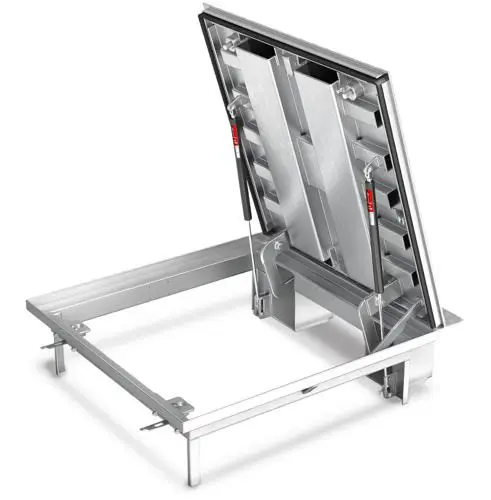
TieYing manufactures custom hatch gas struts designed to assist the opening of hinged access hatches and support controlled panel movement. By matching gas spring force, stroke length, mounting geometry and end fittings to the actual hatch design, we help equipment manufacturers develop practical and reliable access solutions.
As an experienced gas spring manufacturer since 2002, TieYing provides OEM and ODM manufacturing support for industrial equipment builders, access hatch manufacturers, engineering companies and global distributors.
Looking for a custom gas strut for your access hatch? Send us your hatch drawings, dimensions or existing gas spring specifications for technical evaluation.
Gas Struts Designed for Different Hatch Applications
Not all access hatches operate in the same way. Some are installed horizontally in floors, while others open upwards from ceilings or vertically from equipment enclosures.
The hatch structure, opening direction, installation environment and available mounting space all influence the gas spring configuration.
TieYing supports different hinged hatch applications, including:
1. Floor Access Hatch Gas Struts
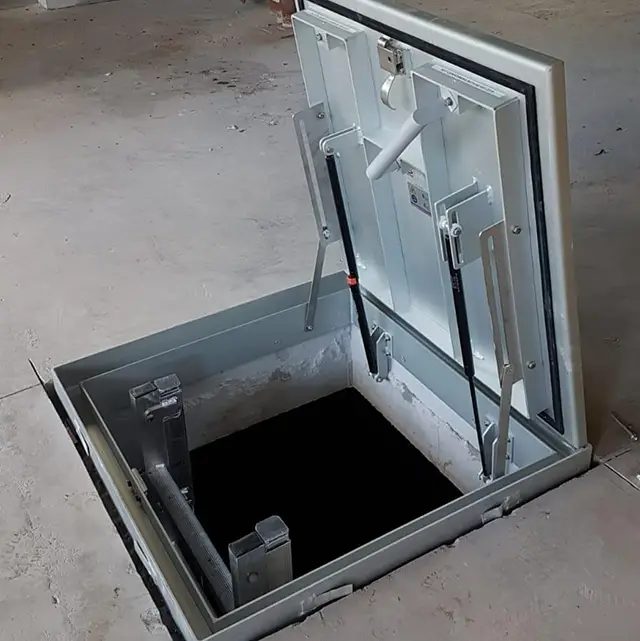
Floor access hatches provide entry to underground service areas, utility chambers, cable trenches, inspection pits and building maintenance spaces.
These panels are often manufactured from steel, aluminium or reinforced materials and may incorporate additional frames, handles and surface finishes.
Gas struts can assist the lifting movement of suitable hinged floor hatches, reducing the physical effort required to raise the panel.
Important design considerations include:
- Total hatch weight, including reinforcement and attached hardware.
- Available clearance beneath the floor surface.
- Hinge position and opening direction.
- Required opening angle and maintenance clearance.
- Bracket strength and structural mounting points.
- A suitable independent safety locking arrangement for personnel access.
For floor-mounted systems, the installation must also avoid interference with surrounding flooring, sealing components and structural supports.
2. Roof and Ceiling Access Hatch Gas Struts

Roof and ceiling access hatches are commonly used in commercial buildings, industrial facilities and mechanical service areas.
These openings provide access to rooftop equipment, ventilation systems, electrical installations and concealed building services.
Depending on the design, the hatch may open upwards from a horizontal position or swing through a defined arc from a vertical mounting surface.
Gas struts help reduce the effort needed to raise the panel and provide support during routine access.
For these applications, the gas spring configuration should account for:
- Panel weight and overall dimensions.
- Roof or ceiling mounting orientation.
- Available space around the hatch frame.
- Wind exposure and outdoor operating conditions.
- Required opening angle and access clearance.
- Temperature and moisture exposure.
A properly engineered arrangement helps integrate the lifting mechanism without compromising the hatch’s intended operation.
3. Industrial Inspection Hatch Gas Struts
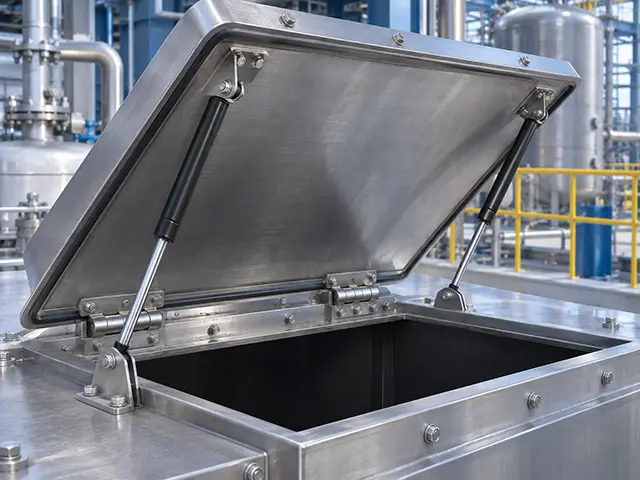
Industrial inspection hatches allow operators and maintenance technicians to access internal machinery, processing equipment and enclosed mechanical systems.
These panels may be opened during equipment inspections, cleaning procedures, component replacement and scheduled maintenance.
A suitable gas strut arrangement can make frequent access more convenient by assisting panel movement and reducing the need for manual holding.
Depending on the machine design, manufacturers may require:
- Compact gas springs for restricted installation areas.
- Higher force ratings for reinforced metal access panels.
- Matched gas struts for wider inspection covers.
- Suitable mounting brackets for machine frames.
- Material and surface finishes compatible with the operating environment.
For machine builders, the gas spring should be incorporated into the enclosure design early enough to verify its movement and clearance throughout the opening cycle.
4. Utility and Infrastructure Access Hatch Gas Struts

Utility and infrastructure systems often contain concealed equipment that requires periodic inspection or maintenance.
Access hatches may be installed in service enclosures, mechanical installations, electrical infrastructure and technical equipment compartments.
Gas struts can provide lifting assistance where the access cover uses a suitable hinged opening mechanism.
For these installations, the design should consider the relationship between the gas spring and nearby electrical components, cables, pipes, insulation and structural members.
The selected configuration should also account for the operating environment, particularly where the enclosure is exposed to humidity, dust or outdoor conditions.
5. Machinery and Equipment Service Hatches
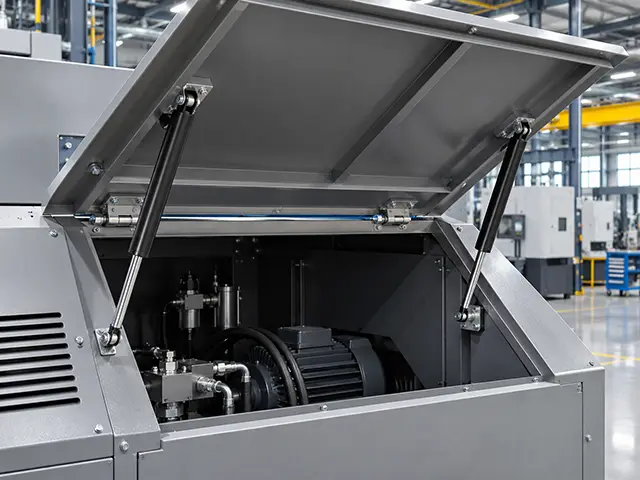
Specialised machinery frequently incorporates hinged service hatches that provide access to internal components without requiring the removal of the complete equipment cover.
These access points are important for routine servicing, inspection and troubleshooting.
A customised gas spring can help support the hatch during maintenance and make repeated opening operations easier for technicians.
Depending on the equipment design, TieYing can discuss gas spring configurations based on the required force, stroke, installation dimensions and mounting connections.
How Do Hatch Gas Struts Work?
A hatch gas strut is a mechanical support component that uses pressurised nitrogen gas inside a sealed cylinder to generate extension force.
When installed between a fixed structure and a hinged hatch, the gas spring works against the rotational force created by the hatch’s weight.
This helps reduce the effort needed to raise the panel and can support it in its intended open position when the force and mounting geometry are correctly selected.
The mechanism generally performs three functions:
Assisted Hatch Opening
When an operator begins lifting the hatch, the gas spring extends and contributes an upward supporting force.
This reduces the manual effort needed to move the panel, particularly when the hatch is relatively large or installed in a difficult-to-reach position.
Supporting the Open Position
Once the hatch reaches its intended opening angle, the gas spring provides supporting force to help counterbalance the panel.
The actual holding behaviour depends on the gas spring force, mounting locations, hatch geometry and external loads.
For applications where the hatch must remain positively secured while personnel work underneath or inside the opening, an independent mechanical locking device or safety support must be provided.
Controlled Closing Movement
When the hatch is lowered, the gas spring compresses as the panel rotates towards its closed position.
The gas spring influences the movement throughout this process. However, a standard compression gas spring should not automatically be considered a soft-close damper.
Where a specific closing speed or impact reduction is required, a suitable damping component or engineered closing mechanism should be evaluated separately.
Key Engineering Considerations for Hatch Gas Struts
Designing a suitable hatch gas spring requires more than selecting a component based on the panel’s weight.
The gas spring must work with the hatch’s complete mechanical arrangement, including the hinge, frame, mounting brackets and available movement space.Hatch Orientation and Opening Direction
The opening direction determines how gravity acts on the moving panel and how effectively the gas spring can assist its movement.A horizontally mounted floor hatch, an upward-opening roof hatch and a vertically mounted equipment access panel may require different gas spring arrangements.The mounting geometry should be evaluated according to the actual installation orientation rather than assuming one configuration will suit every hatch.Hatch Weight and Centre of Gravity
The total moving weight includes more than the main panel.Reinforcement plates, insulation, handles, attached hardware and other moving components must also be considered.The centre of gravity determines how the hatch’s weight acts around the hinge axis.Two access hatches with identical weights can require different gas spring forces if their dimensions or weight distributions differ.Mounting Position and Available Space
The distance between the hatch hinge, gas spring mounting points and cylinder body influences the leverage available throughout the opening movement.The gas spring must fit within the available space in both the fully closed and fully open positions.Engineers should check for possible interference with:- Hatch frames and hinges.
- Electrical wiring and internal components.
- Insulation and sealing materials.
- Adjacent equipment and structural supports.
- Handles, locking mechanisms and access hardware.
Structural Strength and Bracket Loading
Gas springs apply force to both the moving hatch and its supporting structure.The mounting brackets, fasteners, hatch reinforcement and surrounding frame must be suitable for the loads generated during operation.For wider access panels using two gas springs, symmetrical positioning and appropriate structural reinforcement help reduce uneven loading and unwanted panel twisting.Environmental Conditions
Industrial and building access hatches may operate in environments with different temperature, moisture and contamination levels.Material selection and surface protection should be considered according to the installation conditions.For example, equipment installed outdoors or in humid environments may require additional corrosion protection compared with a gas spring used inside a controlled industrial facility.Choosing the Right Gas Spring for Your Hatch
Selecting the correct hatch gas strut involves several technical parameters.
TieYing recommends evaluating the following information before confirming the final specification.
| Selection factor | What needs to be considered |
|---|---|
| Hatch weight | Complete moving assembly, including accessories |
| Hatch dimensions | Width, length and panel thickness |
| Centre of gravity | Position of the moving mass relative to the hinge |
| Opening angle | Required travel and final open position |
| Force rating | Required gas spring force in Newtons (N) |
| Stroke length | Piston rod travel required for the mechanism |
| Extended length | Overall fitting-to-fitting dimension when extended |
| Compressed length | Available installation length when compressed |
| Mounting points | Bracket positions and connection geometry |
| End fittings | Ball sockets, eyelets, fork ends or custom connections |
| Environment | Temperature, humidity, corrosion and contamination |
| Functional requirements | Lifting, positioning, locking or damping |
Gas Spring Force Calculation

The required gas spring force should be calculated using the hatch’s weight, centre of gravity, hinge position, mounting geometry and number of gas springs.
The basic engineering principle is to balance the rotational moment created by the hatch against the supporting moment generated by the gas springs.
For a simplified static calculation at a particular hatch angle:
Hatch moment:
M = m × g × r
Gas spring supporting moment:
M = n × F × d
Where:
- m = Total moving hatch mass.
- g = Gravitational acceleration.
- r = Horizontal distance from the hinge axis to the hatch’s centre of gravity.
- n = Number of gas springs.
- F = Force generated by each gas spring.
- d = Perpendicular distance from the hinge axis to the gas spring’s line of action.
The effective lever arm changes as the hatch rotates. Therefore, a force that appears suitable at the fully open position may not provide the required assistance near the beginning of the opening movement.
Real-world sizing must also consider the full movement range, desired operating effort, friction and operating conditions.
This is why TieYing recommends reviewing the full opening and closing path before confirming the gas spring specification.
Single or Dual Gas Spring Configuration?
Smaller hatches may be suitable for a single gas spring, depending on their construction and mounting geometry.
Wider or heavier panels may benefit from a pair of gas springs installed on opposite sides.
A dual arrangement can distribute support more evenly and help control unwanted twisting, provided that the hatch structure and mounting points are designed for the resulting forces.
The final configuration should be established through application-specific engineering assessment.
Gas Spring Types for Different Hatch Requirements
Different hatch mechanisms may require different gas spring functions.
Compression Gas Springs
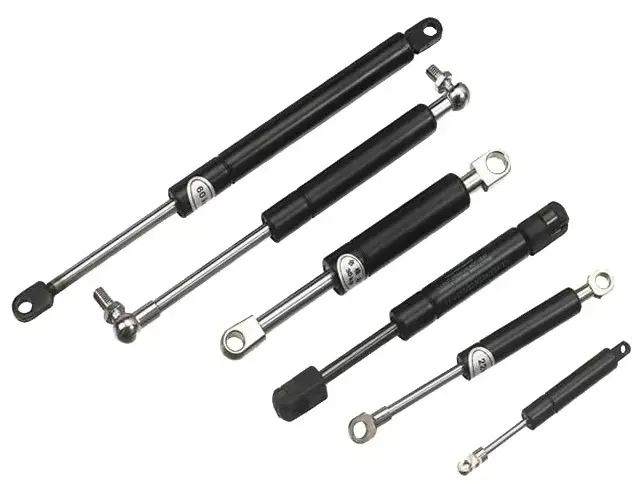
Compression gas springs are commonly used in upward-opening hinged hatches.
They generate extension force to assist lifting and provide counterbalancing support throughout the intended movement range.
They are a practical option for many industrial inspection covers, service hatches and equipment access panels.
Locking Gas Springs
Locking gas springs are suitable for designs that require additional positioning or locking functionality.
Depending on the locking mechanism, they can help maintain a selected position rather than relying exclusively on ordinary extension force.
The required locking direction, operating method and load conditions should be established during product selection.
Gas Dampers
Gas dampers are used when the main requirement is to control movement speed rather than provide significant lifting assistance.
For certain hatch applications, a damper may be incorporated into the mechanism to reduce sudden movement or excessive closing speed.
The correct solution depends on the required damping direction and movement characteristics.
Heavy Duty and Stainless Steel Gas Struts
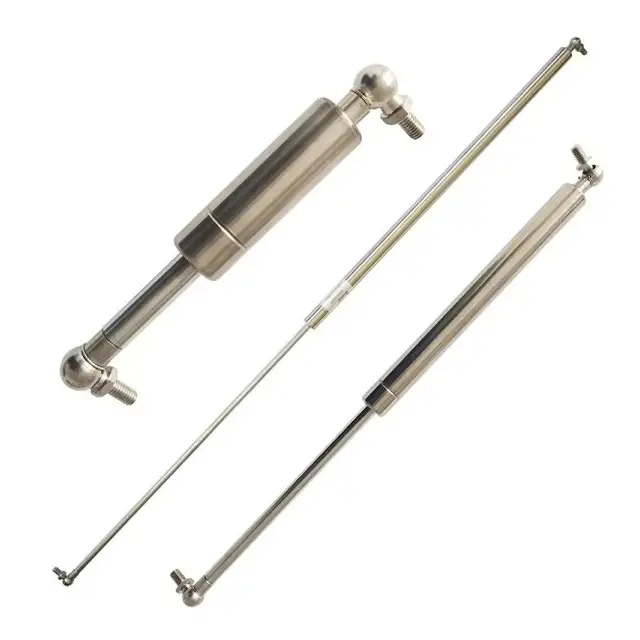
Larger access hatches and installations exposed to moisture or corrosive conditions may require specialised materials or higher-capacity gas springs.
TieYing offers customised gas spring configurations for different force, dimensional and material requirements.
Custom Hatch Gas Strut Manufacturing by TieYing
Not every access hatch can use an off-the-shelf gas spring.
Industrial equipment manufacturers often work with unique panel dimensions, non-standard hinge arrangements, restricted mounting spaces and specific movement requirements.TieYing provides OEM and ODM gas spring manufacturing services to support these projects.Our customisation options can include:- Custom Force Ratings: Gas spring forces selected according to the hatch’s mechanical requirements.
- Stroke and Overall Length: Dimensions tailored to the available installation space and opening movement.
- Cylinder and Piston Rod Dimensions: Configurations developed for the required load and mechanical arrangement.
- End Fittings: Ball joints, eyelets, fork ends, threaded connections and other suitable fittings.
- Mounting Brackets: Connection arrangements adapted to the hatch and supporting frame.
- Material and Surface Finish: Options selected according to the operating environment.
- OEM Branding: Product identification, labelling and packaging for equipment manufacturers and distributors.
From Hatch Design to Production
Our manufacturing support can cover the main stages of a custom gas spring project:- Application Review: Understand the hatch design, opening direction and intended operating conditions.
- Technical Specification: Review force, stroke, overall length, mounting positions and end fittings.
- Sample Evaluation: Where appropriate, assess the proposed configuration against the actual hatch mechanism.
- Production Preparation: Confirm the agreed product specifications, inspection requirements and OEM details.
- Repeat Manufacturing: Maintain the confirmed specification for ongoing supply and production orders.
Why Choose TieYing for Hatch Gas Struts?
Choosing a gas spring manufacturer is an important decision for equipment builders and industrial buyers.
The selected component must fit the mechanical design, provide consistent performance and remain suitable for the intended production requirements.
More Than 23 Years of Manufacturing Experience
Established in 2002, TieYing has developed extensive experience in gas spring design, development and manufacturing.
Our team supports customers across automotive, industrial, furniture, marine and equipment applications.
Custom OEM and ODM Manufacturing
We work with equipment manufacturers, engineering companies, wholesalers and distributors that require gas springs tailored to their products.
From initial drawings to final product specifications, we support customised force, dimensions, fittings and packaging requirements.
Production Capacity and Manufacturing Support
TieYing’s manufacturing facility in Guangzhou has an annual production capacity of up to 3.6 million gas springs.
Our production capabilities support both customised projects and ongoing bulk supply requirements.
Quality Inspection and Product Consistency
Dimensional accuracy, force consistency, sealing performance and component quality are important considerations in gas spring manufacturing.
TieYing applies product inspection and quality control procedures to support agreed specifications and consistent supply.
Global B2B Supply Experience
TieYing exports gas spring products to international markets and works with customers requiring OEM components, wholesale orders and customised manufacturing solutions.
Our team can discuss technical specifications, sample requirements, packaging and production arrangements for your project.
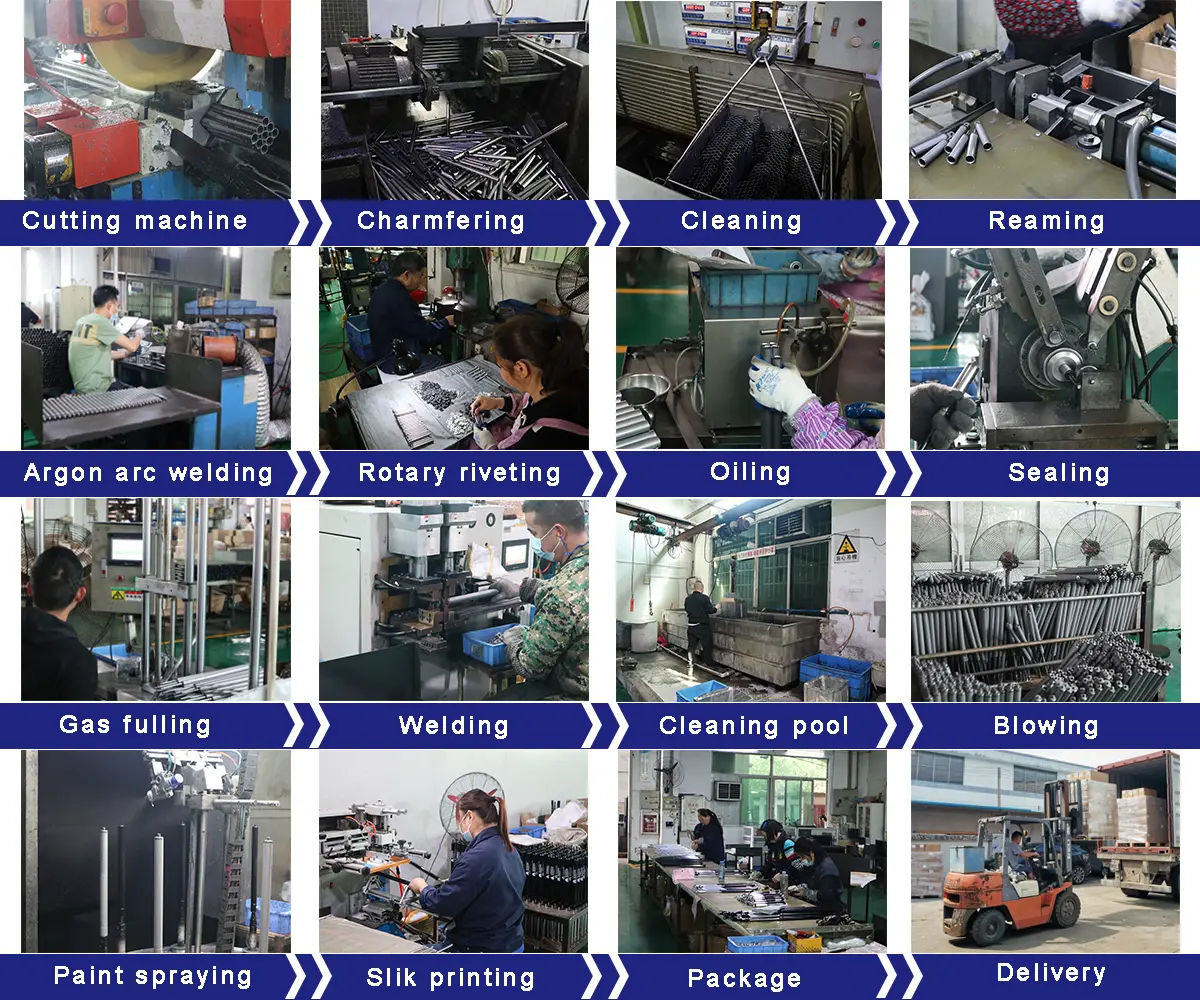
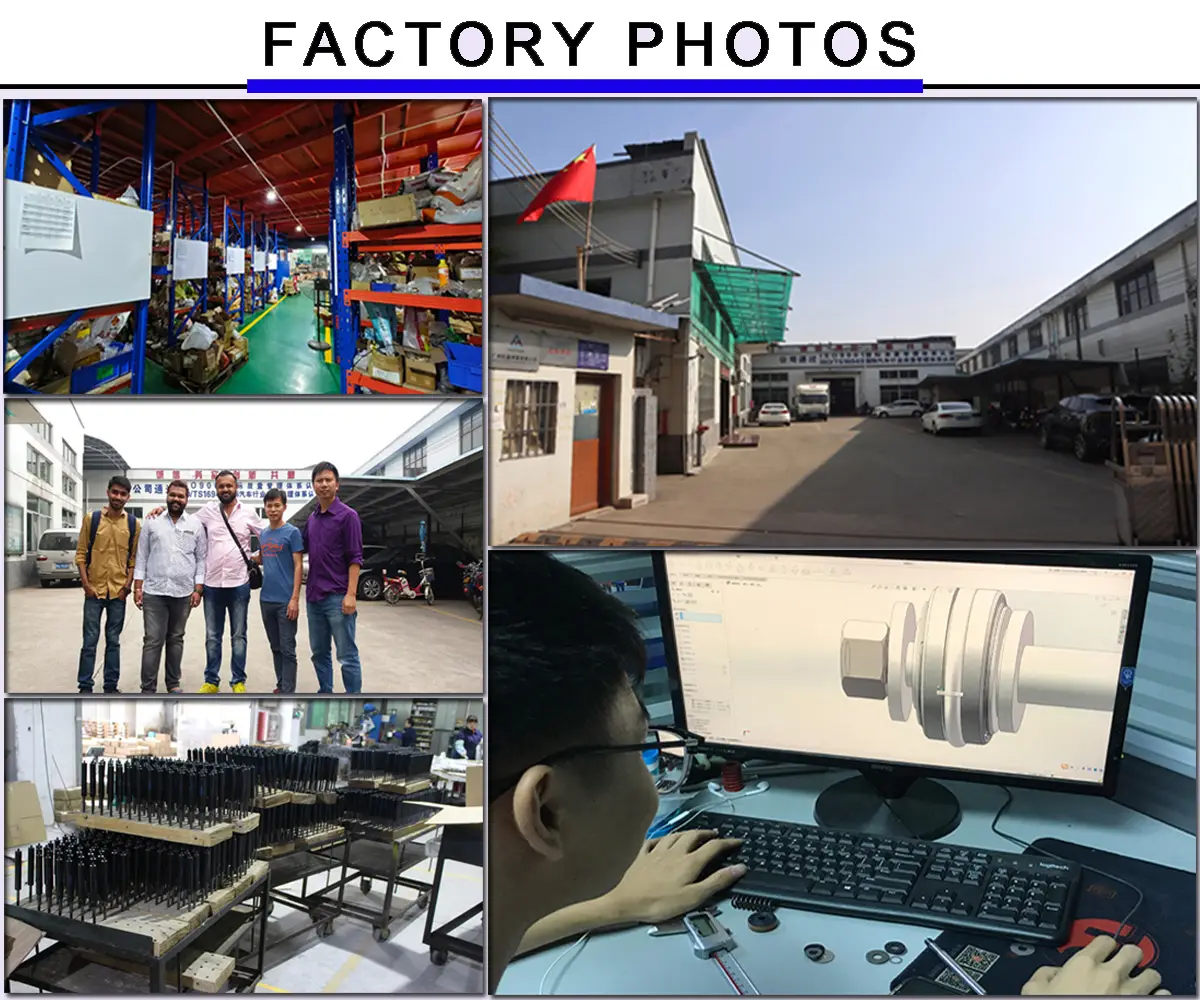
TieYing Factory Photos Show

TieYing Factory Gas Springs Production Flow


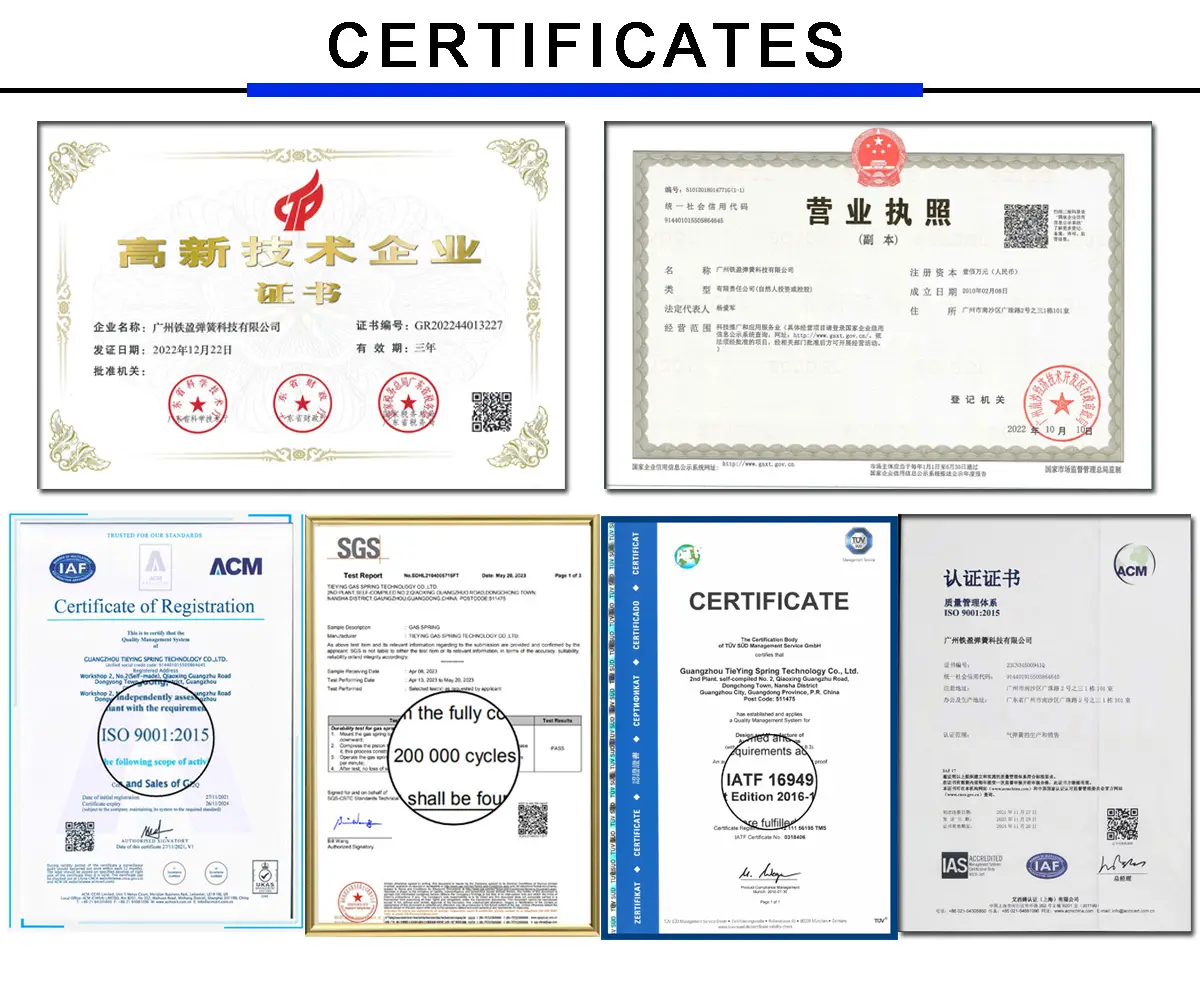
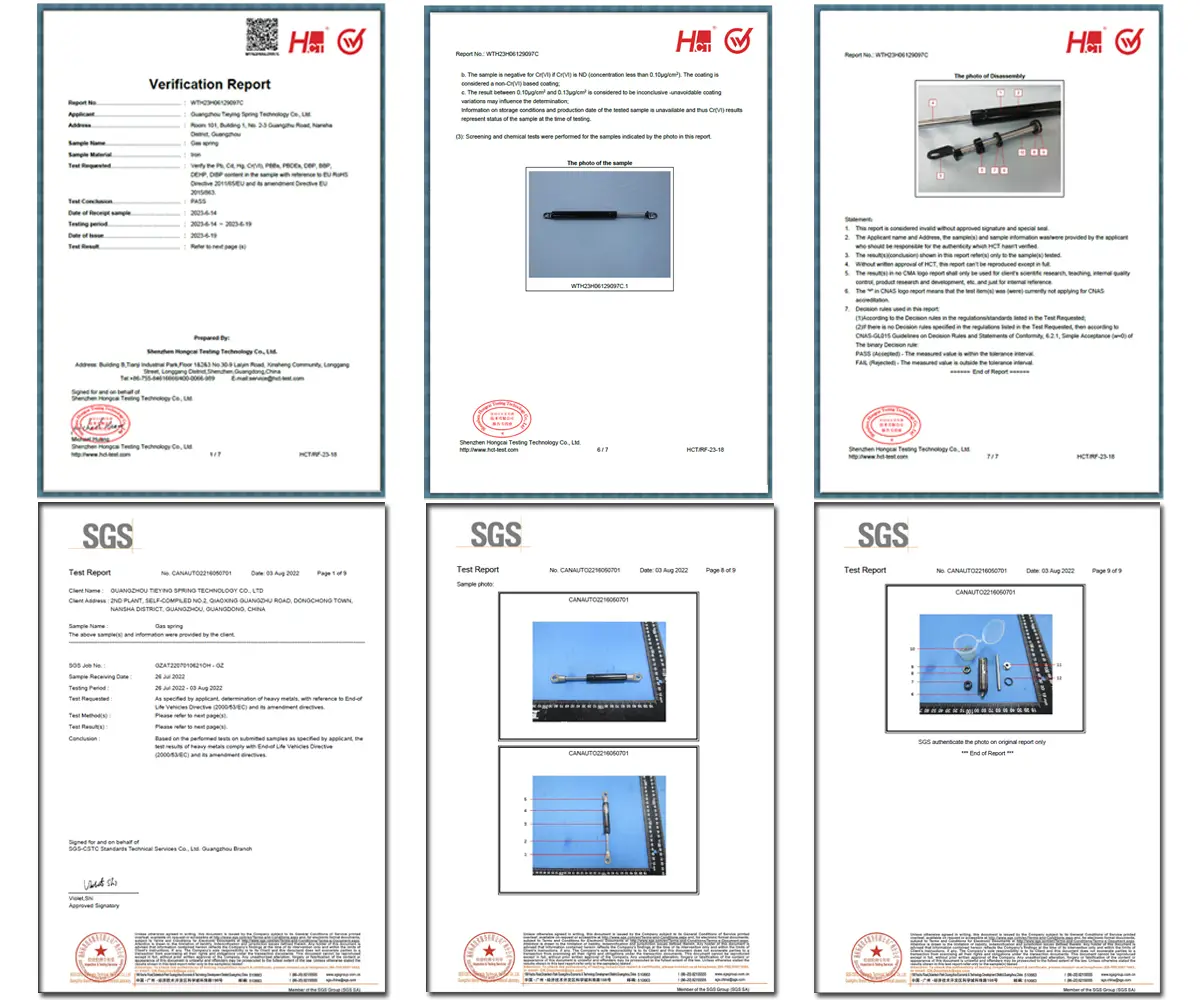
TieYing Factory Certifications & Quality Assurance
Factory Management System Certifications:
ISO 9001 – Quality Management System;IATF 16949 – Automotive Quality Management System
Product Testing & Compliance:
SGS – 200,000-Cycle Durability Test;RoHS – Restriction of Hazardous Substances


TieYing Factory Video Verified by SGS
Competitive Advantages of TieYing Factory Gas Springs
| Item | TieYing Gas Springs | Standard Gas Springs (Other Supplier) |
|---|---|---|
| Certificate | SGS 200000 Cycles Durability Test, ROHS, T16949, IS09001 | Maybe just ISO9001 |
| Material | Top seamless steel (Full inspection by Professional testing equipment) | Maybe steel |
| Oil | Anti-wear hydraulic oil from Garmany | Maybe Semi-Synthetic |
| Piston Roughness | Up to Ra 0.696um | Maybe Ra 0.4um |
| Gas spring resistance | 100°C~-40°C | Maybe 60°C |
| Gas | 99.99% nitrogen | Maybe oxygen / Impure nitrogen |
| Uselife | 80,000-200,000 cycles with SGS test report | Maybe 50,000 cycles |
| Salt spray testing | Up to 96 hours | Maybe up to 12 hours |
| Inspection | All procedure sampling inspect, complete inspect before delivery | Maybe sampling inspection |
| Defective product | Re-produce new, If reach 10%, 100% items re-produce new | Maybe Repair |
What Information Is Required for a Hatch Gas Strut Quote?
To help our engineering team evaluate your hatch application, please provide as much of the following information as possible:
- Hatch Application: Floor hatch, roof hatch, inspection hatch, machinery access hatch or another design.
- Hatch Weight: Total weight of the moving panel and attached components.
- Hatch Dimensions: Width, length and thickness.
- Opening Direction: Upward, downward or side-opening hinged arrangement.
- Opening Angle: Required maximum opening position.
- Hinge Location: Hinge axis and distance from the hatch edges.
- Mounting Space: Available dimensions for the gas spring and brackets.
- Existing Gas Spring: Part number, force, stroke and overall length, if available.
- Operating Environment: Indoor, outdoor, humid, dusty or corrosive conditions.
- Required Function: Lifting assistance, positioning, locking or controlled movement.
- Estimated Quantity: Sample requirements and expected production volume.
Frequently Asked Questions About Hatch Gas Struts
What are hatch gas struts used for?
Hatch gas struts are used to assist the opening of suitable hinged access hatches and provide supporting force during operation.
They are commonly considered for industrial inspection hatches, floor access covers, roof access panels, machinery service openings and other equipment access systems.
How do I choose the correct gas strut for an access hatch?
The correct gas strut depends on the hatch’s weight, dimensions, centre of gravity, hinge position, opening angle and mounting geometry.
The required force, stroke length and extended length should be evaluated together rather than selected independently.
Can gas struts support heavy floor access hatches?
Yes, suitable gas springs can be engineered to assist the opening of many heavy hinged floor access hatches.
However, the hatch structure, mounting brackets, gas spring force and safety locking arrangement must all be evaluated for the actual installation.
Should I use one or two gas struts for a hatch?
This depends on the hatch’s dimensions, weight distribution, structural stiffness and mounting arrangement.
A single gas spring may be suitable for certain compact hatches, while wider or heavier panels may require two matched units for balanced support.
Can hatch gas struts keep an access panel open?
A correctly specified gas spring can help counterbalance a hatch and support its intended open position.
However, a standard gas spring is not a positive safety lock. Where personnel may work beneath a raised hatch, an independent mechanical safety support or locking device should be used.
What is the difference between a hatch gas spring and a gas damper?
A gas spring primarily generates force to assist lifting and provide support.
A gas damper is designed to control movement speed and reduce sudden motion.
The appropriate component depends on whether the application requires lifting assistance, movement control or a combination of functions.
Can TieYing manufacture custom hatch gas struts?
Yes. TieYing supports OEM and ODM gas spring manufacturing with customised force, stroke, overall length, end fittings, mounting configurations and other agreed specifications.
Customers can provide drawings, existing samples, photographs or application details for technical evaluation.
What measurements should I provide when replacing an existing hatch gas strut?
Useful measurements include the fully extended length, compressed length, stroke, end fitting dimensions and gas spring force.
You should also confirm the mounting positions and hatch geometry. Matching the physical length alone does not guarantee that the replacement will operate correctly.
Do hatch gas struts need to be corrosion resistant?
That depends on the installation environment.
Indoor industrial applications may use suitable coated steel configurations, while installations exposed to moisture or corrosive conditions may require stainless steel or additional corrosion protection.
Material selection should reflect the actual operating environment.
Can TieYing supply hatch gas struts for bulk OEM orders?
Yes. TieYing supports customised manufacturing and bulk supply for equipment manufacturers, distributors, wholesalers and other B2B customers.
Production quantities, specifications, packaging and delivery arrangements can be discussed according to project requirements.
Get Custom Hatch Gas Struts Directly from TieYing
Whether you are designing a new industrial access hatch, improving an existing equipment enclosure or sourcing gas springs for ongoing OEM production, selecting the right support mechanism is essential.
TieYing combines gas spring manufacturing experience with custom engineering support to help customers develop hatch lifting solutions that match their mechanical requirements.Share your application drawings, hatch dimensions or existing gas spring specifications with our team.Contact TieYing today to discuss your custom hatch gas strut requirements.