Reverse Gas Struts Manufacturer
Custom Reverse Gas Struts for Pulling and Retraction Applications
At TieYing, we specialize in the design and manufacturing of high-quality reverse gas struts for industrial machinery, automotive components, equipment enclosures, and specialized OEM applications. Unlike conventional compression gas springs, our reverse acting gas springs generate inward pulling force to assist with closing, retracting, and returning moving components. With over 23 years of manufacturing experience, we provide customized solutions engineered around your specific force requirements, dimensions, stroke lengths, and mounting configurations. Whether you need custom components for new equipment or reliable wholesale supply, TieYing is your manufacturing partner.
Factory-Direct Manufacturing
Custom Pulling Force & Dimensions
OEM & ODM Customization
24/7 Customer Support
Custom OEM & Wholesale Solutions
As an experienced manufacturer of reverse gas struts, TieYing delivers reliable quality, flexible customization, and dedicated engineering support for specialized pulling applications. Whether you’re developing a new mechanical system, sourcing replacement components, or looking for a dependable OEM supplier, we provide customized reverse gas springs tailored to your application requirements, ensuring the right pulling force, stroke, dimensions, and end fittings for your equipment.
Force Range
30–5,000 N
Stroke Length
10–700 mm
Service Life
80,000–20,000 cycles
Materials
Carbon Steel, Stainless Steel
23+ Years
Gas spring manufacturing experience
OEM & ODM
Customization for projects and brands
Global Supply
Serving wholesalers and distributors worldwide
24 Hours
Fast response for inquiries and RFQs
What Are Reverse Gas Struts?
Reverse gas struts are specialized gas springs designed to generate tensile force rather than the outward pushing force produced by conventional compression gas springs.
They are commonly referred to as reverse acting gas springs, tension gas springs, traction gas springs, or pull type gas struts.
Inside a reverse gas strut, pressurized gas creates a force that naturally pulls the piston rod inward. Unlike a standard compression gas spring, which normally extends its rod when released, a reverse gas strut tends to remain in its shortened position.
When an external mechanism pulls the piston rod outward, the gas spring develops resistance. Once the external pulling force is reduced, the strut applies its inward force to return the connected mechanism toward its original position.
This operating characteristic makes reverse gas struts suitable for applications where a component needs to be pulled back, returned, or assisted toward a closed position.
How Do Reverse Gas Struts Work?
A reverse gas strut uses internal gas pressure to generate a pulling force along the piston rod.
Its operating process can be understood in three stages:
1. Retracted Position
In its relaxed state, the piston rod is normally drawn into the cylinder. The gas spring remains in its shortened configuration, ready to provide pulling force when extended.
2. External Extension
When the connected mechanism moves outward, it pulls the piston rod away from the cylinder. This movement works against the internal tension force of the gas spring.
3. Inward Retraction
When the external force is reduced or released, the reverse gas strut pulls the piston rod inward. Depending on the mounting arrangement, this force can assist with closing a panel, returning a component, or maintaining tension within a mechanical assembly.
The actual movement and operating force depend on the installation geometry, pivot locations, load characteristics, and gas spring specifications.
Reverse Gas Struts vs. Compression Gas Springs
Although both components use pressurized gas to produce mechanical force, their operating directions are fundamentally different.
Choosing between them depends on how the connected mechanism needs to move.
| Comparison | Reverse Gas Struts | Compression Gas Springs |
|---|---|---|
| Force direction | Inward pulling force | Outward pushing force |
| Rod behavior | Tends to retract | Tends to extend |
| Relaxed position | Normally shortened | Normally extended |
| External movement | Requires pulling force to extend | Requires pushing force to compress |
| Typical function | Pulling, returning and closing assistance | Lifting, opening and supporting |
| Common applications | Closing mechanisms and tensioning systems | Lift-up lids, doors and access panels |
A reverse gas strut should not be selected simply because its dimensions resemble those of a standard gas spring. The direction of the required force must match the mechanical function of the equipment.
For mechanisms requiring both inward and outward forces at different stages of operation, engineers may also consider combining different gas spring types within the same assembly.
Industrial and Commercial Applications of Reverse Gas Struts
Reverse gas struts are used in mechanical systems where an inward pulling force provides a functional advantage. Their suitability depends on the required movement, installation geometry, force characteristics, and operating environment.
Industrial Machinery and Equipment
Industrial machines often incorporate access panels, protective covers, and movable enclosures that need to return toward a closed position after maintenance or operation.
Reverse gas struts can provide inward pulling assistance in suitable designs, helping manufacturers develop compact return mechanisms and reduce the need for additional mechanical tension components.
Potential applications include:
- Machine access covers and protective enclosures
- Industrial equipment doors
- Movable inspection panels
- Mechanical return assemblies
- Specialized tensioning mechanisms
Automotive and Commercial Vehicles
Vehicle manufacturers use different gas spring configurations depending on the movement requirements of individual components.
Reverse acting gas springs can be considered for automotive and commercial vehicle mechanisms that require inward pulling force rather than conventional lift assistance.
Potential applications include:
- Vehicle access doors and compartment mechanisms
- Specialized hood and cover closing arrangements
- Commercial vehicle storage compartments
- Equipment access panels
- Custom automotive return mechanisms
The correct configuration must be determined according to the vehicle mechanism, load, mounting points, and required movement.
Trailers and Transportation Equipment
Transportation equipment frequently includes storage compartments, service doors, protective covers, and movable access components.
Where a mechanism requires a pulling force to return a component toward its closed position, a reverse gas strut may provide a compact solution.
Possible applications include:
- Trailer storage compartment doors
- Equipment access covers
- Transport vehicle service panels
- Specialized enclosure mechanisms
- Custom vehicle component assemblies
Marine Equipment and Enclosures
Marine equipment operates in environments where moisture, salt exposure, and temperature variations can affect component performance.
Reverse gas struts can be designed for suitable marine compartment mechanisms where an inward pulling action is required.
Depending on the installation environment, material selection may include stainless steel construction and appropriate corrosion-resistant surface treatments.
Potential applications include:
- Marine storage compartment covers
- Equipment access doors
- Enclosure closing mechanisms
- Specialized marine return assemblies
For exposed marine environments, the required stainless steel grade, seals, fittings, and corrosion protection should be confirmed during engineering design.
Furniture and Specialized Equipment
Certain furniture systems and specialized equipment incorporate movable panels or components that need to return toward a defined position.
Reverse gas struts may be suitable for custom mechanisms where conventional extension gas springs cannot provide the desired movement.
Applications can include:
- Specialized cabinet mechanisms
- Movable furniture components
- Equipment access panels
- Custom retracting assemblies
- Space-constrained mechanical systems
Engineering Considerations When Selecting Reverse Gas Struts
Selecting a suitable reverse gas strut involves more than matching its overall dimensions. The force direction, mechanical geometry, operating travel, and mounting arrangement must work together.
TieYing evaluates several important parameters when developing reverse gas spring solutions.1. Pulling Force Requirements
The required pulling force depends on the weight and resistance of the moving component, its center of gravity, hinge arrangement, and mounting positions.For hinged mechanisms, the effective force at the piston rod must be considered together with the moment arm created by the installation geometry.A gas spring with insufficient force may not return the mechanism as intended. Excessive force, on the other hand, can make manual operation difficult or place unnecessary stress on hinges and mounting brackets.Providing the load characteristics and application drawings helps determine an appropriate force specification.2. Stroke Length
Stroke length determines how far the piston rod can travel between its retracted and fully extended positions.The required stroke must accommodate the complete movement of the connected mechanism without exceeding the gas spring’s designed travel.Insufficient stroke can restrict movement, while an unsuitable stroke may create interference with surrounding components.3. Compressed and Extended Length
Both compressed length and extended length are important when integrating a reverse gas strut into equipment.Engineers should consider the available installation space in both the closed and open positions.The distance between mounting centers should be checked throughout the movement cycle to ensure the gas spring can operate without mechanical interference.4. Mounting Points and End Fittings
The mounting arrangement determines how the axial pulling force is transferred to the connected component.Depending on the design, possible end fitting configurations include:- Ball socket connectors
- Eyelet fittings
- Clevis connectors
- Threaded mounting ends
- Customized brackets and mounting hardware
5. Material and Environmental Conditions
The operating environment influences the material, coating, sealing, and corrosion protection requirements.Carbon steel and stainless steel options can be considered according to the intended application.For equipment exposed to moisture, chemicals, outdoor conditions, or marine environments, material selection should be reviewed before production.6. Retraction Speed and Damping Requirements
Pulling force and damping are separate engineering functions.A standard tension gas spring should not automatically be assumed to provide controlled closing speed or end-of-stroke cushioning.If the application requires additional speed control, impact reduction, or a specific return profile, the damping requirements should be discussed during product development.7. Operating Temperature and Cycle Requirements
Temperature changes can influence gas pressure and force output. The expected operating temperature should therefore be considered when specifying a reverse gas strut.For applications involving frequent operation, the expected cycle frequency and required service life should also be established during the design stage.Custom Reverse Gas Struts Manufactured by TieYing
Every mechanical application has different operating conditions. A standard component may not provide the correct pulling force, dimensions, or mounting arrangement for a particular design.
TieYing supports custom reverse gas strut manufacturing for OEM and industrial customers, with product configurations developed around actual application requirements.
Our customization capabilities include:
Pulling Force Configuration
Force specifications can be developed according to the required mechanical resistance and return function.
Custom Dimensions and Stroke
Rod diameter, cylinder diameter, stroke length, and overall dimensions can be configured to suit available installation space.
Material Selection
Steel and stainless steel construction options are available, depending on performance and environmental requirements.
End Fittings and Mounting Hardware
We support different connector styles and customized mounting arrangements to simplify integration into your equipment.
Surface Treatment and Corrosion Protection
Surface finishes and protective treatments can be selected according to the intended operating environment.
OEM and Private Label Manufacturing
Custom product identification, branding, packaging, and production arrangements can be discussed for OEM customers and distributors.
Whether you have an established product drawing or only an initial mechanical concept, our team can review your requirements and discuss a suitable manufacturing solution.
Why Choose TieYing as Your Reverse Gas Strut Manufacturer?
Choosing the right gas spring manufacturer is important for maintaining consistent component quality, dependable production, and long-term product performance.
TieYing combines gas spring manufacturing experience with OEM engineering support to serve industrial customers and equipment manufacturers worldwide.
More Than 23 Years of Manufacturing Experience
Founded in 2002, TieYing specializes in gas spring design, development, and manufacturing. Our experience across automotive, industrial, furniture, and equipment applications helps us understand different mechanical requirements.
Certified Quality Management
Our manufacturing operations follow ISO 9001 and IATF 16949 quality management systems, supporting consistent production processes and quality control.
Application-Based Customization
We work with technical drawings, existing product samples, and application requirements to develop gas springs that fit the intended mechanical design.
Material and Configuration Flexibility
From force specifications and dimensions to end fittings and material selection, we support different configurations for OEM and industrial projects.
Production Inspection and Testing
Our quality control processes include product inspection before shipment. Force consistency, sealing performance, and durability requirements can be evaluated according to the project specification.
Global OEM and Wholesale Support
TieYing works with manufacturers, distributors, importers, and wholesalers in international markets, providing factory-direct supply and support for repeat production requirements.
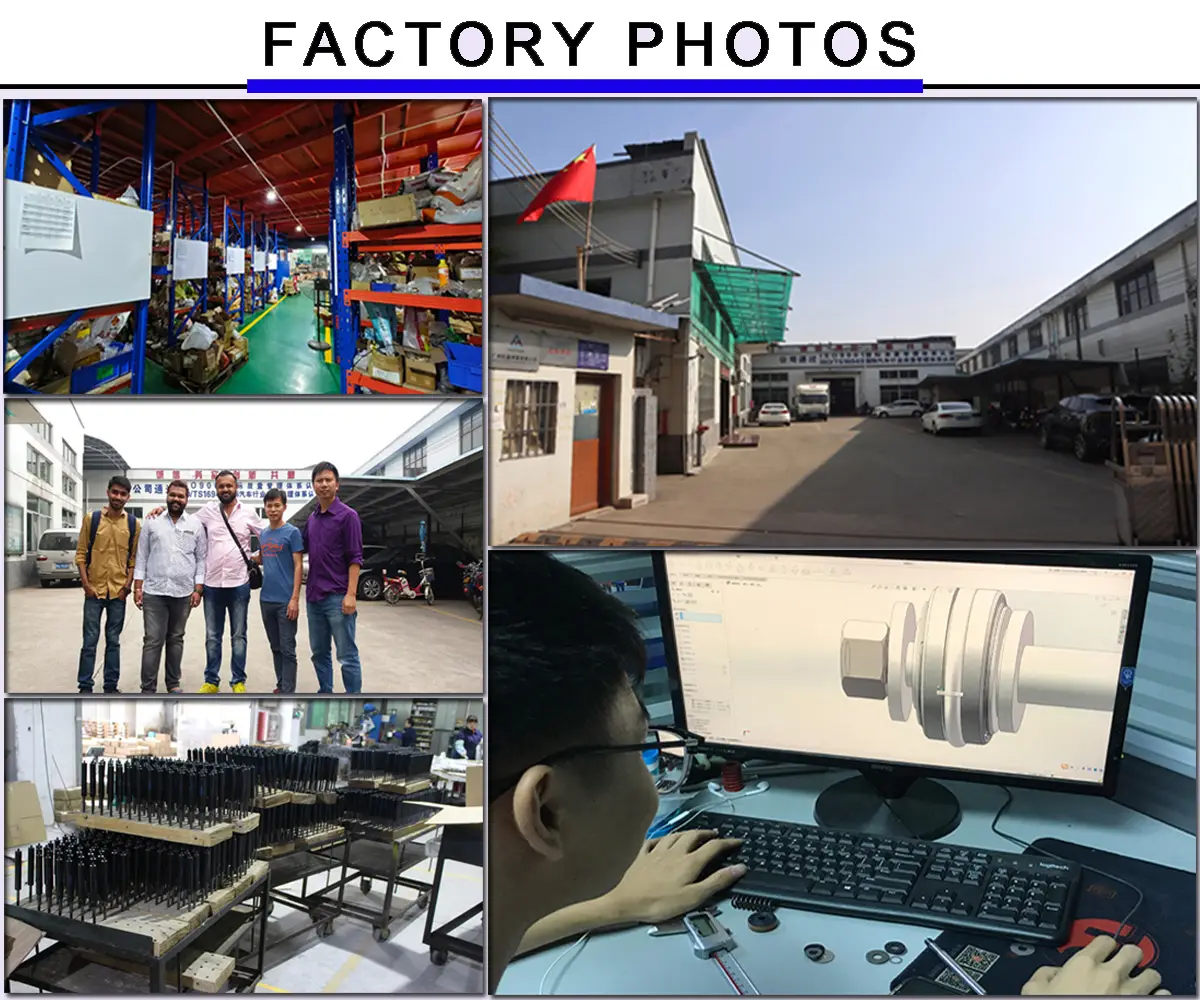
TieYing Factory Photos Show
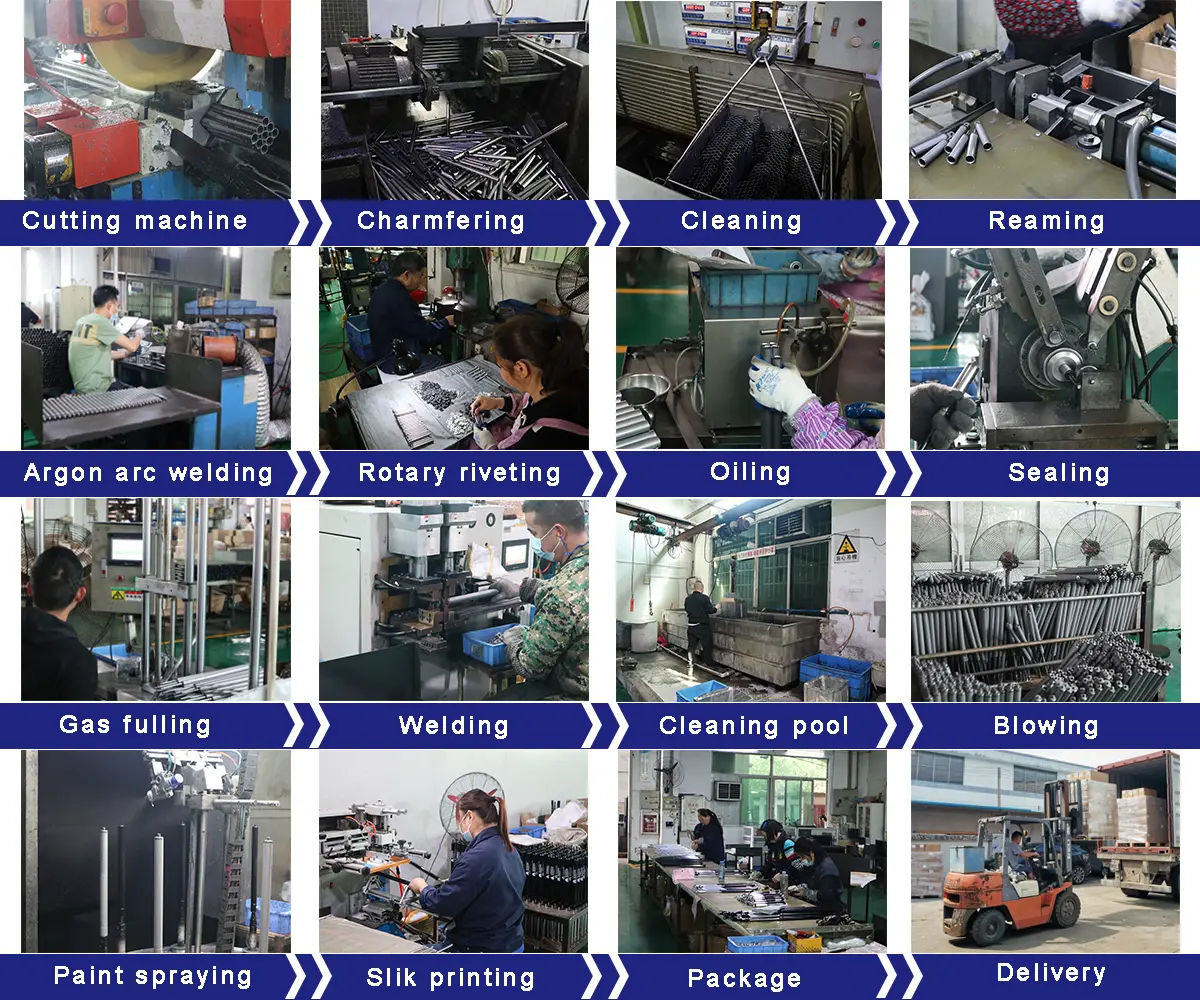
TieYing Factory Gas Springs Production Flow

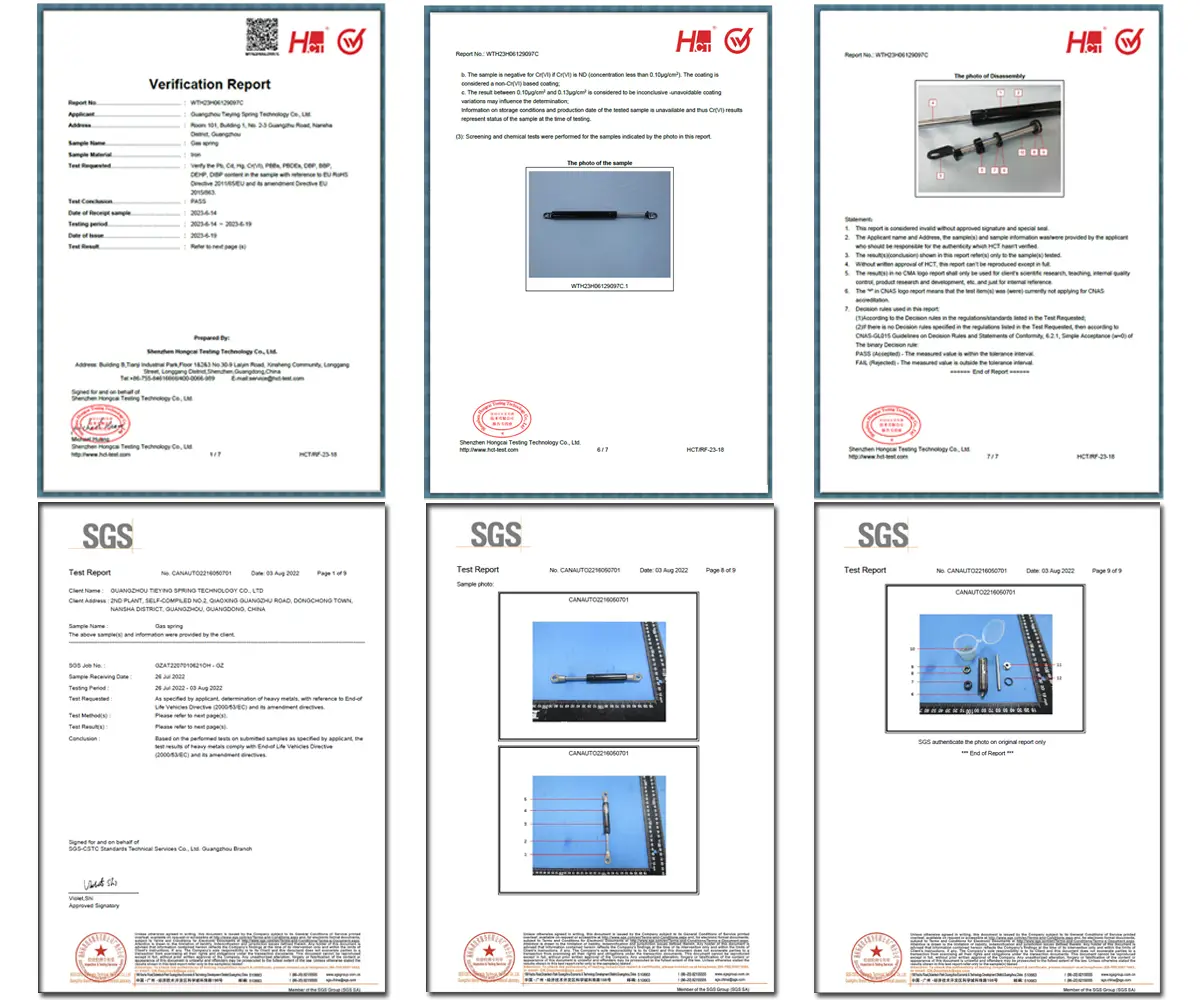
TieYing Factory Certifications & Quality Assurance
Factory Management System Certifications:
ISO 9001 – Quality Management System;IATF 16949 – Automotive Quality Management System
Product Testing & Compliance:
SGS – 200,000-Cycle Durability Test;RoHS – Restriction of Hazardous Substances
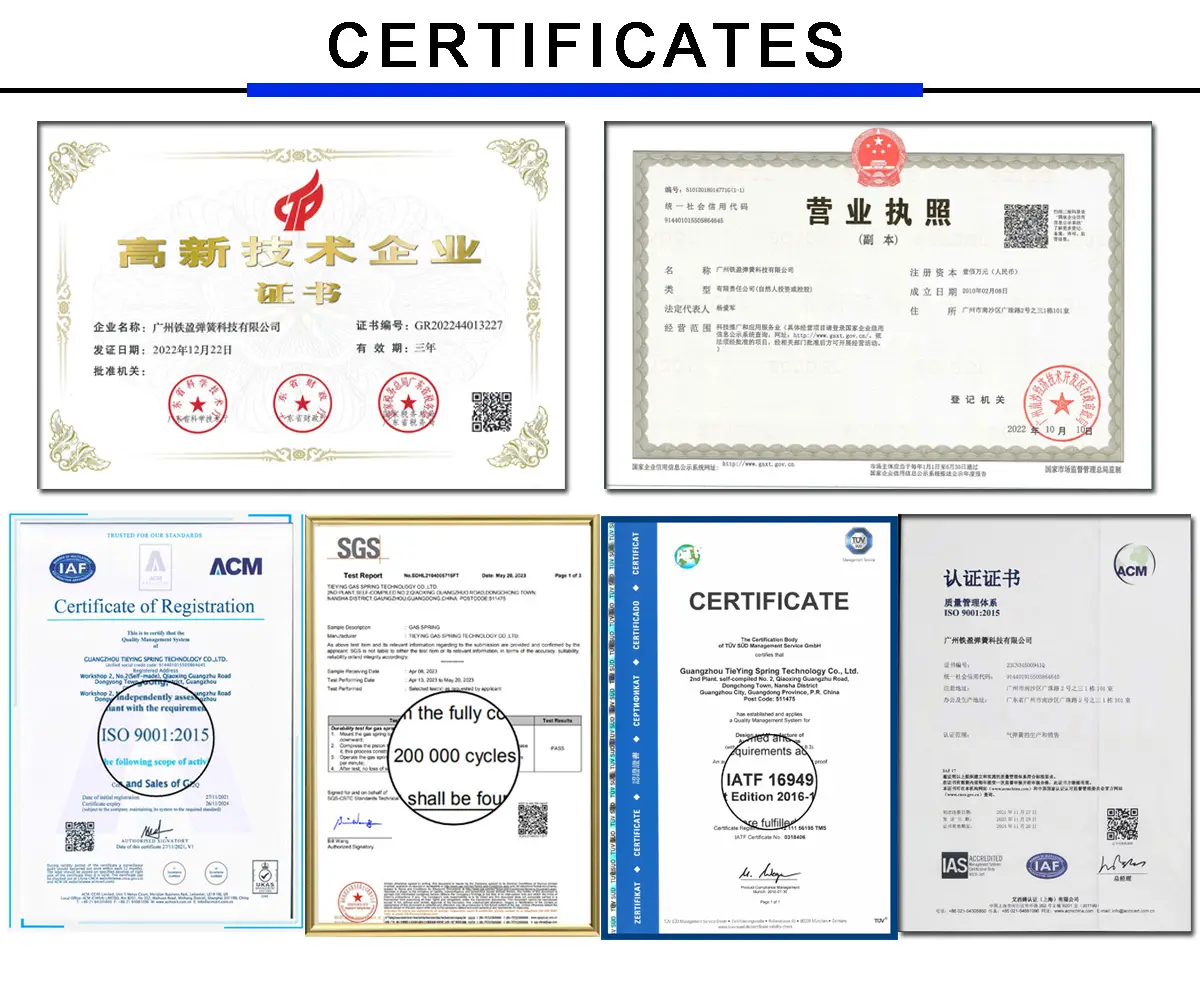
TieYing Factory Video Verified by SGS
Competitive Advantages of TieYing Factory Gas Springs
| Item | TieYing Gas Springs | Standard Gas Springs (Other Supplier) |
|---|---|---|
| Certificate | SGS 200000 Cycles Durability Test, ROHS, T16949, IS09001 | Maybe just ISO9001 |
| Material | Top seamless steel (Full inspection by Professional testing equipment) | Maybe steel |
| Oil | Anti-wear hydraulic oil from Garmany | Maybe Semi-Synthetic |
| Piston Roughness | Up to Ra 0.696um | Maybe Ra 0.4um |
| Gas spring resistance | 100°C~-40°C | Maybe 60°C |
| Gas | 99.99% nitrogen | Maybe oxygen / Impure nitrogen |
| Uselife | 80,000-200,000 cycles with SGS test report | Maybe 50,000 cycles |
| Salt spray testing | Up to 96 hours | Maybe up to 12 hours |
| Inspection | All procedure sampling inspect, complete inspect before delivery | Maybe sampling inspection |
| Defective product | Re-produce new, If reach 10%, 100% items re-produce new | Maybe Repair |
How to Order Custom Reverse Gas Struts?
TieYing follows a structured process to help customers move from an initial requirement to a production-ready gas spring.
Step 1: Submit Your Application Requirements
Share your application description, technical drawing, product sample, or photographs of the existing mechanism.
Step 2: Engineering Evaluation
Our team reviews the required pulling force, stroke, dimensions, mounting points, and environmental conditions.
Step 3: Specification Confirmation
The proposed product configuration is reviewed and confirmed before sample development.
Step 4: Sample Development
Samples can be arranged for dimensional checks, installation evaluation, and application testing.
Step 5: Testing and Approval
The sample is evaluated against the agreed technical requirements before moving forward.
Step 6: Mass Production and Delivery
Following sample approval, production is arranged according to the confirmed specifications and order requirements.
Frequently Asked Questions About Reverse Gas Struts
What is a reverse gas strut?
A reverse gas strut is a type of gas spring that generates inward pulling force rather than outward pushing force. It is commonly used in mechanisms that require retracting movement, closing assistance, or tension control.
Are reverse gas struts the same as tension gas springs?
Yes. Reverse gas struts are commonly referred to as tension gas springs, reverse acting gas springs, traction gas springs, or pull type gas springs. These terms generally describe gas springs that generate inward pulling force.
What is the difference between reverse gas struts and standard gas struts?
Standard compression gas struts generate outward extension force, while reverse gas struts generate inward pulling force. The appropriate type depends on the movement required by the connected mechanism.
Can reverse gas struts help keep doors and lids closed?
Yes. When correctly specified and installed, their inward pulling force can assist a door, lid, or panel in moving toward its closed position. However, a gas strut should not be considered a substitute for a mechanical latch or positive locking device where secure locking is required.
Can reverse gas struts be customized?
Yes. TieYing supports customization of pulling force, stroke length, rod and cylinder dimensions, materials, end fittings, and mounting configurations according to project requirements.
Do reverse gas struts provide damping?
Not necessarily. Pulling force and damping are different functions. If an application requires controlled movement speed or end-of-stroke cushioning, these requirements should be specified separately during engineering development.
What information is needed to manufacture a custom reverse gas strut?
For an accurate evaluation, provide as much of the following information as possible:
- Application description or equipment type
- Product drawing or existing sample
- Required pulling force
- Stroke length
- Compressed and extended lengths
- Rod and cylinder diameters
- End fitting and mounting requirements
- Operating temperature and environmental conditions
- Estimated order quantity
If the exact force requirement is unknown, our team can review the application geometry and discuss the information needed for force calculation.
Can TieYing manufacture reverse gas struts based on existing samples?
Yes. We can review existing samples, product photographs, and technical drawings to discuss replacement or customized manufacturing options. Important dimensions, force characteristics, and mounting interfaces should be confirmed before production.
Does TieYing supply reverse gas struts for OEM customers?
Yes. TieYing provides OEM and ODM gas spring manufacturing services for equipment manufacturers, automotive suppliers, industrial businesses, and international distributors.
Request a Custom Reverse Gas Strut Quote
Looking for a manufacturer that can develop reverse gas struts according to your engineering requirements?
TieYing provides customized gas spring manufacturing for applications requiring reliable inward pulling force and application-specific mechanical integration.
Whether you need a small prototype order, replacement components, or ongoing OEM production, our team is ready to review your project.
Send us your technical drawings, product samples, dimensions, force requirements, or application photographs.
Contact TieYing today to discuss your reverse gas strut requirements and request a factory-direct quotation.